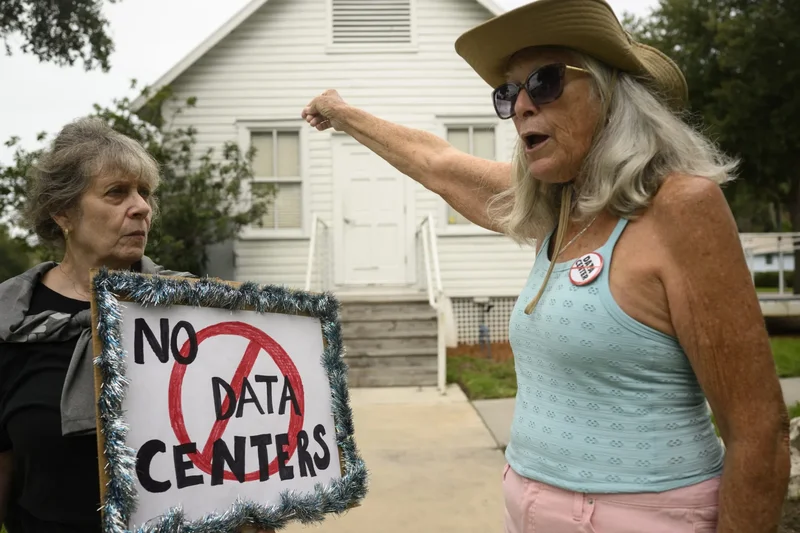
In the era of hyperscalers, the rising unpopularity of data centers has become inextricably linked with the fear of skyrocketing utility prices. A YouGov poll administered last year found that among 1,000 Americans, more than two-thirds expected electricity prices to rise if a data center was built in their area. Earlier this year, Goldman Sachs projected the AI infrastructure buildout to increase electricity costs by 6% between 2026 and 2027, and an additional 3% by 2028.
But a recent working paper from the Electric Power Research Institute is complicating the relationship between the AI boom and what it means for Americans’ electric bill. The research suggested that up until at least 2024, data center operations defied consumer anxieties and actually caused retail electricity costs to decrease. Using data from the Federal Energy Regulatory Commission (FERC) and retail revenue from the U.S. Energy Information Administration between 2015 and 2024, researchers found a causal relationship between data center demand and electricity prices: For every doubling of data center capacity, average retail electricity prices decreased by 3.5%. On a statewide level, this decrease was about 6%.
Much of this relationship can be understood through economies of scale.
“Electricity markets are different than a lot of markets that they interact with,” Asa Watten, the study’s coauthor and EPRI researcher, told Fortune.
Unlike soybeans or gasoline, where prices are determined by the cost of production, electricity prices are based on cost recovery, or how much of it is consumed. As fixed costs are divided among more consumers and kilowatt hours (the standard unit of energy), more kilowatt hours mean a greater division of fixed costs and lower prices. That’s in addition to load increases from increased data center usage, which causes more generators to come online, many of which are becoming more energy efficient.
There’s a catch to this pattern: It’s not guaranteed to continue, and if the trend reverses, it could signal a broader and bigger problem with the future of AI. The writing may already be on the wall. PJM, the largest power grid operator in the country, projected in a report this week that a $6.3 billion increase in consumer electricity costs over the next three years can be mostly attributed to increased data center power demands. The rise in data center construction—expected to reach $7 trillion in spending by 2030—is already correlated with increased power costs. In Virginia, the state with the most data centers, residential electricity prices have increased by more than 13% in the last year, according to data from the U.S. Energy Information Administration (EIA).
What will determine the future relationship between data centers and electricity costs?
Watten explains that the largest determinant of future electricity prices will be if the rapid and rampant AI buildout lives up to the hype.
“If the grid builds capacity, expecting a lot of demand from data centers, and that doesn’t show up, that could be a clear story of how data centers could increase prices in the future in a way that they did not do in the past,” he said.
Data centers are expected to incur a great deal of fixed costs, and if customers for those data centers aren’t there, “then your denominator is less than you thought it would be,” Watten continued. “You’re spreading those fixed costs amongst fewer people. It’s the opposite of what we want to be doing, so that could increase prices.”
Amid a debate of an AI bubble and when it will pop, there are some signs that investors are growing more skeptical of the technology’s promise. On Thursday, share prices for Tesla and Alphabet took a tumble following both companies announcing an increase in AI capital expenditures.
In an episode of the All-In podcast this week, billionaire investor Mark Cuban warned “a lot of data centers…are going to be turned into pickleball courts” because while hyperscalers are correctly assuming AI adoption will continue to increase, AI will become cheaper to use because of increased power efficiency, meaning all of the capacity being created through data centers will not be necessary.
But there is an optimistic read here, Watten said. He doesn’t like to speculate on what the future of AI holds and what that means for the data center buildout, but generally speaking, energy will continue to become more efficient. Electrification, though more electric vehicles and electric heat pumps in addition to data center growth, could continue to reduce household energy costs in a way that could happen independent from an AI boom.
“This clearly efficiency-increasing thing or total budget-reducing thing could have positive spillovers to your neighbors,” Watten said, “such that more electric cars means that if done well, prices are also going down—or at least not going up.”
Sign up here.