Sign in. It’s quick, free and it’s up to you.
An account is an optional way to support the work we do. Find out more.
IT’S A DAY of rest, and you may be in the mood for a quiet corner and a comfy chair.
We’ve hand-picked some of the week’s best reads for you to savour.
Serbian man Ljubisa Karović made headlines recently when he was nearly sucked out the window of a Ryanair plane. Flying from Thessaloniki in Greece to Memmingen in Germany, Karović reflects on the near-fatal ordeal.
(The Guardian, approx. 8 mins reading time)
“Doctors have warned that recovery will be slow, ordering him to wear the neck brace for at least six weeks when they will determine if surgery is necessary. “There are images that come back, the noise of the explosion, the chaos, but I want to recover,” he says. “And, yes, there should be compensation too. Not only emails that have focused on rebooking the flight.
Asked if there is a message he wants to convey, he allows himself to break into a smile. Always make sure to wear your seatbelt. I don’t want anyone to suffer what happened to me”.
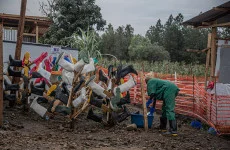
Amid the Ebola outbreak in the Democratic Republic of the Congo, Dr Abdou Sebushishe describes the intense routines and risks of caring for patients. Despite limited resources, fear and uncertainty over when the outbreak will end, he finds motivation in seeing patients recover.
(The New Yorker, approx. 12 mins reading time)
*“In the red zone, I know I’m going to see patients who are confirmed to have Ebola. If I make any mistake, I will also be in quarantine for twenty-one days—or I will also be infected. So we enter with that anxiety, knowing that this is a risk that I’m taking. I know that everybody has that level of fear. But I have to go. Because I’ve been in many other outbreaks, I trust that, if I respect the protocols, there is nothing that will happen to me”. *
In this weekly series, The Journal brings you to a different town or suburb to explore the best gigs and cultural experiences on offer. The setting for this week is bingo night in Whitehall, an important event for locals and one that crosses generations.
(The Journal, approx. 8 minutes reading time)
“Closer to the centre of the room, Catherine O’Connor and Kathleen Byrne said they have been coming to Whitehall together for years. “We’re coming for entertainment. You couldn’t come here to win because you probably won’t,” Catherine said the seats for each other, and they all have their own special machine with the number on the side. They have their machine, and it’s a community of people”.
Should young people living at home contribute to the weekly budget? This article argues parents do too much for children, leaving them unprepared for adult life. Even small contributions make a difference. The message here is that earning money comes with responsibility.
(The Irish Times, approx. 4 mins reading time)
*“There is so much about today’s world that infantilises our young people. Thirty-year-olds who still sleep in their childhood box bedrooms thanks to a housing market that makes renting or house ownership an impossibility – that’s a strong example. Us parents, who with the very best of intentions, and hearts filled with love, over-parent, and are slow to let their offspring find their way – we play a part in it too”. *
The first ever World Cup half-time show featured a diverse mix of performances, from pop divas to puppets. The New York Times breaks down the top moments, and asks if the legendary tournament really needs a half-time show.
(The New York Times, approx. 7 mins reading time)
*“Purists saw it as another concession to American spectacle, like the tournament’s advertising pauses that had euphemistically been dubbed “hydration breaks.” Fans of both teams worried what the added time — the intermission lasted nearly double its traditional 15 minutes — would do to players’ mismatch routines. Even followers of the headlining musicians were left scratching their heads, wondering what a collaboration between such a culturally and sonically eclectic hodgepodge of acts might sound like”. *
What country has the most powerful passport – and what does that even mean in practice? CNN has written about an index of the world’s strongest passports, with Singapore topping the list while the US continues to drop in the rankings. Have a look at Ireland’s position…
(CNN, approx. 10 minutes reading time)
*“The world’s strongest passports belong to nations that other countries want as partners — for trade, investment, security or cooperation. Mobility is ultimately a measure of the value other countries place on their relationship with you”. *
This week marked the 57th anniversary of the moon landing. The New York Times spoke to astronaut Michael Collins on the 50th anniversary of the event, who believed he had the best seat in the house, without setting foot on the moon.
(The New York Times, approx. 11 mins reading time)
*“He did not mind his solitary time aboard the spacecraft, which was named Columbia.“I had this beautiful little domain,” Mr. Collins said. “It was all mine. I was the emperor, the captain of it, and it was quite commodious. I had warm coffee, even.” Unlike half a billion people on Earth, Mr. Collins did not see the broadcast of Mr. Armstrong’s first steps on the moon”. *
Note: The Journal generally selects stories that are not paywalled, but some might not be accessible if you have exceeded your free article limit on the site in question.
To embed this post, copy the code below on your site