- Conquest by Ferdinand Addis (Head Of Zeus £30, 464pp)
August, 55BC, off the Kent coast, near Deal. And the Romans have arrived...
‘How, wearing heavy legionary armour, do you cross the deck of a beached transport ship? The surf makes the ship roll awkwardly. You feel tired, perhaps sick. Your limbs are cramped and stiff. You grip the rail, feeling the crusted salt...’
This is how the legionary must have felt. No Roman army had ever stepped foot on to this mysterious, fog-shrouded island before. What horrors awaited? Besides, that is, the ferocious Britons themselves, who loved nothing more than fighting.
This bravura, multifaceted new history of the Roman conquest of Britain brings it to life with such detail and cinematic vividness it’s impossible not to call it ‘epic’.
The brief episode with Julius Caesar in 55 and again in 54BC was really a PR stunt, to cement his reputation as a great general back home. It achieved next to nothing. He didn’t even get as far as the fabled and hugely lucrative tin mines of ‘Belerion’ – Cornwall.
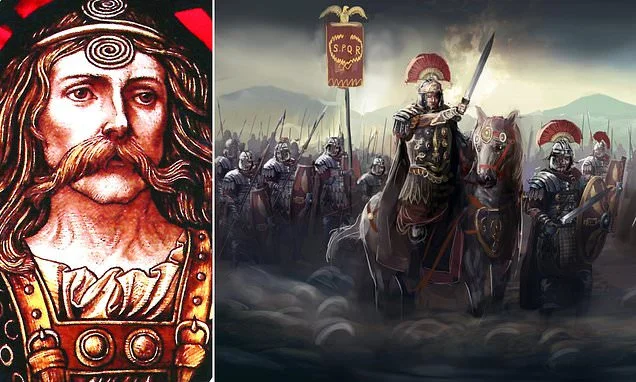
Caratacus stained glass window in Colchester Townhall
No, the serious conquest began in AD43. And as so often in the capture of cities or countries, traitors within were at work. When Britain fell to Rome, the ordinary Britons were slaughtered or enslaved en masse. Britain’s elite, meanwhile, seeing which way the wind blew, did very well cosying up to their new overlords, being rewarded for their treachery with amphorae of wine, silver cups, fancy foods such as olives, and even palatial country villas. One such example, suggests Ferdinand Addis, is Fishbourne palace in Sussex, with its heated pools, marble and colonnaded gardens.
These British chieftains had been ‘feast-givers, beer-drinkers, torc-wearers’. But under the new Roman order, they were expected, says Addis dryly, to be ‘reasonable and reliable, conversant with the ideology of the times, and respectful of the new order of things’. This is how you cement your social position.
The conquered tribes, though, did fight back against the legions. Caratacus – or ‘Caradoc’ most probably, in his own tongue – led a heroic resistance. But the Roman war-machine was efficient and relentless. The British-Celtic way of fighting was colourful but chaotic, a free-for-all of magnificentlooking, vainglorious individuals, ‘barbarians’ scornful of the very of idea of fighting as an obedient unit. They even, as the author reminds us, duelled to the death with each other over who got the best slice of roast pork. They wore beautiful woollen capes, sported huge moustaches, and groomed with such care that their graves contain mirrors and tweezers. War was an art form. They rode chariots because they looked good, ‘a noisy and colourful podium for the display of martial virtue’.
The 'Caratacus' a rare 2000 year old Iron Age coin
For the Roman soldiery, it was just a job. They were ‘a class of skilled labourers, whose work was death’. Indeed. they seem to have found their routine of relentless killing almost dull and repetitive, so when Titus captured Jerusalem in AD70 and ordered 500 Jews to be crucified daily, the soldiers ‘diverted themselves by nailing their victims to the crosses in a whole variety of different poses, “as a joke”.’
Obeying orders and fighting in the 5,000-strong units known as legions, they nearly always beat the barbarians in the end.
Caratacus understood this, and fought asymmetrical warfare, using hit-and-run guerilla tactics, for years. But eventually the legions brought him to bay in the hills of Wales – we don’t know exactly where – and he was defeated. He fled for help to Queen Cartimandua of the Brigantes, in northern England – but she, being another ruling-class traitor, handed him over to Rome for ritual strangulation. The Romans however, capable of magnanimity as well as cruelty, admired his sheer fighting spirit, his refusal to bow, and it seems he lived on for years in Rome, a captive but alive.
There was also Boudica’s ferocious revolt in AD61, of course – and you can understand why. The new overlords had flogged her and raped her daughters, ‘as a lesson’. She burned Colchester and London to the ground, slaughtering thousands and torturing others, but was then defeated again by legionary discipline.
Soon the landscape too was Romanised, as well as the upper-class Brits. A certain hot springs in south-west England, known for its unearthly mists and strange smells, sacred to the Britons for generations, was thoroughly Romanised, and today is known as Bath. Rome’s mission, after all, said the Roman writer Pliny, was to ‘gather the scattered realms... to soften customs... to unite the discordant wild tongues of so many peoples... give civilisation to mankind’.
But another voice, the British chieftain Calgacus, looking out over his own ruined lands and broken people in today’s Scotland, is recorded as commenting caustically: ‘They create a desert and they call it peace.’
I love the way the author goes off at a tangent on any subject that piques his interest and makes that fascinating too. There’s a riveting chapter on the Yamnaya people of the steppes (today’s Ukraine, roughly), from whom some 90 per cent of today’s native British are descended. Tall and fair, these ‘cowboys of the open steppe’ rode horses and chariots, and around 3000BC burst out across Europe with breathtaking speed and aggression, from the Dnieper to the Atlantic.
They came in bands of young males of fighting age, the koryos, ‘wolf-boys’, descending on the more peaceful farmers of Europe, where they ‘raped and raided and stole and killed. But crucially they did these things far away from their own people.’ Modern DNA analysis shows the result: ‘much of the genetic make-up of Europe was transformed’. As so often in history, the victorious Yamnaya slaughtered all the men and raped/married/impregnated all the women, so that European male DNA today is distinctly Yamnaya, while the female, ‘mitochondrial DNA’ is rooted further back in the European neolithic. Darkly fascinating if disturbing. We’re descended from genocidal killers.
Conquest is a riveting narrative that takes an enjoyably winding path through our complex history, a brilliantly fresh and up-to-date account of a most violent and desperate time that changed our island forever.