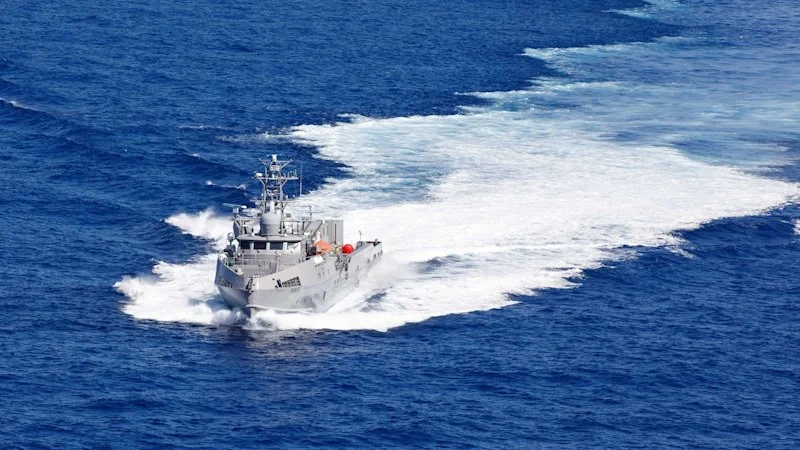
A centrepiece of the Albanese government’s push to modernise the navy – a fleet of large, heavily armed warships that can operate with or without sailors on board – has been thrown into doubt after the United States military dumped its plan to develop the vessels.
The government insists it is committed to the vision outlined in its 2024 surface fleet review, but defence experts say they expect the plan will need to be abandoned or overhauled.
The government announced with much fanfare two years ago that it would boost the firepower of the navy by acquiring six large optionally crewed surface vessels packed with missiles and based on a prototype being developed in the US.
But the US navy last year scrapped that program and is instead pursuing a fleet of smaller drone ships that do not have the option of crew members.
Richard Dunley, a senior lecturer in maritime strategy at UNSW, said the US navy’s large unmanned surface vessel program “has been killed”, raising serious questions about the future of Australia’s plan.
“The universal assumption was that Australia would piggyback off the US vessel,” he said.
“I find it very difficult to see how Australia could do this on our own.
“I keep expecting to hear that it’s dead, and I was surprised to see it feature in this year’s national defence strategy.”
Former naval officer Jennifer Parker, an expert associate at the Australian National University’s national security college, agreed, saying: “I think we will end up abandoning the idea of large optionally crewed vessels and move to unmanned medium-sized surface vessels in line with the US.”
The vessels would also probably use containerised weapons rather than the vertical launch system envisaged under the government’s plan, she said.
The government allocated up to $300 million for optionally crewed surface vessels in its 10-year defence spending plan released in April. But with the vessels estimated to cost around $US250 million ($360 million) each to build, the total cost of the program would ultimately be billions of dollars.
“The government is investing $52-$65 billion over the decade to deliver a larger, more lethal surface combatant fleet, through enhancements to strike, air defence and undersea warfare capabilities including six large optionally crewed surface vessels with up to 32 vertical launch system cells to increase the ADF’s maritime long-range strike capability,” a Defence spokesperson said.
Greens defence spokesman David Shoebridge called for the government to admit it was proposing to buy a “ghost ship”, describing the affair as the “perfect example of what is wrong with Defence right now.
“The US had a thought-bubble about an experimental and boutique military asset and Labor and the Coalition was so desperate to show their loyalty to the US they immediately signed us up,” he said.
“Then when the US spiked the program, without ever consulting Australia, we are left with $300 million attached to a project that is dead in the water.
“It’s not just the embarrassment and the incompetence, there is also a huge opportunity cost here in terms of public money and defence resources.”
Kamikaze drone boats have played a crucial role in the war in Iran, but these are far smaller and more expendable than the large arsenal ships Australia plans to acquire.
Defence firm Austal in November unveiled designs for two new optionally crewed surface vessels – known as the Vantage-class – which it said could meet the Australian navy’s needs.
But military leaders have said they remain committed to developing the vessels with the US.
“There is an opportunity for us to realise a really important capability that would take our fleet forwards in terms of its lethality and survivability, but that can’t happen if the US navy don’t commit to the program,” Defence Force vice chief Robert Chipman told Senate estimates hearings in June.
“It was tied to the US navy, and there are currently no other options that we’re considering.”
Chipman added: “We recognise that there are potential delays to the large optionally crewed vessel, so, yes, we are tracking what the US Navy is saying.”
The surface fleet review said the navy would acquire the six vessels “through formal engagement with the United States Navy program as a fast follower”, with an expectation they would enter service in the 2030s and 2040s.
Defence Minister Richard Marles said at the time the vessels would be “exactly based on what has been developed in the United States”, describing the prototype as a “known quantity”.
“They have the capacity to operate in an uncrewed fashion, but it is the intention of the Royal Australian Navy to crew these vessels,” he said.
Dunley warned at the time that the government was gambling on unproven technology and that the vessels had critics within the US navy.
Rear Admiral William Daly, the US navy’s surface warfare requirements director, said last year the large vessels had “walked the path towards exquisite, expensive [and] unpalatable”.
The US Naval Institute reported last year that the US military was moving away from optionally crewed vessels because they are considered too costly and complicated.
Unmanned vessels do not require berthing space, galleys, toilets and other features needed to support sailors on board.