Sign in. It’s quick, free and it’s up to you.
An account is an optional way to support the work we do. Find out more.
THE REDISCOVERY OF a prehistoric tomb in Co Galway has led to the unearthing of another tomb next to it, hinting at the “complexity” of the culture of Ireland’s first farming communities.
Researchers believe the site in the Maree area represents the only known example in Ireland where two different types of megalithic tombs are located together – one for rituals and the other for burials.
Archaeologists from the University of Galway said the discovery provides new insight into the traditions and beliefs of the first farmers who lived in the Galway area almost 6,000 years ago.
The site dates from the early Neolithic period, which marks the end of the Stone Age and the beginning of when humans began to farm and form settled communities.
The Maree site features a court tomb, a burial monument with an open area where rituals or ceremonial activities took place, and a portal tomb, a stone-built burial chamber marked by a large capstone.
A small amethyst pendant found in the newly discovered portal tomb on Thursday is said to be unlike anything else discovered at similar sites across Ireland.
The tombs were used for communal gatherings and rituals, some of which involved human remains and efforts to interact with ancestors.
Researchers said the discovery of the two monument types side by side provides a “rare” chance to examine different approaches to burial, ritual and monument building during the Stone Age in Ireland.
They said it suggested a sizeable community lived in the area who came together to build the monuments as part of their beliefs.
Project co-lead Dr Michelle Comber said the chance to find and excavate such sites raised new questions about traditions at the time.
“(It) provides a golden opportunity to locate – and attempt to understand – the first farmers of this place,” the lecturer in Archaeology at University of Galway said.
“Working here with colleagues, students, and community members, playing a part in such important discoveries, is thrilling both professionally and personally.
“The size and scale of the tombs, and the effort required to construct them, reflect a sizeable community living in and farming this part of coastal Galway.
“Their location right next to each other represents a meeting of two traditions, raising new questions about the nature of that interaction.”
Project co-lead Dr Noel McCarthy said the opportunity to investigate such a site was “not something that occurs very often”.
“Discovering the second monument has added a layer of complexity that informs our understanding of culture and society in the Neolithic period and beyond,” the archaeology lecturer at the University of Galway said.
“Whole communities came together to create these monuments in what must have been great displays of group identity and religious expression.”
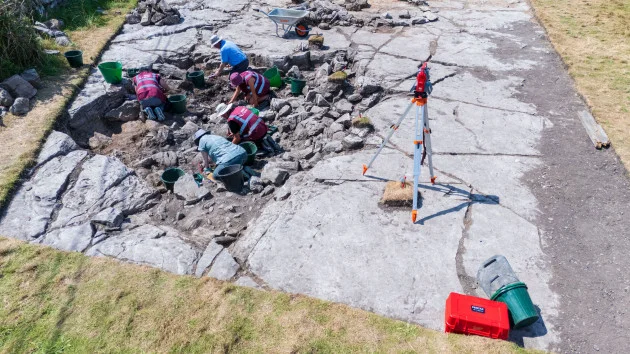
The court tomb at Prospecthill, Maree, was rediscovered during University of Galway archaeological excavations this summer.
At approximately 30 metres long, it is one of the largest tombs of its type to have been discovered.
The remains of a large portal tomb was then discovered beside the court tomb, previously unrecorded as a burial monument.
Its “impressive” capstone measures almost four metres in length and one metre deep, weighing an estimated 14 tonnes.
The University of Galway said the archaeologists also identified a large bedrock pit in which the portal tomb was originally constructed.
It said: “This enabled the exceptional preservation of the original burial deposits, providing a rare opportunity to investigate evidence from the monument’s earliest use, offering fresh insights into how these communities honoured and buried their dead.
“The excavation uncovered stone tools, prehistoric pottery and cremated bone, including a small amethyst pendant from the portal tomb.
“While quartz beads are known from a few megalithic sites, nothing like this amethyst pendant is known from anywhere in Ireland.”
The discoveries were made as part of the university’s research project, Maree – Land Use Through Time, which is exploring how people lived and used the landscape in the area over thousands of years.
The excavation is being carried out by researchers and students from the university and community volunteers, who are hosted by the Burke family who own the land, with support from the Royal Irish Academy and survey work by the Discovery Programme, the national archaeological research body supported by the Heritage Council.
To embed this post, copy the code below on your site