- Do YOU have a story? Email tips@dailymail.com
- See more Daily Mail on Google - save us as a Preferred Source
It's one of the highest-achieving state schools in the country which hundreds of parents every year compete to get their children into, many even moving house to qualify.
But despite its extraordinary academic results, Mossbourne Victoria Park Academy in Hackney has become the subject of a bitter battle between parents over how it is run.
The east London secondary has seen a cabal described as 'a handful of woke middle-class Corbynites' trying to force a softening of its super strict disciplinary code – to the consternation of the majority of parents who back the school and its results completely.
One parent said: 'This is a fight over the very existence of Mossbourne as we know it. There's a small band of liberal parents who insist it's too strict – and a much bigger group of parents who totally support its strictness as they want their kids to get on. We just don't want a culture change.'
The debate among parents was ramped up when Mossbourne, whose headteacher is Matthew Toothe, became the first school in England to be formally rebuked over its 'no excuses' disciplinary policy following a landmark safeguarding inquiry.
The hugely oversubscribed academy – which is rated outstanding by Ofsted – is ranked in the top five of all non-selective schools in the country for pupil progress.
But an investigation into its practices found the school's success came at 'too high a cost for some pupils' – particularly those who struggled within its 'rigid and inflexible behaviour system'.
The report, published earlier this year, cited Human Rights legislation and found that 'a substantial minority' of pupils were negatively affected by methods 'designed to humiliate pupils' with some parents complaining their children had been shouted at.
Mossbourne Victoria Park Academy is one of the country's highest achieving state schools, rated outstanding by Ofsted and is in the top five non-selective schools for pupil progress
The co-educational secondary school was established in 2004 by a businessman from Hackney who expressed regret at the shoddy education standards offered to the poorest families. At the time Hackney's school were ranked the worst in the country
But critics claim that accusations of 'cruelty and abuse' were fuelled by a politically motivated campaign by activists who despise high-achieving schools that seek to give children in some of the most deprived parts of the country 'a world-class education'.
And they fear campaigners are now setting their sights on academies across the country which are run independently of local authorities.
When pupils join, parents and carers sign up to the school's behaviour contract which stipulates no mobiles, no disrespect, no physical contact and no exceptions to the uniform and haircut policy.
Other rules include no talking in corridors, no clock-watching and no loitering in large groups after school – while causing disruption by dropping pens can also lead to detention.
If students miss homework or lessons due to illness, they stay behind and are supervised by teachers until they catch up.
Trouble initially flared when one campaigner parent, Andy Leary-May, 54, became unhappy about the treatment of his son.
He disagreed with the school over how his son's return should be managed after being diagnosed with chronic fatigue syndrome.
Mr Leary-May, who now lives in Berkshire, withdrew his son from the school before contacting a local councillor who represents Hackney's independent socialist collective.
They launched the Educating Hackney website which encouraged parents to report concerns.
The campaigners compiled a dossier, which was handed to the Left-wing newspaper The Observer, which reported in November 2024 that a group of almost 30 parents had accused the school of bullying children and damaging their mental health.
Stickers – which Educating Hackney has distanced itself from – began appearing on lampposts which said: 'Press reports reveal a culture of systematic bullying by Mossbourne teachers against their pupils.
'If you are a student, teacher or parent of a child at Mossbourne with experience of such cruelty and abuse, report it anonymously.'
The campaign also won the backing of Anti*Capitalist Resistance, a revolutionary Marxist organisation, which blamed the 'scandal' on 'a society dominated by capitalist corporate logic'.
After gathering more supporters, the campaign led to Hackney council's independent commissioner on children's safeguarding announcing a safeguarding review into the academy.
The cornerstone of the school's extraordinary results is discipline. When pupils join, parents and carers sign up to the school's behaviour contract which stipulates no mobiles, no disrespect, no physical contact and no exceptions to the uniform and haircut policy. Other rules include no talking in corridors, no clock-watching and no loitering in large groups after school – while causing disruption by dropping pens can also lead to detention
Such inquiries are usually triggered only by concerns over 'serious harm' such as the death or abuse of a child.
The inquiry – which found the school instilled 'a climate of fear' among pupils – published its report last December but campaigners are pushing for further action and aired their complaints at a public meeting this month.
Now parents have lined up to give their backing to the school despite fears that by doing so they will be subjected to abuse.
One mother, who runs a business and has two sons at the school, told the Daily Mail: 'Parents are desperate to get their kids into Mossbourne because the quality of education is so high.
'The vast majority of parents aren't looking for the school to do anything different.
'Why would you want to break the thing that gives social mobility and opportunity to children who otherwise wouldn't have it? It's just not fair.
'Many, many children are flourishing at the school and its results are exceptional but Hackney is in the middle of an identity war and now there is so much vitriol associated with this.
'There is a very vocal minority behind this. Some people want the educational attainment but they don't want the method.
'There would appear to be a problem, especially amongst certain middle-class parents, that their child's individuality needs to be respected and every desire they have needs to be negotiable.
'These parents have so many options – they have potentially the ability to consider private, the ability to move house, the ability to choose different grammar schools in some areas.
'We moved to this area because of the schools and we were lucky to be able to do that.
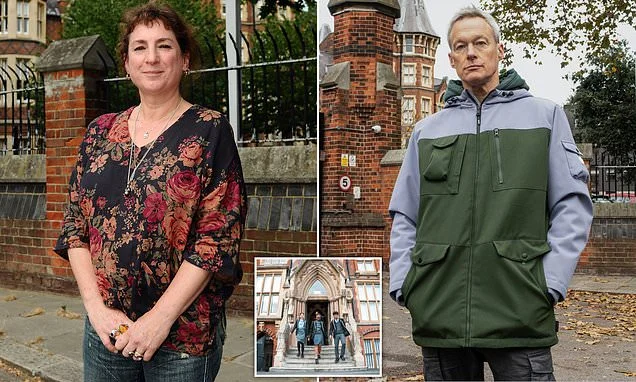
But the school's 'draconian' approach has led some parents to claim it's too strict. Trouble flared when activist Andy Leary-May, 54, clashed with the school over his son's treatment. He disagreed with the school over how his son's return should be managed after being diagnosed with chronic fatigue syndrome - and Mr Leary-May has now removed him
'I worry that people with money and educational choices are criticising and trying to dismantle a model that creates opportunities for families that don't have those advantages.'
Another former parent, Joanna De Guia, said: 'Mossbourne gets extremely good results for almost all its kids regardless of background – that's a massive achievement.
'Nothing is perfect and I am sure the school have got things wrong but I think this is a massive temper tantrum by parents who signed up for it but it didn't suit their child, for one reason or another.
'Middle-class parents want their kids to go there because they are aspirational and they want their children to go to the best school but there are parents whose children didn't get on and so they decided it must be the school's fault.
'Some of the people involved in the campaign against Mossbourne can afford to pay to send their child to a lovely liberal-valued private school.'
Joanna, who runs an academic think-tank, added: 'I think the demonisation of the school is unforgivable. I think it's ideological. It's a very spoilt attitude.
'Just because you ideologically disagree with it, it doesn't mean that you should then try to destroy it.'
But the stance of a minority of campaigners against the schoo's strict approachl has led to a war between parents. Joanna De Guia, whose child went to the school, called the 'demonisation' of the school 'unforgivable'. She said: 'Mossbourne gets extremely good results for almost all its kids regardless of background – that's a massive achievement.'
Another mother of a child at the school told the Daily Mail: 'There is quite a lot of anger among parents about the campaign.
'Parents feel the school has been unfairly maligned. The school are very clear about what their rules and expectations are.
'That works really well for most kids. Most kids are really happy and the majority of parents support the school.
'While the area is very diverse, it's becoming increasingly gentrified and there is a hardcore group of middle-class parents who are quite anti-discipline.
'Their kids really struggled at the school and they banded together.
'A lot of the parents are concerned that it has become a political football. They feel their school has been dragged through the mud to prove a political point and take down academies.'
The co-educational secondary school, which was established in 2004, is part of the Mossbourne Federation which was founded ten years later by local businessman Sir Clive Bourne.
After growing up in a working-class family and leaving school aged 15 with few qualifications, he went on to make a fortune operating international courier services but expressed regret at the shoddy education standards offered to the poorest families.
At the time Hackney's schools, then under local authority control, were ranked the worst in the country while the borough's Labour MP, Diane Abbott, faced fierce criticism after she sent her son to a private school.
The trust, which now runs nine schools in east London and Essex, was established on the principle that 'Hackney children are as bright as children anywhere'.
It set out to reverse 'the too-low expectations of the people in charge' which was 'driven by unfounded assumptions about what Hackney children could achieve'.
Focusing on high-quality teaching 'that doesn't allow 'excuses, mediocrity and disruptive behaviour to get in the way', the academies remain 'unapologetic about having high standards and high expectations'.
Hackney remains one of the most deprived areas in the country and of the school's 833 pupils aged between 11 and 16, 40 per cent do not speak English as a first language while 49 per cent are on free school meals.
Mossbourne Victoria Park Academy's headteacher Matthew Toothe
Mother-of-two Lisa Gowland said: 'Mossbourne was brilliant for my two kids.
'My children's friends are from all different backgrounds and they're getting opportunities they would never usually get. They want to do medicine, they want to go to Oxford.
'It's not a machine for churning out robots who pass exams. The kids are lovely, polite, hard-working people. It's the work ethic they've been given. You turn up, you're responsible, you do your job.
'The teachers just want to get in and teach the kids, which is what they do very very well.'
Lisa said of her son who has autism: 'At another school they could have made excuses, but they had really high expectations for him.'
And she told how she believed the campaign against the school was 'very politically driven' adding: 'The most vocal people speaking out against the school are white middle class.
'If you look at the makeup of the school, that's not what it is. Mossbourne's still there and still doing well and I don't think they like it.'
Gianna Plainioti – who is also a mother of two whose younger son attends the school – said: 'The school was my first choice, it was my son's first choice. It was our first choice because of its academic standards.
'My younger son likes structure. I was astonished by how he responded in the first few months. Coming back from school talking about the subjects and teachers with enthusiasm.
'He likes his teachers a lot. I was impressed.
'I kept checking in on the strictness. He said certain teachers are more strict than the others but he loved all the teachers. I have not heard a single negative thing about the teachers. I have met them and I have a very positive impression.'
She added of her son: 'He is happy and doing well and is challenged and wants to do well for himself. It is very impressive for a state school to get this level of engagement.
'I cannot comment or dismiss other people's challenges but I don't like the school-blaming, as a parent.
'I've seen politicians commenting on the school, which I could not believe. You say it's about wellbeing but what about the school, its kids and teachers, and the impact on their wellbeing?
'It frustrates me as a parent. The energy and work the school has now to deal with this, it takes funds and time from the children's education.'
A teacher who sent her own child to Mossbourne said: 'It's just not true that the rules are designed to "humiliate" kids.
'It's a simple equation – the more time you spend learning, the more you learn.
'Every rule, even rules that sound daft like not dropping your pens on the floor, or staying for a few minutes to make up if you go to the bathroom in lesson time, is there to minimise disruptions and maximise learning time.
'Every year I see new kids come in and most adapt really quickly. I've taught at secondary schools which are chaotic.
'There's the manosphere now, so many more female teachers who say they struggle with some boys who ignore them because they are female, make sexist comments, won't accept discipline.
'At Mossbourne the classrooms are calm. You get through three times the amount of teaching in a lesson at Mossbourne than you do at the average secondary.
'Some kids have a lot going on outside the classroom but our purpose at school is to educate. Teachers want to teach.'
Another mother at the school added: 'I think the media punishment is vindictive, politically motivated, part of an anti-academy agenda.
'We do all this bashing, then ask why teachers are leaving the profession. Teachers have a right to tell young people off when they do something they shouldn't.'
The whole saga has left the school facing a £400,000 legal bill.
These costs were incurred when Mossbourne responded to the criticism by commissioning a safeguarding review led by Sir Alan Wood, who had run Hackney children's services for ten years, at a cost of £205,000.
An investigation into the school's practices found its success came at 'too high a cost for some pupils' – particularly those who struggled within its 'rigid and inflexible behaviour system'. The report, published earlier this year, cited Human Rights legislation and found that 'a substantial minority' of pupils were negatively impacted by methods 'designed to humiliate pupils' with some parents complaining their children had been shouted at
That review, yet to be made public, found that no pupil was at risk of serious harm and Hackney council confirmed that it had reviewed all the complaints and none indicated an adult had harmed a child.
But then, acting on advice from the Department of Education, the school separately commissioned a second, independent external review by Anne Whyte KC, which cost a further £191,000.
This second review, published last November, characterised the culture at Mossbourne as 'standoffish and inflexible'.
But it stopped short of finding the school cruel or unsafe, and said that Mossbourne's safeguarding and complaints policy were lawful, while acknowledging that communication, parental engagement and transparency could and should be improved.
The school has won the backing of Katharine Birbalsingh, who has been dubbed Britain's strictest headmistress after co-founding the high-achieving Michaela Community School in Wembley, London.
She said: 'What happened to Mossbourne is a total witch hunt. And that is because they do not want to see deprived and disadvantaged children succeed.'
When the report was published, Tom Bennett, the DfE's behaviour advisor, dismissed it as a 'hit job' with 'methodology that would shame a fortune teller'.
He pointed out that Sir Alan Wood, who authored the review, had never visited the school or interviewed current students and said the 'jaw-dropping, mind-boggling problem' with 73 complaints made against the school was that 'the review itself doesn't even attempt to establish if any of them are true, or untrue'.
The school has insisted that 'its outcomes and results are achieved because of the discipline, not in spite of it'.
Mr Leary-May is insistent there is a problem, however.
He said: 'This should not be reduced to a debate about strict versus permissive schools.
'Schools can have clear rules and high expectations. The question is what happens when a school's culture appears to cause harm to some children, and when families have no effective route to get that pattern recognised.
'I was a parent who saw what appeared to be a pattern of harm and acted according to my conscience.
'The Wood review suggests those concerns were not misplaced. I hope some accountability and change will still come in time.'