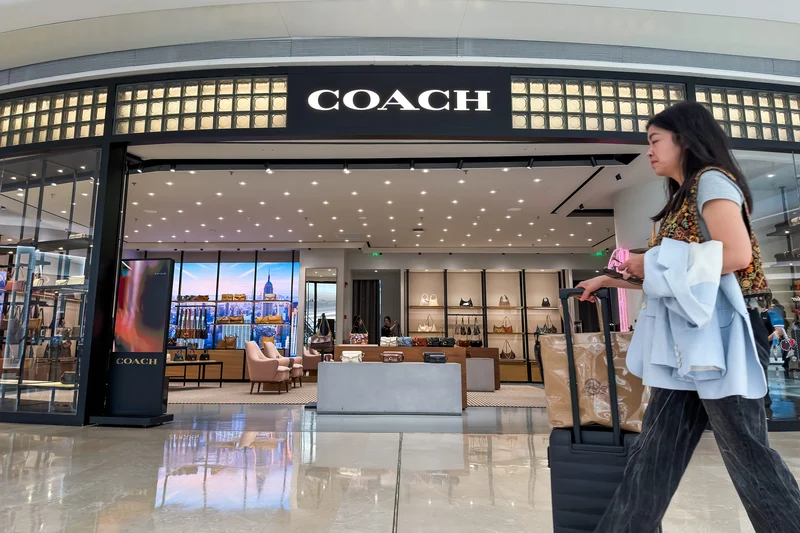
Higher-end retailers are trying to drum up business by pouring money into their outlet operations and attracting more lower-end shoppers — a strategy that could drive gains for certain stocks in the space. Companies such as Tapestry -owned Coach and Ralph Lauren have elevated their discount stores, transforming them into higher-end destinations for aspirational shoppers from dumping grounds for last season's wares. Aspirational customers are those who stretch their budgets or save up to buy premium products. "Until 10 years back, outlets were thought of as an inventory clearance mechanism," Kinshuk Jerath, a professor at Columbia Business School, told CNBC. "Now it's kind of different … outlets are like an alternate channel for value-conscious consumers who still want to spend the money to get a sort of a premium brand." Retailers' dual-tier strategy has emerged as demand for luxury goods continues to fade. Since 2022, the luxury market has shed roughly 70 million customers, falling to about 330 million by the end of 2025, according to a report from consulting firm Bain . That year, sales fell roughly by 2%, to just north of $400 billion. That downtrend has been reflected in the sector and the companies in it. The U.S. Global Investors Funds Global Luxury Goods Fund (USLUX) , which is made up of companies such as LVMH , Ferrari , Hermes and Christian Dior , is down about 7% year to date, per FactSet. The S & P 500 is up more than 8% in that time. "The ultra-wealthy are actually quite a small percentage of revenues ... even for those high-end luxury brands," Bernstein analyst Aneesha Sherman told CNBC. "The majority of the revenues are kind [coming from] of aspirational consumers who are well off, but it's a splurge for them." "In the past, people have thought … maybe there's like a young professional or a student and let's sell them something at the outlet and have them trade up to sort of the regular brand," Columbia University's Jerath said. But, "it's not about shifting [less affluent consumers] into a higher tier anymore…this is a stable segment that will continue to buy from there." To court those customers, Ralph Lauren and Tapestry now stock made-for-factory apparel and accessories alongside select full-priced mainline products at their outlets, while offering the highest-quality wares at their regular locations. "Coach and Ralph Lauren have certainly done a good job of really elevating the outlet experience, becoming less promotional [and] introducing more full-price products that they know are working in other channels," Citi analyst Paul Lejuez told CNBC. "It's a way to connect with new customers." Ways to play the trend Although Coach and Ralph Lauren have already gained some ground by overhauling their outlet experiences, the stocks likely still have more room to run, according to analysts. "We see additional room to grow from greater quality of sales," Wells Fargo's Ike Boruchow said Tuesday in a note to clients, speaking of Ralph Lauren. The polo-shirt maker has seen its net sales nearly double since fiscal 2021 to more than $8 billion in the fiscal year that ended in March. For the current fiscal year, analysts on average expect Ralph Lauren's top line to reach $8.627 billion, per FactSet data. "RL has put more focus on full-price stores, while elevating the product offering in their outlet and wholesale channels, and reducing off-price by 75% since [fiscal year 2018]," Boruchow added. RL YTD mountain RL year to date Wells Fargo has an overweight rating on the polo maker. Earlier this week, the bank hiked its price target on shares to $425 from $415, suggesting 14% upside from its closing price on Friday. Tapestry is also expected to advance its shares by widening its customer base. "We would note that … new customers are entering at higher [average until retail] and higher spending levels," which should boost shares, Bernstein's analyst Sherman said in a note to clients earlier this month. Coach, meanwhile, has grown its sales by 20 or more percentage points for the last several quarters, "whereas the high-end luxury brands are literally not growing or growing at very low-single digits," she told CNBC on Friday. Sherman has an outperform rating on Tapestry. She also has a $180 price target on shares, which is 26% Friday's close. Another name to watch Bernstein's Sherman told CNBC that Michael Kors, which is owned by Capri Holdings , could also follow in Coach's footsteps by leaning into the elevated outlet model, driving upside to shares in the near future. "Over the last year [or] year-and-a-half, they've changed their strategy," the analyst said. "They've brought full-price products down to a realistic level, and they are now upgrading the outlet assortment." She added, "there's a new line of product coming in the fall, so they are excited to move through the same strategy, but it's not quite kicked off yet." CPRI YTD mountain CPRI in 2026 Sherman has a market perform rating on Capri Holdings and a $24 price target on shares. That implies upside of 55% from Friday's close. While the bag maker hasn't fully launch its new strategy, the foray into its competitor's elevated outlet model seems poised for success given the similarities between Michael Kors' and Coach's businesses, per Citi's Lejuez. Lejuez has a buy rating on Tapestry, Ralph Lauren and Capri Holdings. He has a $170 price target on Tapestry, which is 19% above Friday's close. His $400 target on Ralph Laruen implies 8% upside. His $31 price target on Capri Holdings suggests 100% upside Shares of Capri Holdings have plunged 36% year to date.
Luxury retailers turn to outlets for growth. Analysts say these stocks can benefit