New vision centres established at government health facilities in the rural areas of Rajasthan’s Alwar district under the Jeevan Jyoti Project have strengthened eye care services for villagers. The initiative has embedded timely and effective services within the existing public health system.
Opened under Sightsavers India’s rural eye health programme, the vision centres, staffed with trained optometrists, are being utilised for door-to-door eye screenings and counselling for the early detection of cataracts and refractive errors. Those living in remote villages in the district receive timely diagnosis and treatment.
The project has led to the establishment of vision centres at Community Health Centres (CHCs) in the Ramgarh and Laxmangarh blocks. Besides bringing essential services closer to local communities, the vision centres provide primary eye screening, refraction services, identification and referral of cataract cases, and dispensing of near-vision glasses free of cost.
In collaboration with the district administration, each vision centre has been staffed with a qualified optometrist and equipped with key instruments such as a retinoscope, slit lamp with non-contact tonometer, LED vision test chart, and a trial set with frames and lenses, enabling thorough and accurate eye examinations.
Babulal Yadav, Medical Officer in-charge at Ramgarh CHC, said spectacle prescriptions were generated on site and transportation facilities arranged to take cataract patients to and from the treatment centre.
“The ophthalmic assistant placed at the hospital helps us deliver better eye care services. Additionally, the team goes door to door to encourage people to seek treatment. Our patients are all praise for these efforts,” Dr. Yadav said.
In the project’s community outreach component, a total of six community mobilisers, three in each block, carry out screening and refer patients to the vision centres for further assessment. About 54,000 door-to-door screenings have been conducted so far to ensure the early identification of eye health issues.
Before cataract patients are referred to the district hospital in Alwar for surgery, they undergo comprehensive eye examinations by the optometrist, along with blood pressure and blood glucose tests.
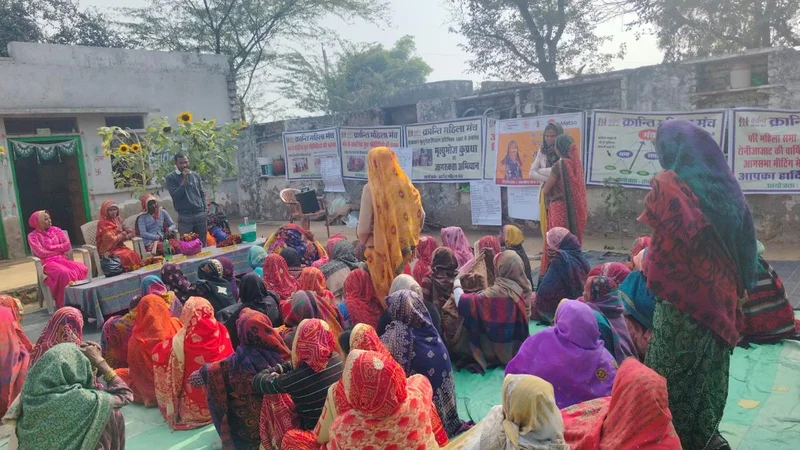
Community-level eye camps, organised in village panchayats in collaboration with the Panchayati Raj institutions, have also taken eye care services to people’s doorsteps. A total of nine eye camps have been organised so far, covering 400 villages across the Ramgarh and Laxmangarh blocks.
Kishan Devi, 64, a resident of Ramgarh, said the sight in her left eye had been restored through the Jeevan Jyoti Project. “Earlier, everything appeared dark and I even fell once, injuring my knees. After the surgery, I can see clearly and manage all my household work with ease,” Ms. Devi said.
These efforts by the voluntary organisation, working for the prevention of avoidable blindness, have led to a two-fold increase in footfall at the CHCs for eye care services, demonstrating the growing trust and reliance of communities on the vision centres. Timely eye care has transformed the lives of people in rural areas.
Lakshman Singh, 68, a resident of Laxmangarh, said the cataract in his eye was affecting his farming work and even simple tasks such as reading or using a mobile phone. “I was diagnosed at a screening camp in our village and sent to Alwar for undergoing surgery. I can see very well now and read documents easily without help,” he said.
According to physicians at the Alwar District Hospital, the Jeevan Jyoti programme has increased the number of patients accessing eye care services, and a large number of people have benefited from it.
The timely diagnosis and treatment of visual impairments have not only improved people’s access to livelihoods, education and dignity, but are also expected to reduce avoidable blindness in the State, where large rural populations still face barriers to healthcare access.
Besides this, a school eye health programme in Alwar district has focused on the early identification and correction of vision problems among children in government schools, while an inclusive education programme has supported children who are blind or have low vision by providing Braille education, low vision devices and accessible learning materials.
Published - July 26, 2026 07:05 pm IST