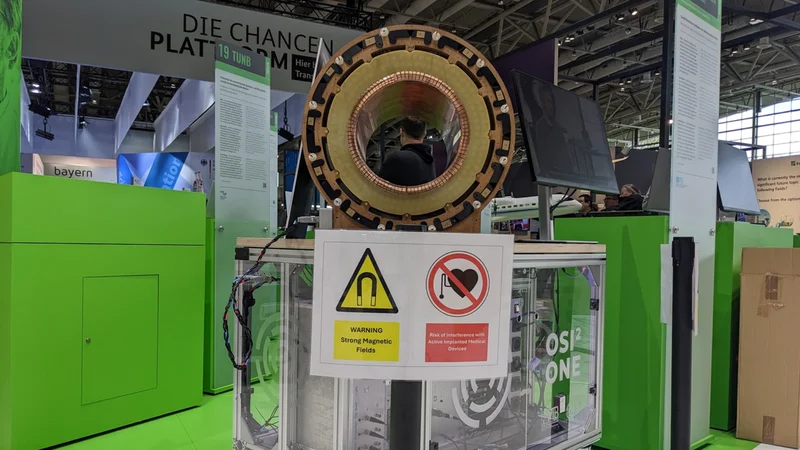
MRI machines are life-saving medical devices that can let doctors and radiologists diagnose various critical conditions, but they’re also insanely expensive. Brand-new models start at $1.1 million and could go as high as $3 million per unit or more. The Open Source Imaging Initiative recognized this limitation and has been working on the open-source OSI2 ONE MRI scanner, which had already been replicated multiple times globally. However, this portable device, which has a 3D-printed core, has a limited field strength of just 50mT (compared to the 1.5T to 3T used by full-sized units). This gave them lower spatial resolution and lower signal-to-noise ratio, but tech analyst Brian Roemmele said on X that AI can overcome this and make it usable for medical diagnoses.
“Low-field MRI has historically been limited by lower signal-to-noise and greater field inhomogeneity. That is exactly the regime where modern AI thrives,” Roemmele wrote on the social media platform. “Image reconstruction becomes dramatically better when deep networks trained on high-field data or physics-informed models denoise, correct for inhomogeneity, and push resolution beyond the raw acquisition limits. Real-time sequence adaptation can adjust gradients and RF pulses on the fly as the AI monitors signal quality.”
Note that this isn’t just a general run-of-the-mill AI that everyone uses but a specially trained model on high-field MRI (1.5T to 8T) data or using the actual physics of the MRI machine so that it can create a more accurate picture. Scientists have already been using this technique for years, with some researchers training an AI model on 1.6 million brain scans to make it more accurate in detecting dementia. If an institution does not have access to anonymized patient data used to train the specialized AI, it can rely on synthetic data generation because of the open-source nature of the OSI2 ONE MRI scanner. Since all the information about the machine is publicly available, researchers could use this instead to build a physics model that the AI model can use.
Some people commented, saying that this won’t work in the highly regulated medical environments usually found in first-world countries. Nevertheless, Roemmele said, “No one can stop us from building in garages.” It also seems to be targeted for regions that have low access to technologies like these or do not have the financial capacity to purchase and maintain a full-sized device (even refurbished MRI machine units start at $100,000, and you also have to spend more to set up the specialized room that will house it).
While a portable MRI scanner like the OSI2 ONE will never have the resolution of the expensive, full-sized machines, it’s arguably better to have something that doctors can use for diagnosis without costing millions of dollars if the specialized AI model turns out to be effective and accurate. With that, even less wealthy hospitals and clinics could have access to this imaging device and save more lives. It also shows how the medical industry and even patients use AI to save on costs.
Get Tom's Hardware's best news and in-depth reviews, straight to your inbox.
Jowi Morales is a tech enthusiast with years of experience working in the industry. He’s been writing with several tech publications since 2021, where he’s been interested in tech hardware and consumer electronics.