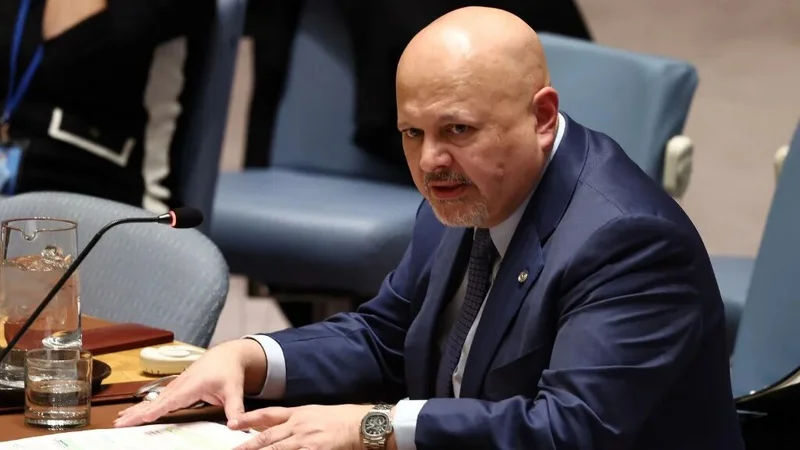
Exclusive: UK told Karim Khan it would not back him as ICC prosecutor before removal vote
The UK government told Karim Khan it would not support him as chief prosecutor and declined his request to meet ministers before International Criminal Court member states voted to remove him from his role, Middle East Eye can reveal.
Eighty-two of the court's 125 member states voted in a secret ballot on Friday to dismiss Khan as prosecutor over sexual misconduct claims at the United Nations headquarters in New York.
In March, Khan, who has denied all allegations, was cleared of all wrongdoing by a panel of judges appointed by the ICC's governing body, the Assembly of State Parties (ASP) bureau, to review a UN investigation into sexual misconduct allegations against him.
The judges concluded unanimously that the UN investigators' findings "do not establish misconduct or breach of duty under the relevant framework".
But a group of disproportionately western and European member states of the ASP bureau voted to disregard the judges and re-investigate the case.
The bureau then concluded last month that Khan "engaged in a sexual relationship" with the complainant, arguing that "in the context of that power imbalance a sexual relationship could never be appropriate".
Khan has denied that any sexual relationship had taken place, while the complainant’s account - the focus of the UN investigation - had centred on allegations of non-consensual conduct.
The UK is a founding member of the Rome Statute, the ICC's governing charter, and a member state of the court. It voted on Friday in the secret ballot.
According to sources with detailed knowledge of the matter, a UK official told Khan, who is himself British, on 17 June that the UK would not support his return to office.
UK refused Khan's request to brief government
Sources said the official told Khan the UK's decision was based on sight of a summary of the UN investigation into misconduct claims against Khan and a summary of the judges' report after that investigation, which had cleared Khan of misconduct.
These summaries, seen by MEE, were distributed by the bureau to member states, but they presented allegations featured in the UN report as factual findings - although the report did not make any factual findings related to the contested allegations.
Sources told MEE that Khan asked the UK official if he or his lawyers could meet a British minister to brief them on the issue.
But on 1 July, sources said, a UK official told Khan that this request had been declined.
MEE has contacted the UK Foreign Office for comment.
This occurred in the last weeks of Keir Starmer's premiership, while Yvette Cooper was foreign secretary.
The vote on Friday came shortly after Andy Burnham succeeded Starmer as prime minister.
Burnham appointed a new foreign secretary, Ed Miliband, who said on 20 July that "I will be a foreign secretary who fights for Britain’s interests and our values of democracy, freedom and the rule of law on the world stage".
He added: "Today, as we face a time of greater instability and threat to international law and democracy than at any time since the Second World War, these values are more important than ever."
Criticism of the vote to remove Khan
The vote on Friday followed an 18-month disciplinary process against Khan that Palestinian rights groups, former judges and the prosecutor's lawyers have described as politicised.
Francesca Albanese, the UN's special rapporteur on the occupied Palestinian territories, wrote on Saturday on X that "Khan's removal lines up neatly with the fight to neutralise [Israeli Prime Minister Benjamin] Netanyahu's arrest warrant. Coincidence is a luxury intl law can no longer afford".
Israeli media reported on Friday, citing anonymous Israeli officials, that a task force set up by Israeli Foreign Minister Gideon Saar worked to lobby ICC member states to vote against Khan.
Saar himself described Khan's removal as "long-delayed" in a statement, calling on the court to drop the arrest warrants "immediately".
'Khan's removal lines up neatly with the fight to neutralise Netanyahu's arrest warrant'
- Francesca Albanese, UN special rapporteur
The investigation into Khan has unfolded against the backdrop of an intensifying intimidation campaign, documented by MEE last year, targeting the prosecutor and the ICC itself over his office's efforts to bring Gaza war crimes prosecutions against Israeli leaders.
In May 2024 he sought arrest warrants for Netanyahu and his then defence minister, Yoav Gallant. The court issued the warrants that November.
Since then, Khan, his two deputies and a number of judges have been subjected to US sanctions.
US Secretary of State Marco Rubio said earlier this month that Washington would "dismantle the ICC - brick by brick, if necessary".
On Friday, Khan’s chief lawyer, Tayab Ali, expressed "regret" that the ASP had disregarded recent concerns about due process raised by more than 180 rights groups and legal experts.
"The decision is unsupported by any lawful or properly reasoned finding that Mr Khan KC committed misconduct or breached his duties as prosecutor," he said.
In an interview with CNN last week, which was her first public appearance in connection with the case, the complainant stood by her allegation of non-consensual sexual conduct. Member states did not vote on this allegation.
MEE reported last June that on 23 April 2024, weeks before Khan applied for arrest warrants for Israeli officials, then-UK Foreign Secretary David Cameron phoned Khan and threatened that the UK would defund and withdraw from the ICC if it issued warrants for Israeli leaders.
Since then, numerous British MPs have urged a Foreign Office investigation into the call and a Foreign Affairs Select Committee inquiry.
The Foreign Office has repeatedly refused to comment on the matter.