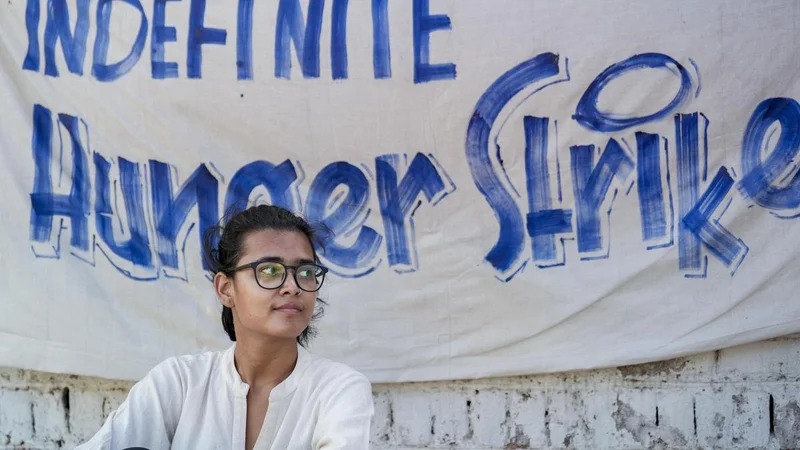
Six of them sat on a hunger strike, a little way away from the main dais at Jantar Mantar, surrounded by their colleagues from the All India Students Association (AISA). Slightly off to the side from where the spotlights were trained on activist Sonam Wangchuk. Three of the six were still around after Mr. Wangchuk was forcibly admitted to hospital by the Delhi Police on July 18. On July 25, when Union Education Minister Dharmendra Pradhan announced his resignation, they were still there at Jantar Mantar.
Also read | Police crack down on AISA march in Patna seeking resignation of Dharmendra Pradhan
They had sat there for 23 days. Doctors took their blood pressure, conducted ECGs, and pricked their arms for blood tests, all out there among the heaving masses who gathered around them.
AISA is the student body of the CPI(ML) Liberation. The Cockroach Janta Party reached out to student organisations. Besides AISA, other Left student bodies were also associated with the protests, including the Students Federation of India (SFI), the All India Students Federation (AISF), and the Krantikari Yuva Sangathan (KYS). Many in Left circles questioned the political affiliations of this newly minted organisation — the Cockroach Janta Party — born on social media. Many dismissed it as a “pressure valve” that would function to dissipate the discontent.
Neha, Delhi secretary of AISA, said that her organisation too was cautious. Ms. Neha was among the three AISA activists who sat on a hunger strike for 23 days. But all these apprehensions were set aside for two reasons. One, she said, “if those of us with experience of running mass movements such as these are around, we won’t allow anyone to hijack the agenda.” Second, this protest held great potential to reach out to young people who have so far been served only communal politics, she said. Ms. Neha added that the Left students unions contributed to the organisational heft of the protest.
The doubts melted away, a day at a time, as the footfall increased at the tiny stretch of road boxed in by police barricades. “This protest was bigger than any organisation,” Ms. Neha said.
Though her stomach was empty, her heart was filled during those 23 days with people walking up to her. “Many of them came to me apologising, saying that I have to go hungry since they voted for the BJP. Many even cried.” The experience that has stayed with her is that of the father of a NEET student who died by suicide, weeping. “He said he had voted for the BJP and made everyone in his family vote for the BJP,” Ms. Neha said.
Her phone has not stopped ringing since July 25, 2026, and amidst innumerable interviews, Ms. Neha, looking back at those 23 days, said that the thought of giving up never crossed her mind. “It was never about self-sacrifice. It was rather a challenge to the government. The question was: will the government let us waste away slowly rather than forcing their Minister to resign?” Ms. Neha expresses confidence that Mr. Pradhan’s resignation is only the first of many. The protest at Jantar Mantar may have ended but the movement has not, she said.
The other Left student unions also contributed to the footfall. SFI All India president Adarsh M. Saji said that his organisation’s idea was to take the protest beyond Jantar Mantar. “We organised protests in 24 States,” he said. Two SFI activists sat on a hunger strike from July 18, the day Mr. Wangchuk was picked up, ending it on July 20, when protesters marched to Parliament.
Jantar Mantar, which saw a steady stream of parliamentarians, also saw multiple visits by Left MPs. “We didn’t have any confusion about the ultimate goal of this protest. Even when many political parties expressed doubts, we wholeheartedly involved ourselves here. It was clear that it went beyond slogans; it was an agitation to regain democratic space that has been ceded in the last 12 years,” CPI(M) Rajya Sabha leader John Brittas said.
Published - July 26, 2026 10:12 pm IST