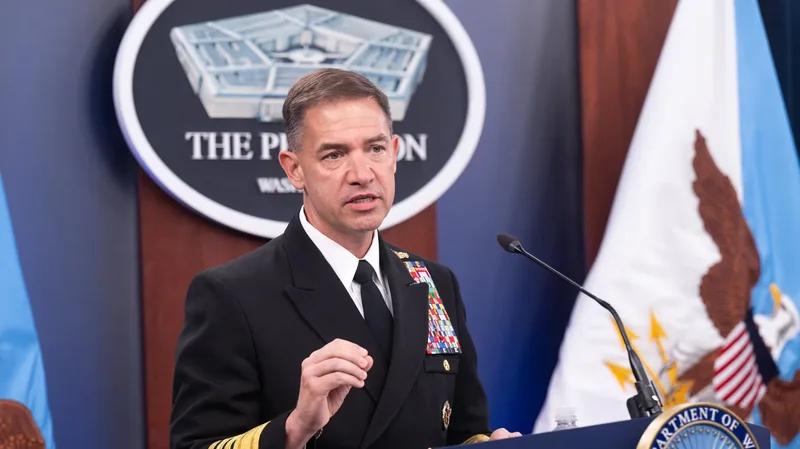
The top U.S. military commander in the Middle East, Adm. Brad Cooper, recommended stopping the bombing campaign around the Strait of Hormuz because it has reached the limit of its effectiveness, according to two sources with knowledge of his position. Why it matters: The recommendation by Cooper, the commander of the U.S. Military Central Command (CENTCOM), together with other advisers impacted President Trump's decision on Friday to pause U.S. strikes against Iran, the sources said. It was an acknowledgement by both military and civilian advisers to the president that there are limits to what can be accomplished through military action, and specifically an air power campaign. Driving the news: For the first time in two weeks, Trump ordered the military to hold fire and not conduct strikes against Iranian targets around the southern coast of Iran and in the Strait of Hormuz area. The decision came after a meeting with top advisers and military officials who presented him with a new strike plan for the day. In the days before the meeting, Trump had been leaning toward returning to major combat operations, but his mindset started to change on Thursday evening, sources said. His decision to pump the brakes on bombing the strait solidified on Friday.Behind the scenes: Earlier in the week, Admiral Cooper gave his recommendation on the way forward to the Pentagon, the joint chiefs and the White House, the sources said. He stressed that the two weeks of strikes in the Strait of Hormuz area had significantly degraded Iran's ability to attack ships.Cooper noted that the designated bombing targets had been mostly exhausted.The CENTCOM commander said a possible next step would be to resume major combat operations to finish the 20% of targets the U.S. military designated but didn't strike during Operation Epic Fury. Absent a decision to return to major combat operations, he stressed there was no point in continuing the bombing campaign of the previous two weeks, the sources said. CENTCOM spokesman Capt. Tim Hawkins declined to comment.Zoom in: The sources said the chairman of the Joint Chiefs of Staff Gen. Dan Caine also cautioned Defense Secretary Pete Hegseth and Trump in private that a shortage of air defense interceptors could hamper the ability to protect U.S. forces and allies in the region. Caine's warning was first reported by the New York Times. A spokesman for the chairman of the Joint Chiefs of Staff declined to comment "on confidential military advice the Chairman provides the President".What to watch: Iran and Oman are still negotiating a new arrangement to reopen the strait of Hormuz that would be designed to reopen it for transit of ships with no attacks. But it is unclear if a deal between the two countries would be acceptable to Trump. If not, the war could escalate again. In the meantime, the situation on the ground seems to be "quiet for quiet," with both sides pausing their attacks. U.S. ambassador to the UN Mike Waltz told NBC's "Meet the Press" on Sunday that while Trump is "keeping all options on the table," the president is also "giving talks [with Iran] some space."Waltz said talks between the U.S. and Iran "are ongoing on every level."Zoom out: The U.S. and U.K. are still discussing the international conference they want to convene later this week on establishing a coalition to protect and clear mines from the strait of Hormuz.No final date for the meeting has been set.
Top U.S. military commander in Middle East advised halting Hormuz bombing