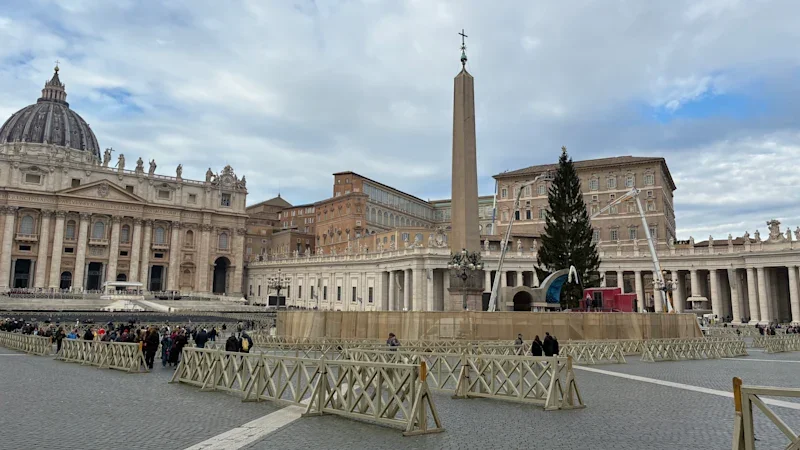
It was a bright, cold day in December and the Pope was putting up his Christmas tree. Well, someone was: Leo XIV himself was out of town that day, but a 25-metre spruce was standing in the middle of St Peter’s Square.
There were also two cranes to add decorations. For the tourists that morning, the work on the tree marred the otherwise uninterrupted view of Vatican City and spoiled the vision Michelangelo had in mind.
While it was easy enough for the eye and mind to filter the cranes out and focus on the travertine, they were there in the photographs. “A pity,” one tourist said to her husband. “Never mind,” he replied, “we’ll get rid of it with AI.”
Capturing the perfect picture is a vital part of the holiday experience. After all, what is the point of getting away from it all if you can’t rub it in for those left behind?
Then you arrive in Singapore and it pours. Or in San Francisco you find access to The Rock is blocked. La Rambla in Barcelona is more like La Crumbler.
Get exclusive travel deals delivered straight to your inbox. Sign up now.
Barcelona’s famous boulevard – a bastion of culture, cuisine, the odd prostitute and pickpocket, and the site of civil war clashes – was under renovation during a recent stay there. It felt as if the construction site stretched all 1.2 kilometres from the Placa de Catalunya to the statue of Christopher Columbus that peers over the port and points beyond the Mediterranean Sea all the way to the New World.
Indeed, the entire precinct is getting a major redevelopment under a plan approved in 2017 and expected to be completed next year: vehicle access will be restricted, the pavement will be even and uniform, the trees will be aligned, and it’s all been designed to balance the needs of long-term residents with the pressures of tourism.
As with big construction projects in Australia’s major cities, it sounds as if it will be terrific once it’s finished. For now, though, it’s less than picture-perfect and artificial intelligence software would be hard-pressed to erase it all. (I put it to the test and the results were, shall we say, mixed.)
There were ways to get around the problem: I took a wander through the nearby alleys; I zoomed in on the ancient mosaics and modern street art; I looked up to try to figure out where the ravages of history ended and the help of restoration began. But I also leaned into the mess and captured the moment, because it’s not every day I fly halfway around the world, and who knows when I’ll be back?
We should be wary of overusing the AI airbrush. A “Chinese uncle” went viral in January for his unfiltered images of Paris, captured under grey skies, that netizens joked would undo a year’s worth of French promotional efforts. The man himself was reportedly not embarrassed by being unable to capture the most flattering angles or use filters to their best effect, and said Paris was beautiful but it happened to rain. His images were not ugly or off-putting; they were honest.
In Rome, on the walk from the Pope’s Christmas tree to the Colosseum, many of the brilliant monuments and buildings along the way had benefited from being well preserved over the years. A few others were under wraps: thanks to construction work, it was hard to see the balcony from where fascist dictator Benito Mussolini delivered some of his most famous and chilling speeches, and one of the propaganda columns extolling a great Roman victory over vanquished enemies was covered in scaffolding.
It barely made a difference to the experience of seeing one of the world’s great cities, and knowing it was being looked after was reassuring. There’s an art to photographing around, beside or through construction work, and there are techniques to make the most of lighting and camera settings. But there is a brilliance to travelling and seeing the world as it is that no number of filters or AI magic can replace. If you keep your eyes open, you may even see the Pope putting up his Christmas tree.
The writer travelled to Europe as a guest of MSC Cruises.