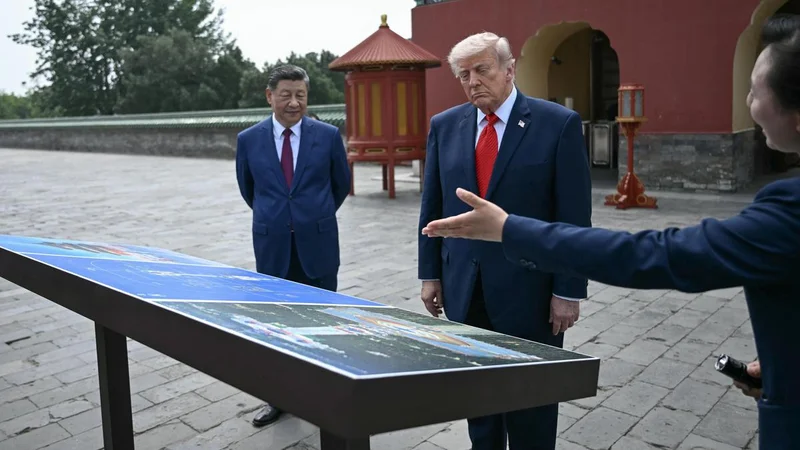
A volatile political climate in Washington has triggered a wave of strategic anxiety in New Delhi. Buffeted by the transactional, often erratic policy shifts of the Donald Trump administration — which hit India last year with punitive tariffs on steel and aluminium, stripped its preferential trade status, and aggressively renewed ties with Islamabad while imposing irritants such as tightening H-1B visa rules — a growing chorus of domestic voices is calling for a fundamental reset of India’s China policy.
Economic actors, their flawed line
The argument, championed largely by an influential business lobby, suggests that India’s confrontational approach toward Beijing was overly synchronised with Washington’s strategic agenda of “containment” rather than India’s national interests. The lobby contends that because India remains deeply reliant on Chinese technology, supply chains, industrial inputs, and capital, a dogmatic anti-China stance ultimately stymies domestic economic growth while barely denting Beijing’s economy. The core risk, critics warn, is Washington’s historical pattern of tactical flip-flops — escalating tensions one day and striking bilateral deals the next — which risks leaving an overextended India strategically vulnerable to Chinese retaliation.
While the warning against subordinating Indian interests to an unpredictable Washington is entirely valid, it is not clear that this is what is occurring. In any case, the proposed alternative — a hasty, unreciprocated economic embrace of China — is a dangerous prescription. It mistakes tactical business convenience for long-term national security. A premature capitulation to Beijing ignores a decade of unprovoked hostility, deepens an asymmetric dependency, and strips India of its leverage just as the global order enters its most volatile phase since the Cold War.
Let us face it: the primary domestic driver for a China reset is an influential business lobby obsessed with short-term balance sheets. For years, parts of corporate India have argued that access to cheap Chinese capital, machinery, and active pharmaceutical ingredients (APIs) is indispensable for India’s growth. However, this view suffers from severe strategic myopia. It treats international trade as an apolitical transaction, completely divorced from the realities of comprehensive national power.
By advocating a return to the pre-2020 status quo, these economic actors choose to selectively forget a dozen years of relentless, unprovoked aggression by the People’s Liberation Army (PLA) and the Chinese Communist Party (CCP). The list of Beijing’s hostile acts against Indian sovereignty is not a series of isolated border skirmishes; it is a coherent strategy of containment and humiliation. From Depsang (2013) and Chumar (2014) to Doklam (2017) and then the fatal clashes in the Galwan Valley (2020), China has systematically attempted to alter the Line of Actual Control (LAC) through salami-slicing tactics, unilaterally violating decades of border peace protocols. Beijing continues to aggressively assert absurd claims over the entire State of Arunachal Pradesh, renaming geographical features in places it does not control (but plans to), and issuing stapled visas to residents of Jammu and Kashmir and Arunachal to weaponise India’s internal geography.
And then there is economic coercion. China has routinely used its manufacturing dominance as a political weapon, abruptly withholding critical machinery and industrial inputs, even weaponising its monopoly over rare earths and tunnel-boring machines during bilateral disputes, simply to inconvenience Indian industries and signal its leverage, knowing fully that India has none to exercise in return. Most alarming has been Beijing’s overt, coordinated military support for Pakistan during Operation Sindoor (May 2025). By providing Islamabad with real-time tactical satellite data and intelligence, China transformed itself from a mere military supplier into an active, hostile participant in Pakistan’s security architecture against India. To ignore this track record in pursuit of cheaper components is not pragmatism; it is strategic blindness.
The myth of reciprocity
The core flaw in the argument for a quick reset is the naive assumption that if India relaxes its economic guard, China will reciprocate with geopolitical goodwill. The foundational tenet of Chinese foreign policy in Asia is the establishment of a unipolar continent. Beijing does not view New Delhi as a peer, nor does it desire India to become one.
For over a decade, China has weaponised its veto at the United Nations Security Council (UNSC) to shield Pakistan-based terrorist organisations from international sanctions and condemnation. It has blocked India’s legitimate aspirations for permanent membership in the UNSC and membership in the Nuclear Suppliers Group (NSG). If India opens the floodgates to Chinese capital and market access without any fundamental resolution of the border dispute or a halt to Beijing’s hostile behaviour, it effectively subsidises its own encirclement. Pouring billions of dollars into Chinese coffers as a compliant consumer market merely expands the asymmetric trade deficit (China’s annual surplus over India now exceeds $100 billion). More dangerously, it hands Beijing an economic kill-switch over the Indian economy. In a future crisis, the threat of cutting off critical components could paralyse Indian industry, rendering New Delhi incapable of independent strategic decision-making.
Advocates of a reset argue that easing economic tensions could pave the way for a permanent demarcation of the border. In reality, the opposite is true. China respects power and exploits vulnerability. If India surrenders its economic leverage and signals that it cannot sustain a prolonged stand-off, Beijing will conclude that its strategy of multi-domain pressure is working. China will simply bide its time, allowing India to grow comfortably dependent once again. When Beijing eventually decides it is ready to discuss a permanent border settlement, it will dictate terms from a position of absolute dominance. An India structurally dependent on Chinese technology and cowed by the threat of economic disruption will have no choice but to accept a deeply disadvantageous territorial status quo.
Leverage, once surrendered, cannot be easily reclaimed. The restrictions India placed on Chinese apps, investments, and telecom infrastructure post-Galwan were not just emotional reactions; they were crucial diplomatic leverage. Dismantling them for minor economic relief would be an act of unilateral disarmament.
India is undeniably in a complex position. The Trump administration’s unpredictable shifts mean that relying entirely on Washington as a security guarantor is unwise, despite the enthusiasm of his emissary to India, Sergio Gor. The United States will always prioritise its own domestic and global calculations, and New Delhi must remain clear-eyed that it stands alone on the heights of Ladakh. However, realising that Washington is an unreliable partner does not mean India must run into the arms of an actively hostile neighbour. There is an immense strategic space between subordinating India’s national interests to the U.S. and conceding an unconditional economic and political surrender to China.
The path India must tread
The correct path for New Delhi is one of strategic patience and internal fortifying. India must accelerate its supply chain resilience, diversify its trade partnerships across Europe, East Asia, and the Global South, and aggressively build up its domestic manufacturing capabilities — even if it comes with short-term inflationary costs. The last decade has proven that China presents a structural, generational challenge to India’s rise. A hasty rethink driven by panic over Washington or the complaints of a short-term-profit-driven business lobby will only ensure that India remains permanently exposed, economically vulnerable, and strategically diminished.
We do not have to “tilt” either way. We must, instead, develop the strength to walk straight.
Shashi Tharoor is the fourth-term Member of Parliament (Lok Sabha) for Thiruvananthapuram (Congress party), the Chairman of the Parliamentary Standing Committee on External Affairs and the Sahitya Akademi Award-winning author of 29 books, including Pax Indica (2012)and The New World Disorder (2020)
Published - July 27, 2026 12:16 am IST