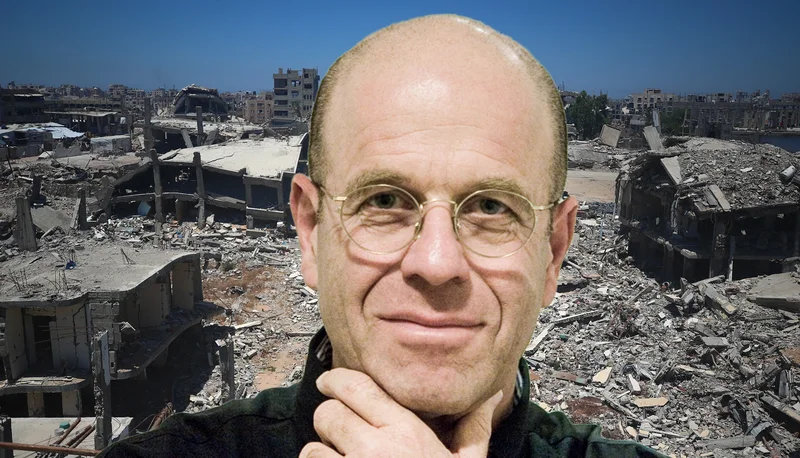
âListen, Tucker, I cannot stand you,â Avraham Burg said to Tucker Carlson during their wide-ranging interview on the latterâs online platform in late March. âBut youâre a nice person, so I talk with you.â
Carlson laughed heartily. âIâll take that as a half-compliment,â he replied.
As Daily Maverick would discover four months later, itâs almost impossible not to laugh at Burgâs perfectly timed one-liners. At the Festival of Dangerous Ideas held in Johannesburg and Cape Town on 18 and 19 July 2026, an event organised by the left-leaning Jewish Democratic Initiative (among the JDIâs co-founders are Anton Harber and Irwin Manoim, who were also co-founders of the Weekly Mail), Burg won over the audience with the same characteristic humour.
The JDI festival numbers were nowhere near the 1.4 million who watched him spar with Carlson, but the comic relief was just as necessary.
Burgâs humour, after all, is the vital âspoonful of sugarâ for the bitterness of his medicine. For countless Westerners, and probably for the overwhelming majority of the worldâs Jews, his message is directly hostile to their loyalties and values. To Burg, aside from being criminally murderous and maliciously libertarian, the Israeli state can only be defined as religious-fundamentalist, territorialist and imperialist.
From an Israeli insider with such unequalled pedigree, these labels hold a particular sting. Burgâs father was a famous German-born politician during the early years of the Israeli state; his mother was a survivor of the 1929 Hebron massacre â Burg himself would become the first Speaker of the Knesset to have been born in Israel after its founding in 1948.
As he explains to Daily Maverick, his final break with the Zionist mainstream happened on a particular Thursday in 2007. But for a South African audience, arguably his most compelling insights are the ones he offers about our own country â its heroes, its triumphs and its lessons.
Our interview with Burg took place in Cape Town on Monday evening, 20 July. The text below has been edited for length and clarity.
**Kevin Bloom: So this morning you went for a walk with Albie Sachs, who you count as a good friend. At the JDI festival, you quoted another famous member of the South African Jewish community, the late Mendel Kaplan, who once said to you during â and regarding â apartheid: âAvrum, you donât understand, if there is no solution, there is no problem.â Back when it counted, the difference between those two men was like night and day; itâs no secret that Sachs was regarded by the Jewish mainstream as a dangerous dissident, while Kaplan was in a very literal sense the voice of the complicit majority. **
**To me, the ironies are as obvious as the analogies. Today, when it comes to Israeli policy in the wake of 7 October, mainstream South African Jewry is spoken for by the Mendel Kaplan characters while the Albie Sachs characters are dismissed as traitors or worse. Given your intimate knowledge of Jewish history and thought, what does this augur for the local community in the years to come? **
Avrum Burg: Listen, my former profession was politician, not prophet. But I can say that a day will come when the majority will look back and say, âAt that time, we were all Albies.â I have no doubt about it, because it has happened so many times in history. When you look at Jeremiah versus the entire kingdom of Judea, he went to jail, he was in confinement, but who remembers the king of the time? Nobody. And who quotes and keeps quoting the prophet Jeremiahâs wisdom and morality? All of us.
I can give you line by line in Jewish history where what was perceived at the time as a dangerous idea became later on the strategy of the majority. The same will happen here. Now, Iâm not in a position to judge neither community nor individual. Who am I? But I can tell you what I feel, and what I feel is that I am an âAlbieâ Jew, always was.
I can tell you that the most important adult in my life besides my parents, who are the two angels who brought me here, is my father-in-law â he is now 102 years old. He was a partisan in the Second World War. He was in the French Resistance, fought the Nazis, came out of the war with the teaching that the miracle of the Second World War was not the fact that the Jewish people survived. Thatâs nice, okay, thank you very much. But the miracle was that there were Righteous Among the Nations who had the courage to save humanity. And he dedicated his life, decades of his life, to identifying, documenting and decorating all of these Righteous Among the Nations.
So when I look at the struggles here for the liberation of South Africa, it was difficult, it was malicious, it was full of blood and racism. Unfortunately, the apartheid regime was supported by Israel at the time, and therefore indirectly by the Jews. But those who saved humanity and served as the extended arm of the images of God were Ronnie Kasrils and Helen Suzman and Albie Sachs. These are my Jews. Being a mainstream Jew is very convenient, but there was a musical in Israel many years ago called âOnly Dead Fish are Swimming with the Streamâ. I never swam with the stream.
KB: To move on almost seamlessly from there, it was South Africa that brought the ICJ [International Court of Justice] case. What does that mean to you â not diplomatically, but morally? Does it carry weight that it came from here specifically? Also, the TRC [Truth and Reconciliation Commission] is the model that people reach for when they imagine post-conflict reckoning. Does it offer Israel anything real, or is the analogy structurally false? What would âtruth and reconciliationâ even mean in the Israeli-Palestinian context?
AB: Yes, the fact that South Africa is leading the ICJ case is very significant. In global discourse, itâs significant for two reasons.
First, here is a nation that overcame crimes against humanity and a criminal regime, and it is now trying to offer its experience to the rest of the world, to say we are somehow committed to preventing this kind of criminal, patronising, arrogant attitude towards others. Of course, there are the cynics who say you should not believe the South African government, that they are hypocrites, that they donât mean it. Doesnât matter â symbolically speaking, there is a case here.
I would like it one day if Israelis and Palestinians together, after making their own iconic conflict into an iconic reconciliation, if they will also decide to go around the world and accuse others who perform this crime. And I believe itâs possible. I believe it will happen. So this is one thing.
The second is we are living in our comfort zone in the West. This case is very important for the Global South, because the Israeli and Palestinian conflict, besides being a local one between two tribes, two biblical tribes around an imagined biblical well, is also the outcome of two 19th-century European poisonous fruits â colonialism and the Holocaust. And colonialism has a lot to do not just with Israelis and Palestinians; it has to do with the African continent, it has to do with the Indian-Pakistani conflict, it has to do with Southeast Asia, it has to do with so many other places. So yes, the Global South should say something here.
As for the TRC â yes, I wonder. You need a culture â and maybe this is a prerequisite â but you need a culture of a will to lead together. So letâs say we end the conflict, then there is a political deal, some kind of a schmutzig [dirty trick] of a deal â you know, some here, some there, I give you here, you pay me there, whatever will it be, okay. But then, if the inner, deeper motivation of both sides is still dreaming about the extinction of the other, no truth and reconciliation process can overcome it.
So step number one before that is the de-radicalisation of both societies. And de-radicalising the Israeli society no less than de-radicalising parts of the Palestinian society â not all, but parts of it. And then, the second stage is accepting the very existence, the legitimacy of the existence of the other, and even welcoming that existence. Then we can go for truth and reconciliation. But if you put the TRC first, it might be too early.
Breaking away from the inside
KB: So in that sense, there is a growing phenomenon of diaspora Jews publicly breaking with their communities over Gaza â facing shunning, professional consequences, loss of communal belonging. But for more than two decades now you have been breaking away from the inside, methodically severing your ties with the Israeli establishment of which you were once an intimate and influential part. Is the inside break more or less costly? Does it carry different weight?
AB: Listen, I love your description. It sounds heroic, but itâs not me. I didnât change a millimetre since my first day on the public stage. When I first started with my political life, it was when Anwar Sadat came to Israel. It was way before I was a member of the Knesset. I was just a young student, a recently released paratrooper officer running after the convoy of Sadat and chanting, âNo more war, no more bloodshed.â And that one wind blew into two sails of mine. I donât have a big agenda, just two small things: end of the occupation and the separation between church and state.
Ever since, I havenât moved a millimetre in terms of my commitment and my devotion. The methodologies, the parties, the venues, the platforms are different, but the core mission is the same. Israel, on the other hand, has changed dramatically in the years that we are speaking about. Israel at its establishment was a secular social democracy â I mean, a democracy in diapers, but a democracy that wanted to get better and better. The Israel of today is religious in the worst way, fundamentalist, very capitalist to the level of libertarianism, a malicious libertarianism, triumphalist, territorialist, imperialist. Itâs a different, completely different country. So in a way, I didnât move a millimetre. Reality moved.
But then there was a moment in which I stopped to be â I donât know how you translate it into proper English â the âgood guyâ of the system. I was quite popular, one of the most popular public figures in Israel, which was nice. I mean, itâs nice to wake up in the morning and be loved by all, or appreciated by many. Then I wrote a book. I wrote a couple of books, but one of my books was called in Hebrew âDefeating Hitlerâ; in English itâs called âThe Holocaust is Over; We Must Rise from its Ashesâ. And there I argued about the omnipresence of the Holocaust in our Israeli life and how our leadership, in a very manipulative way, exploits the credit given to us by those atrocities. If you read it today, itâs moderate, itâs humble. But at the time, almost 20 years ago, it was a riot.
So, the book was published on Tuesday. Wednesday, there was a huge interview with me in the papers. Thursday, Iâm standing in line in the bank. And itâs a long line, and Iâm standing waiting, and there is a guy who is looking at me. And I see that heâs fuming and boiling. Finally, the popcorn erupted. He said, âYouâre Burg, right?â I said, âYes.â He said, âIâm mad at you.â I said, âWhy are you mad at me? You donât even know me.â So he said, âYou wrote against the Holocaust.â And I said, âAnd you? Would you have written for the Holocaust?â So I enjoyed the exchange. He didnât know what I was talking about, of course. But the minute I touched the sacred cow, it was my last day in the Israeli mainstream. The last day. And it was overnight. On the one hand, there are prices to pay for something like that. I had to resign from boards, both of companies and NGOs. I was not invited any more to places I used to be invited.
But you ask me if itâs difficult or costly? No. Why? It liberated me. It gave me a position in life in which Iâm at liberty to say exactly what I think, and this way articulate â I try to articulate â the feelings of many who are not liberated, who do not have the privilege to be so relaxed about it. And Iâm relaxed about it. Itâs fine. I mean, you donât like it? Get lost. So I paid prices, but I benefited more.
Diaspora dissent
KB: The Israeli state has successfully conflated itself with Jewish identity globally â which, at its core, is what makes the genocide charge legible as anti-Semitism. Does diaspora dissent rupture that conflation in any meaningful way, or does the apparatus just absorb it?
AB: There is no diaspora. There are diasporas. Within each and every community, you have so many subdivisions. I mean, look at the South African community. Is Lubavitch the same as Orthodox rabbinate here? Not sure. Are both of them like the liberal community, the Reform, the Conservative? Not at all sure. Are any of those like the secular progressive marrying-in and marrying-out Jews?
The answer is no. There are so many layers of identity that there is no one diaspora globally or locally. Itâs a very diverse reality, maybe as diverse as it used to be. And at the same time, there are two different dynamics occurring. People do not understand that the State of Israel belongs to its citizens only. We are the stakeholders and the stockholders. When you say that the Israeli state belongs to the entire Jewish people, it may sound good rhetorically. I have used this metaphor so many times in my own life, never gave it a second thought. But when you just scratch the surface of this formula, you realise how ridiculous it all is.
Because, all of a sudden, Israel has stakeholders who will never come to live in Israel, never pay its taxes. And on their behalf, Israel is doing things that they have no power to prevent, to influence, to change, to impact, none whatsoever. And on the other hand, when you say Israel is the state of the Jewish people, it means that every synagogue is an outpost and every Jew is a potential soldier. So in a way, you legitimise, God forbid, every attack against the Jews because you are the ones who said that Israel belongs to all the Jews. So this is why the formula is both ludicrous and dangerous. At the same time, what I hear â I try to hear the grass grow â and I hear the rebirth of diasporism.
There was a guy named Simon Rawidowicz, and he wrote in the â50s â earlier, later, he wrote about Jerusalem and Babylon. And he was against the fact that Jerusalem since â48 does not really take into account the Babylonian input, which means the diasporic input, the diasporaâs aspirations. It sounds awful, and it feels awful, but Iâm not at all sure that Iâm wrong about this fact â October 7th was the day of independence of the Jewish diaspora from Israel.
KB: You opened the JDI festival on 18 July, Mandela Day, which was no coincidence. After you spoke, we heard from Arab Barghouti, the son of Marwan Barghouti, who has been languishing in an Israeli prison for 24 years and who â for good reason â is widely referred to as the âPalestinian Mandelaâ.
Arab told the audience that thereâs a leadership crisis in Palestinian politics â that the PA [Palestinian Authority] is effectively non-existent as a going concern, and that his fatherâs release could do for Palestinians what Mandelaâs release did for South Africa. Mandela himself reportedly said in 2002 that what was happening to Marwan Barghouti was exactly what had happened to him. Do you believe that comparison holds? Is a Mandela moment possible in Israel-Palestine?
AB: A South Africa moment is possible because, I believe, the overwhelming majority of the people want life. The killers are the minority, even if the atmosphere right now is one where most Israelis believe that all Palestinians are suicide bombers, and the majority of Palestinians believe that we are all either soldiers or settlers. But most people would like to have a good life, would like to have hope for their kids. Itâs possible â and I believe itâs relatively close.
Can you compare one situation to another situation? Can you compare Mandela to Martin Luther King? I donât know. Is Barghouti the one? I have no clue. I know one thing: that two of Israelâs prime ministers were terrorists. Menachem Begin and Yitzhak Shamir. They were declared terrorists by the British. And if you judged their actions by the same criteria as we judge the Palestinians today, they would never have been released. They had on their hands more blood than Barghouti has on his. But they became the prime ministers of Israel, and one of them, Menachem Begin, even made peace.
So if Israel was a wise Israel, which it is not â we are a stupid Israel, I mean, we somehow failed to adopt the alleged Jewish wisdom, we prefer the option of Jewish assholism â but if we had some wisdom, we would say, okay, we have held Barghouti for over 20 years, so we built the image, now we should release him and profit from our investment. Why? If heâs the one who can bring peace, letâs bring it to the table.
But since this Israel is so afraid of peace, they would prefer for him to die in jail. If you understand the philosophy behind Netanyahu supporting Hamas, you understand the problem. Because Netanyahu says the more he supports Hamas, the more Hamas goes against the Palestinian Authority. The weaker the Palestinian Authority, the less chance there is of a Palestinian state. So Netanyahu supported Hamas in order to serve his purpose of no Palestinian state. With this kind of stupidity, Barghouti will never be released.
However, I believe that the situation that you call the âMandela momentâ and I call the âSouth Africa momentâ is a situation in which international sanctions can and will bring Israel down. The minute the international sanctions are more effective â theyâre not effective now, I mean, theyâre troubling, but there are ways to do effective sanctions on individual Israelis and on Israel itself â so the minute the sanctions are unbearable, Marwan Barghouti will be free. **DM **