Americans are not buying Donald Trump’s predictions that the Iran war is nearing its end, nor do they believe that Iran has lost the will or the means to keep fighting.
And one of his top advisers is no longer sticking to that timeline, either.
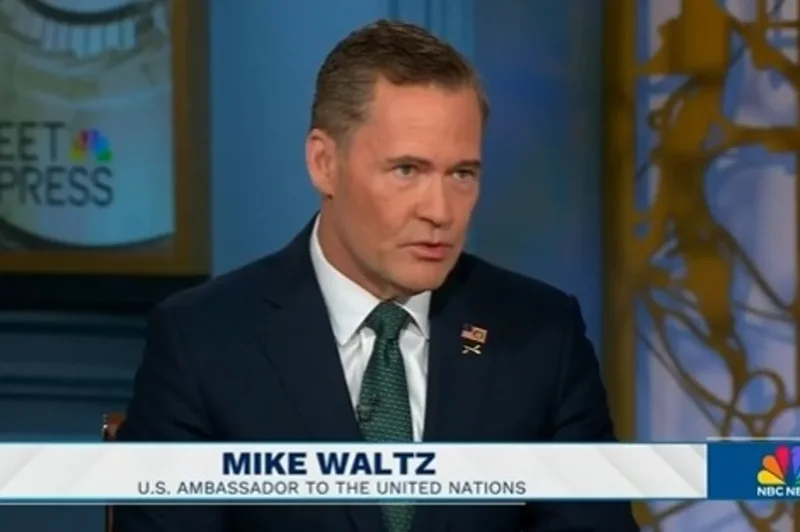
U.N. Ambassador Mike Waltz appeared on NBC’s Meet the Press on Sunday and unlike other senior Trump administration officials who’ve appeared on the Sunday circuit previously, the ambassador would not commit to the war ending before the end of 2026.
"I'm not going to put some kind of timeline on it,” said Waltz.
His comments come as the president has dismissed the idea of further negotiatons and allowed the war to resume at full strength after a 60-day extension of the ceasefire between the two countries dissolved earlier this month. A tanker struck a mine in the Strait of Hormuz and exploded this weekend as the crucial waterway has become increasingly unsafe, once again, for global shipping traffic.
They reveal a growing sense of doubt within the administration itself, with fewer and fewer officials willing to say that the war is definitively over amid a withering barrage of criticism from Capitol Hill. Though senators continue to defeat War Powers resolutions aimed at restricting the president’s power, the Senate GOP caucus is increasingly opposed to the war and several senators have spoken out about their beliefs that the war was a mistake from the beginning.
Elsewhere on Sunday a new poll revealed that Americans have abandoned the Trump administration as a reliable source of information about the topic of Iran. A CBS News poll found that only a single digit percentage of Americans now believe the White House’s predictions — that the war will be over within days, or a couple weeks.
Instead, more than half believe the opposite — that the war will likely continue for many months or even years, as the conflict approaches the five-month mark and senior Trump officials appear unable to break a deadlock in the negotiations, which are now on the backburner altogether thanks to the resumption of hostilities. This week, the president attended the dignified transfer of four U.S. service members killed in an Iranian attack this month, and claimed afterwards without any proof that the slain soldiers “said very strongly” that “we can’t let Iran have a nuclear weapon”.
Waltz, in his interview, dodged a question from Kristen Welker on whether Americans should brace for further casualties.
The ceasefire extension signed by Trump in June agreed to the principle of beginning negotiations over Iran’s nuclear material, but significant differences remain over the U.S. and Iranian positions over the future of Iran’s nuclear energy ambitions.
The war itself remains highly unpopular, and has been blamed by a Koch-linked group in a new statement for detracting from GOP voter enthusiasm as the midterms approach. Gas prices passed $4 a gallon nationally for the second time this year in July, spurred by new hostilities in the Strait of Hormuz and the breakdown of talks between the U.S. and Iran, and the associated costs of transporting goods have begun to spread out into other sectors of consumer goods.
The problem is particularly of issue to Republicans as the president ran and won on an economic message in 2024 which, in part, stressed that he would avoid entering “forever” wars in the Middle East and elsewhere that he correctly blamed for driving up prices.
Republicans are now faced with a midterm electorate suffering a sense of betrayal over the president’s campaign promises, a problem that polling shows extends to core members of Donald Trump’s Republican base as well.
U.S. and Iranian forces have paused attacks in the region for the past two days, with the exact reasons unclear. A White House spokesperson indicated that diplomatic talks remained Trump’s preferred outcome, but the existence or scope of any talks have not yet been confirmed.
“President Trump has always been consistent in saying he prefers a diplomatic solution, but he continues to retain all options if Iran continues terrorist activities in the Strait of Hormuz or against allies," White House spokesman Steven Cheung said.