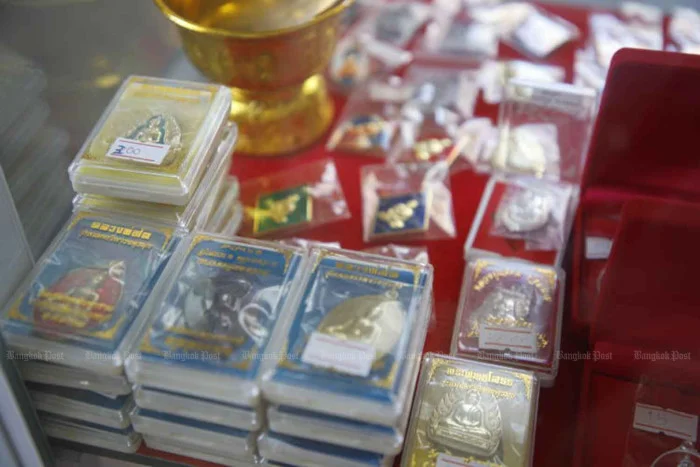
The Chinese visitors arrived with cameras, social-media teams and ambitious business plans. They travelled from temple to temple, rented display space, bought sacred objects and promised to introduce Thai spiritual products to millions of followers back home.
For many Thai amulet traders, the growing interest from China appeared to be a success story. Temples attracted more visitors, dealers found new customers and sacred objects once traded mainly among local collectors began reaching audiences across Asia.
But immigration police are warning that, in some cases, the booming trade may be attracting more than genuine collectors and believers.
Pol Maj Gen Choengron Rimpadee, deputy commissioner and spokesman of the Immigration Bureau, has urged traders, collectors and devotees to be cautious of becoming unwitting participants in money-laundering schemes linked to Chinese grey-capital networks.
The warning comes as authorities intensify scrutiny of foreign groups suspected of laundering proceeds from online gambling operations, call-centre scams and drug trafficking through businesses dealing in Thai amulets, talismans and other sacred objects.
The phenomenon is rooted in a genuine surge in demand.
Pol Maj Gen Choengron said many younger Chinese consumers face intense social and economic pressures, prompting some to seek spiritual support to improve their prospects in love, wealth and career advancement.
The trend has been amplified by Chinese celebrities, singers and social-media influencers who publicly endorse Thai amulets, takrut charms and kuman thong figures.
As interest spread across platforms such as Douyin and Taobao, demand for Thai spiritual products expanded into a sizeable cross-border business. Videos reviewing amulets, temple visits and blessing ceremonies have attracted millions of views, turning some sacred objects into highly sought-after commodities.
For legitimate traders, the trend represents a soft-power success story for Thailand. It has generated tourism income, increased exports and introduced elements of Thai culture and spirituality to a wider international audience.
Yet investigators believe the same market characteristics that attract collectors also make it attractive to criminals.
Unlike gold, shares or property, sacred objects often have no fixed market value. Prices are determined by rarity, reputation, history, craftsmanship and personal faith.
"That makes them difficult to value objectively," Pol Maj Gen Choengron said.
Investigators believe this creates several vulnerabilities.
The first is valuation. A charm worth only a few thousand baht can be marketed as a rare item worth hundreds of thousands or even millions.
The second is traceability. Transactions are frequently conducted in cash, cryptocurrency or informal payment systems that are difficult to monitor.
The third is price manipulation. Criminal networks can create stories around an item, stage auctions or use associates to artificially inflate its value.
The fourth is the use of front businesses. Amulet shops, rental centres and spiritual-product businesses can potentially serve as vehicles for moving funds and assets across borders while appearing legitimate.
Among the methods authorities are monitoring is the use of fake auctions. A low-value amulet may be presented as exceptionally rare, while members of the same network bid against one another until the price reaches several million baht.
"When the money is paid, and the object is transferred, the funds immediately appear as legitimate sales income, even though it is essentially money being moved from one side of the same network to the other," Pol Maj Gen Choengron said.
Another technique involves what investigators describe as a "temple leasing" model. Using Thai nominees, investors may secure commercial space at temples, particularly in provincial areas, before selling spiritual products or amulets to visiting tour groups at heavily inflated prices. Large cash revenues can then be presented as income from cultural tourism and religious commerce.
Authorities are also monitoring cryptocurrency transactions in which high-value amulets are exchanged through peer-to-peer transfers that bypass conventional banking channels.
Another method, known as the wash cut, involves using illicit money to purchase genuine, high-value amulets from respected dealers, who are allowed a 20% to 30% cut as a fee. Although the network takes an initial loss on the commission, the remaining proceeds can later be presented as legitimate trading income that is difficult to trace back to criminal activity.
The Immigration Bureau has also encountered cases involving foreign nationals suspected of conducting commercial livestreams at temples without proper authorisation. One example involved Chinese nationals livestreaming activities at Wat Phra Mahathat Woramahawihan in Nakhon Si Thammarat.
The bureau is working with the Anti-Money Laundering Office, the Central Investigation Bureau, cyber police, the Department of Business Development, the Revenue Department and Customs officials to tackle the problem.
Officials are increasing scrutiny of travellers entering Thailand for business purposes, particularly those attempting to operate without appropriate visas or work permits. He said immigration officers are also examining unusual travel patterns and business activities that may indicate links to grey-capital networks.
For legitimate traders, the advice is straightforward: verify customers' identities, conduct transactions through recognised banking channels, issue tax invoices, maintain complete documentation and avoid accepting large amounts of cash. Sellers are also urged not to hold assets on behalf of others or act as nominees in commercial transactions.
Thailand welcomes genuine tourists, investors and collectors, Pol Maj Gen Choengron said. What authorities will not tolerate is the use of one of the country's most cherished cultural traditions as a vehicle for organised crime.
"Amulets are part of Thailand's cultural heritage and faith," he said. "They should not become instruments for concealing criminal activity."
For many honest traders, that distinction is crucial. The majority of buyers are enthusiasts, collectors or believers seeking spiritual comfort. Yet as the market grows and more money flows through it, authorities believe vigilance is essential.
The challenge is to ensure that a trade built on faith, culture and tradition does not become a convenient hiding place for criminal proceeds. As Thai amulets gain popularity far beyond the country's borders, protecting the integrity of that market may prove just as important as promoting it.
Choengron: Genuine investors 'welcome'