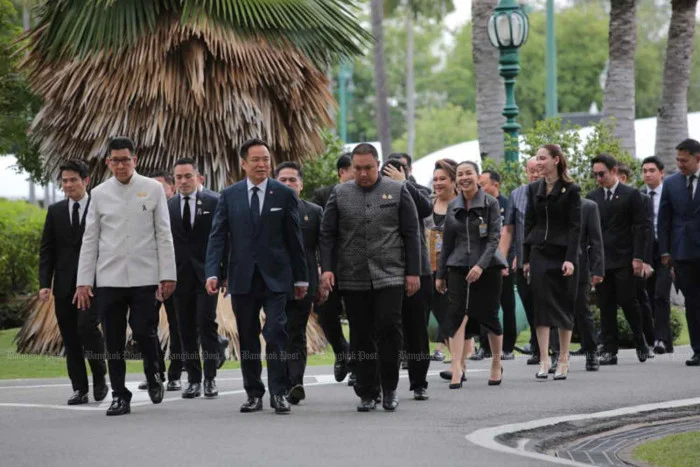
Three months after taking office, Prime Minister Anutin Charnvirakul's administration is facing a sceptical public rather than enjoying the customary honeymoon period afforded to new governments.
Instead of showcasing policy achievements, the government is grappling with multiple crises -- from economic hardship and bureaucratic inertia to high-profile corruption allegations -- that have eroded public confidence.
Political analysts said the difficulties stem not only from immediate policy shortcomings but also from long-standing structural weaknesses that successive governments have failed to address.
Yet they argue the Anutin government is now paying the political price for those accumulated problems while appearing unable to offer convincing solutions.
The administration has attempted to ease rising living costs through short-term stimulus measures such as the Thais Help Thais Plus programme.
However, critics say such initiatives provide only temporary relief while failing to address deeper economic challenges, including weak productivity, declining competitiveness and structural inequality.
According to analysts, the government's approach has been largely reactive rather than strategic. Cash injections may ease household burdens temporarily, but do little to improve long-term economic resilience or restore confidence among investors and consumers.
Bureaucratic dysfunction
Political scientist Olarn Thinbangtieo, deputy dean of the Faculty of Political Science and Law at Burapha University, said the administration's biggest obstacle lies within the state apparatus.
He described the situation as a political "ruptured abscess" -- a moment when years of institutional decay have become impossible to ignore.
Successive governments, he said, have relied on temporary fixes rather than comprehensive reforms, allowing structural weaknesses to deepen.
Mr Olarn said the bureaucracy was oversized, inefficient and resistant to change. Policies often lose momentum once they enter the administrative system, where excessive regulations and procedures slow implementation.
"The government's greatest strength is the unity among the political elite," he said. "But political unity has not translated into an ability to solve people's problems."
He said the cabinet had largely repeated previous governments' approaches while avoiding difficult structural reforms, contributing to a rapid decline in public satisfaction.
Deepening distrust
Analysts said the most damaging issue facing the government is the perception that systemic corruption remains unresolved.
They pointed to allegations surrounding a local government recruitment examination scandal as a key test of the administration's credibility. Critics question whether investigations will reach senior political figures or merely punish lower-ranking officials while leaving powerful networks untouched.
Mr Olarn said patronage systems within politics and the civil service have created incentives to protect vested interests rather than pursue genuine accountability.
Senior politicians and bureaucrats, he said, often depend on one another for political survival, making meaningful anti-corruption efforts difficult.
Political analyst Thanaporn Sriyakul, director of the Political and Public Policy Analysis Institute, said the government had lost its honeymoon period unusually quickly.
While new administrations often receive six months to a year before facing sustained criticism, the Anutin government encountered widespread scepticism within three months because expectations were high following its electoral victory.
Mr Thanaporn identified three major factors damaging the government's credibility.
The first is controversy surrounding major state projects such as the TH-AI Passport initiative, where public concerns have focused less on the technology itself than on procurement transparency and a lack of clear explanations.
The second is the local recruitment examination scandal, which many view as a test of whether investigations will reach senior figures. Failure to identify high-level responsibility could cause lasting political damage.
The third is what he described as the problem of "forgotten ministers" -- cabinet members appointed largely through political connections rather than expertise, many of whom have yet to demonstrate significant achievements.
Critics argue some ministers have relied more on social media publicity than substantive governance.
Mr Thanaporn also criticised the government's welfare policies, particularly eligibility criteria for the state welfare card.
He said efforts to exclude those who are not legally classified as poor may have resulted in some genuinely struggling households being left out.
Using vehicle ownership as a poverty measure, he argued, reflects a bureaucratic mindset that fails to understand rural livelihoods, where vehicles are often essential tools for earning income rather than signs of wealth.
He also accused ministers of distancing themselves from unpopular eligibility rules despite approving the policies collectively, showing a disconnect between policymakers and citizens.
Beyond welfare policy, Mr Thanaporn said several economic ministries have struggled to deliver tangible results.
Although the Commerce Ministry has communicated with the public, he said strategic issues such as agricultural market problems and free trade negotiations remain unresolved.
Similar concerns surround the Agriculture Ministry, where critics see limited policy direction while possible European Union scrutiny of Thailand's fisheries sector threatens additional risks for exporters and farmers.
Questions have also been raised over whether the government's diplomatic efforts have translated into concrete domestic benefits.
While overseas visits and agreements generate positive headlines, critics argue weak follow-up implementation has reinforced perceptions that foreign trips prioritise political optics over strategic gains.
Political reset
Both analysts said restoring public confidence requires more than improved communication.
They called for a cabinet reshuffle based on competence rather than political patronage, decisive action against corruption regardless of political affiliation, and meaningful civil service reform.
Mr Thanaporn said Mr Anutin must demonstrate political resolve by allowing corruption investigations, particularly the local recruitment examination case, to reach all responsible parties if warranted.
He also urged the prime minister to replace underperforming ministers with experienced professionals and ensure bureaucracies properly implement government policies.
Ultimately, the analysts argue that unless the administration tackles entrenched bureaucratic inefficiency and patronage networks, short-term stimulus programmes and public relations campaigns are unlikely to reverse its growing crisis of confidence.
Thanaporn: Policies fail to impress
Olarn: Decay can't be ignored