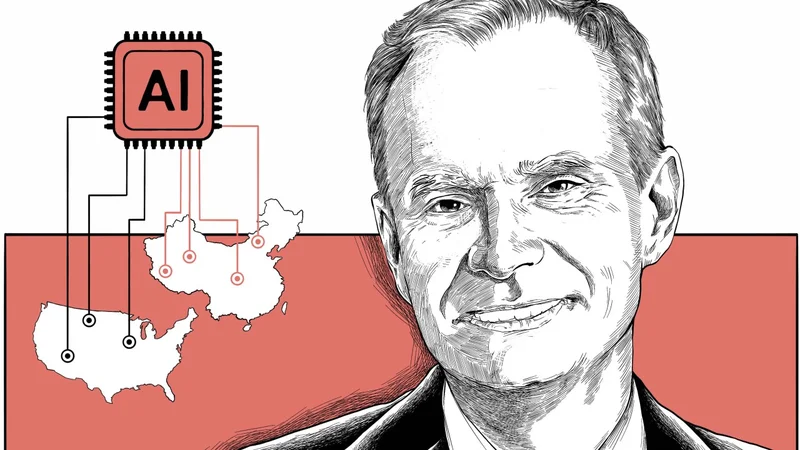
ExclusiveNobel laureate Simon Johnson on the AI race and China’s ‘over-automation’ problem
The Nobel Prize-winning economist discusses how AI is reshaping US-China competition – and poses unique challenges for both economies
Simon Johnson is a professor of entrepreneurship at the Massachusetts Institute of Technology (MIT). A former chief economist of the International Monetary Fund (IMF), he won a joint Nobel Prize for economics in 2024 for his research into how institutions shape national prosperity. On June 8, the British government announced Johnson as chair of its new AI Economics Institute.
In this interview, conducted on the sidelines of the UBS Asian Investment Conference in Hong Kong, Johnson discussed the rise of artificial intelligence, the future of US-China competition, and how the technology poses unique challenges to both economies.
This interview first appeared in
SCMP Plus
. For other interviews in the Open Questions series,
click here
.
As your research focuses on AI, how do you expect AI to change the job market globally? Will the impact be positive or negative for human workers?
It is obviously very early in the process, so we do not know for sure yet. But what seems to be likely, call that the default, is that AI will replace a lot of people who currently have relatively routine tasks in all businesses.
This is going to affect a lot of people in the middle of organisations, including white-collar workers at the beginning of their careers, or in information processing or compliance. These sorts of tasks are definitely in the line of fire.
For example, as long as people have money to invest, then you are going to need some people in any banking organisation to manage those relationships. But when it comes to making decisions about where to deploy the money and other processing functions – preparing statements, customer service and making adjustments to people’s accounts – a lot of that can already be handled by AI.