Commentary: Move in, give way - the everyday acts that shape a better Singapore
It is the small, repeated decisions people make in everyday situations that shape how we feel about the kind of society Singapore is becoming, say SUSS’ Victor Seah and Leslie Chew.
SINGAPORE: You’re on a crowded MRT train during the morning rush. The doors open and more passengers try to board. There is space further inside, but no one moves. You consider moving in but you are getting off in a few stations. What would you do?
This is a small decision made in seconds. But multiplied across millions of commuters, these add up to shape whether things work smoothly or become harder for everyone.
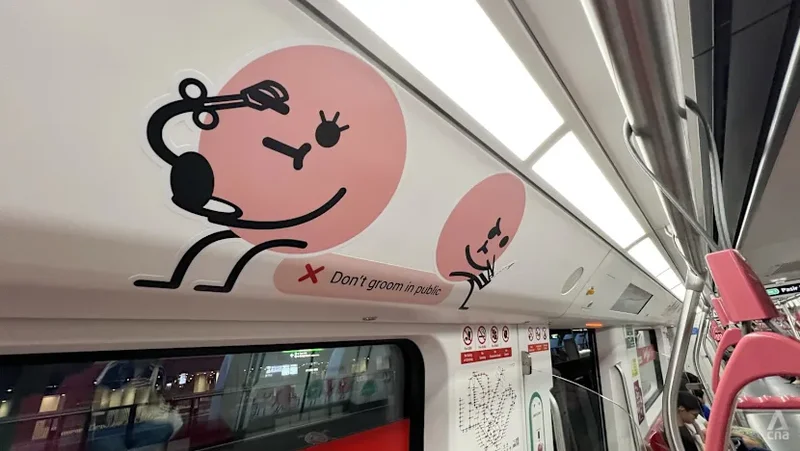
It is no surprise then the act of not giving way or moving in is one of the concerns flagged by commuters in the recent Public Transport Customer Satisfaction Survey. Other sources of frustrations include commuters playing music or videos aloud and an unwillingness to give up seats to those who need it more.
The same goes for those who have their own mode of transport. Remember the perennial debate about whether Singaporeans are impatient and inconsiderate drivers?
Our frustrations commuting, whether on public transport or in private vehicles, reflect the challenge behind Singapore’s push towards a “we first” society. This was raised by Prime Minister Lawrence Wong in his National Day Rally speech last year where he called for Singaporeans to look beyond individual interests and take shared responsibility for one another.
Whether we achieve that ideal depends less on grand gestures than the small, repeated decisions people make in everyday situations. Together, these shape how we feel about one another and the kind of society Singapore is becoming.
MAKING IT EASIER TO LOOK BEYOND INDIVIDUAL INTERESTS
A lack of contribution or consideration does not always reflect a lack of care. Even people who believe in the common good do not always act on it. In a dense, fast-moving city, it is easy to default to convenience, impatience and self-protection in the moment.
It sometimes happens because the first step is too vague, inconvenient or easy to postpone. For example, someone may intend to volunteer but never got around to it because signing up involves multiple steps, deciphering unclear instructions, or providing information they do not have in the moment. In this case, simple changes, such as one-click sign-ups, pre-filled forms and prompts about what help is needed, can make taking the first step easier.
There are already good examples around like the Singapore Civil Defence Force’s myResponder app which alerts volunteer first responders if they are within 400 metres of an emergency, ComChest’s Change for Charity which among other things allows you round up your transactions during checkout to donate, and the option for Singaporean households to donate Community Development Council (CDC) vouchers for a good cause.
We can also make it easier for people to see the benefits of prosocial actions. People are more likely to keep contributing when they can see what their efforts have achieved. Concrete and timely feedback in the form of “Your two hours supported 15 seniors.” and “Your team packed 300 meals”, will be more effective in making contribution feel worthwhile rather than symbolic.
We can also make it rewarding. The refundable 10-cent deposit from Singapore’s nascent beverage container return scheme can be viewed as a form of incentive. Similarly, the awarding of Healthy 365 Healthpoints for blood donation is a useful token of appreciation for lifesaving giving.
LEGAL FRAMEWORK FOR GOOD
There is a role for policies and laws too. People are more willing to do their part when they believe the broader system is fair, predictable and not easily exploited.
For one, while law cannot manufacture kindness, it can shape expectations, reduce uncertainty and create the conditions in which cooperation becomes more likely.
Singapore’s Good Samaritan Food Donation Act 2024 is one example. By limiting liability in defined situations, it makes food donation easier, supporting efforts to reduce waste and increase redistribution to those in need.
Relatedly, Singapore can consider going one step further by enacting laws to provide immunity to rescuers and volunteers from civil suits, as some other jurisdictions such as the Australian state of New South Wales have done. This topic was last raised in parliament in 2012 and the government noted there was no need for such a law.
When conflict occurs, legal processes such as mediation can help to support relationships and social stability, especially in neighbourhood disputes. Unlike adversarial litigation, mediation seeks to create space for dialogue and mutual problem-solving with the help of a neutral facilitator. In that sense, it supports not just private settlement, but the broader social fabric.
PEOPLE AROUND TAKE CUES FROM YOU
That said, Mr Wong noted that a “we first” society is not something the government can force or direct, and will be up to Singaporeans to decide.
Regardless of what makes the headlines, most Singaporeans would support efforts to strengthen our social fabric. Most will say that we value graciousness, neighbourliness and helping others. But if we think most people will not act that way, many of us will hesitate to do so ourselves.
This “me first” thinking is easy to see on our daily commute. When no one moves further into the train, others feel justified in staying put too. When tailgating, not signalling, or speeding up to block another vehicle start to feel normal on our roads, more drivers adapt in a race to the bottom.
But the reverse is also true – “we first” can be the social norm too.
We shouldn’t need National Day to remind us to be gracious and considerate but as we approach the day where national pride is donned in red and white and celebrated in big ways, let’s take the first small step to show care and concern for others.
You can set a norm by signalling early, giving way, lifting a hand in thanks, giving up your seat or moving in to allow others to board the train. You can help make consideration and graciousness contagious.
Victor Seah is Director of Behavioural Insights Centre of Excellence at the Singapore University of Social Sciences. Leslie Chew is Dean of the School of Law at the same university.