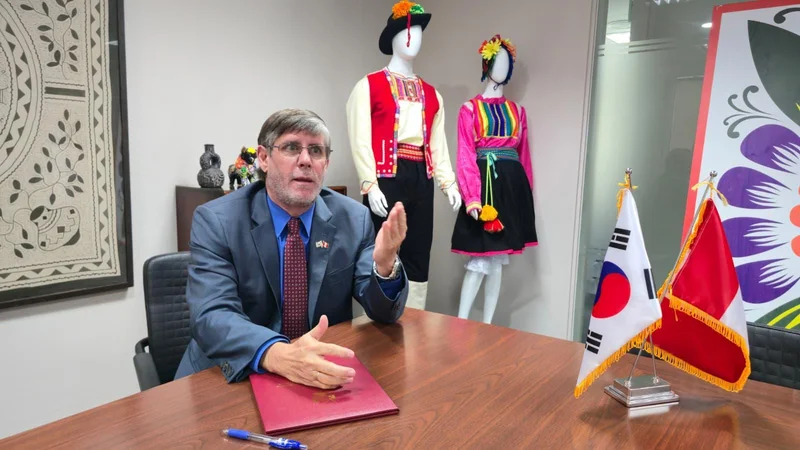
As Peru marks the 205th anniversary of its independence on July 28, the same day President-elect Keiko Fujimori is inaugurated — Peruvian Ambassador to Korea Paul Duclos said his country and Korea are entering a new phase of their 63-year partnership, with cooperation expanding beyond trade into critical minerals, defense, logistics, green energy, artificial intelligence, digital government and other strategic sectors.
In an interview with The Korea Times ahead of Peru's National Day, Duclos described Korea as one of Peru's key strategic partners in Asia and expressed confidence that bilateral ties will continue to deepen across both traditional industries and emerging areas.
"I consider that the commemoration of the 205th Anniversary of Peru's Independence is an occasion not only for celebration, but also for reflection on the progress we have achieved as a country in recent years and on the challenges we continue to face," Duclos said.
"On this very day, Peru's new president, Keiko Fujimori, will begin her term in office with the commitment to further strengthen a stable, open and globally engaged economy and legal stability for investments, building on Peru's strategic geographical position," he said.
He added that Peru looks forward to continuing progress on logistics infrastructure and public policy reforms tied to its aspiration to join the OECD, where the country counts on the valued support of Korea.
In addition to the 63 years of diplomatic relations, this year marks the inaugural celebration of Peruvian-Korean Friendship Day, which falls on April 1.
"This initiative reflects our shared commitment to further strengthening the bonds between our two peoples and our partnership founded on shared values, complementary economic ties and a positive bilateral agenda," he said.
**From FTA to strategic ties **
Looking back on more than six decades of diplomatic relations, Duclos identified the 2011 Korea-Peru Free Trade Agreement (FTA) and the establishment of a Comprehensive Strategic Partnership in 2012 as the two milestones that fundamentally reshaped bilateral cooperation.
The FTA has fueled rapid growth in trade, making Korea one of Peru's most important trading and investment partners in Asia. Bilateral trade reached approximately $2.5 billion in 2025, roughly six times the 2010 level.
"A second milestone was the establishment of a Comprehensive Strategic Partnership in 2012, which reflects the special nature of our relationship and encompasses a wide range of issues of mutual interest and the development of institutional mechanisms such as the Political Consultations and the Committee on Economic, Scientific and Technical Cooperation, which meet regularly to identify new opportunities and provide fresh momentum to our bilateral agenda," he explained.
The partnership gained additional momentum following the Korean president's official visit to Peru in 2024, when the two governments adopted a Joint Declaration outlining a roadmap for future cooperation.
Duclos said the declaration recognizes Peru as a reliable supplier of critical minerals including copper, zinc and molybdenum, while also emphasizing the country's efforts to expand production of lithium, uranium and rare minerals essential to the global energy transition.
He added that Peru is also increasing exports of fresh agricultural products, fisheries products and superfoods, contributing to Korea's food security.
Gateway to Latin America
Duclos said Peru offers Korean companies significant opportunities as one of Latin America's most stable economies.
"Overall, Peru is expected to remain one of the most stable economies in Latin America in the coming years, supported by strong macroeconomic fundamentals, low public debt, significant mineral exports and a great network of free trade partners," he said.
A key initiative is Peru's new Special Tax and Customs Regime for Private Special Economic Zones, introduced in May to promote logistics, industrial and technology hubs.
"It represents an important opportunity to diversify the Peruvian economy through greater value-added production, innovation and productivity, while attracting new and more sophisticated industries specially from Korea," he said.
Duclos said Peru's National Strategic Development Plan 2050 prioritizes green growth, renewable energy, the circular economy and sustainable infrastructure, with green hydrogen identified as one of the country's future growth engines.
He also stressed the $3.6 billion Port of Chancay, which is expected to become one of South America's leading logistics hubs linking the continent with Asia. According to Duclos, the port and surrounding industrial clusters will promote innovation, technology transfer, sustainability and deeper integration into global value chains, particularly spare parts for Korean military aircrafts, creating significant opportunities for Korean investors.
Defense has also emerged as one of the fastest-growing areas of bilateral cooperation.
"Our partnership includes, with great potential to grow, initiatives to modernize Peru's naval shipyard facilities in Callao, the co-production of naval vessels and armored vehicles, and Peru's integration into global defense manufacturing value chains," Duclos said.
He said the projects will strengthen Peru's defense capabilities while promoting technology transfer, industrial development and highly skilled employment.
Beyond Machu Picchu
While ancient citadel Machu Picchu remains Peru's best-known attraction among Korean travelers, Duclos encouraged visitors to explore the country's broader historical and cultural heritage.
"We are the cradle of civilization in the Americas, with the city of Caral dating back more than 5,000 years," he said, noting Peru's rich archaeological legacy, UNESCO World Heritage sites and living cultural traditions.
To attract more Korean tourists, Peru recently launched the Korea-exclusive #MyStoryPERU campaign featuring Korean influencers and artists. Duclos also noted that the two countries have maintained a visa exemption agreement since 1982 and that tourism has steadily recovered following the pandemic.
In addition, Duclos emphasized that exchanges between people remain central to the bilateral relationship.
"We want our Peruvian community in Korea — although relatively small, with around 2,000 residents — can perform as ambassadors of our country," he said.
The embassy also continues to promote cultural diplomacy through exhibitions, concerts, gastronomy events and film festivals. This year, as the country of origin of the potato, it celebrated International Potato Day in Goesan and plans to hold Alpaca Day in Gangwon Province, while Peru will showcase its culture during a monthlong program at the Yeosu World Island Expo.
Looking ahead, Duclos said maintaining the current momentum in bilateral relations remains one of his highest priorities. He identified green hydrogen, Antarctic cooperation, environmental protection, disaster risk management, U.N. peacekeeping and defense as promising areas for future collaboration.
"I firmly believe that Peru and Korea are an excellent example of how two countries separated by geographic distance and linguistic barriers, but united by solid common interests, can build a close and enduring partnership based on shared values, mutual trust and common interests," he said. "I would summarize our relationship as resilient and constantly evolving — one that will continue to grow and adapt to the opportunities and challenges of the future."