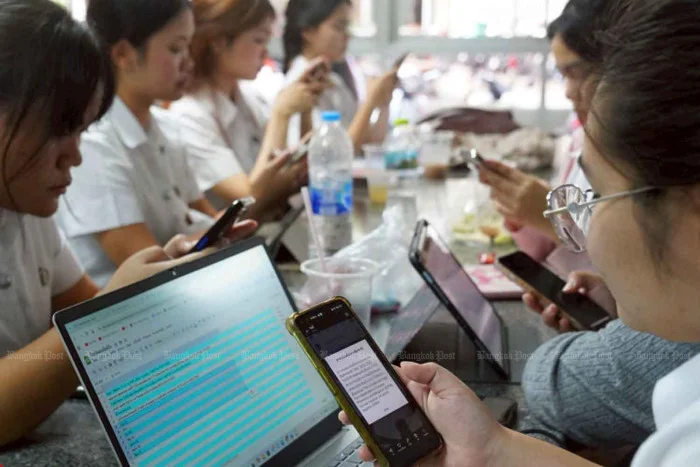
Concerns over children's mental health is renewing debate whether excessive use of mobile devices is harming academic performance and learning capability, while boosting social isolation and criminal behaviour influenced by online personalities.
Unicef says nearly half of young adults aged below 25 admitted participation in online gambling while another 33% are addicted to cyber gaming.
At the heart of the debate is a tug-of-war between schools and families over who should bear primary responsibility for regulating children's mobile device use and setting appropriate boundaries for the digital age.
Among schools in Bangkok, Lat Pla Khao Phitthayakhom School director Wilaiwan Anmak said only 10% of families have reported issues relevant to game addiction or spending too much time browsing on the phone.
"In these cases, teachers and parents work together to find solutions." She said parents feel that school authority has weight on students' obedient tendency.
From her observation and teachers' report, students interact normally with friends and participate in school activities. Schools have not observed widespread social isolation resulting from mobile phone use.
"During the pandemic, students needed smartphones or tablets for online learning. Once schools returned to normal, it became much harder to reverse that dependence because digital devices had already become part of education."
On school policy, the school allows students to carry their personal devices into school. Mobile phones are not permitted during lessons unless they are required for learning activities when teachers ask them to conduct research or complete classroom tasks.
"As we are a public school, with limited resources, we do not have facilities for students to leave mobile phones in their lockers or having teachers take responsibility for this matter."
Massive administrative burden will be lingered when devices are lost or damaged, it would create further complications.
Nevertheless, there have been occasions where students have argued on social media, leading to disagreements or challenges to meet in person to resolve conflicts. However, the school monitors these situations closely.
"We have students who help monitor online issues and alert teachers if problems arise. Teachers then intervene promptly through discussion and mediation. As a result, we have not experienced incidents that escalated into serious violence because of social media."
The Thai Health Promotion Foundation says 98.2% of Thai children are screen addicts. She noted that the widespread use of smart devices is somehow inseparable from youth these days. Measures must be aligned to the growth of technology.
Students are encouraged to use AI, while teachers are trained to use AI in teaching and learning. "We see AI and technology as a new remedy providing treatments to education issues. Many teachers now use AI to reduce preparation time and improve classroom efficiency".
While the social media ban among youth is expanding worldwide, Thailand should carefully study both the benefits and the risks before making policy decisions. Unlike drugs or vapers problems, parents are particularly important because they provide the devices for their children.
"Students use social media without sufficient digital awareness, problems can arise. Adults need to guide them, teach them how to distinguish reliable information from misinformation, and help them understand how to use digital media safely."
Jananan Kindergarten director and licensee Janana Srivardhana says the school has long prioritised emotional development in early childhood.
As part of the admissions process, parents are required to disclose their children's screen time habits. However, she notes that children's behaviour often reveals whether parents have been entirely truthful in the school's admission survey.
"Children whose parents spend quality time talking, reading and interacting with them generally demonstrate different behaviours from those who receive less direct engagement."
She said children raised mainly by nannies sometimes receive less verbal interaction and developmental stimulation.
Others may have spent long periods lying in a cot with little meaningful engagement. These differences often become apparent when they arrive at school.
Similarly, children raised primarily by grandparents may display different behavioural patterns, including being more accustomed to having their own way.
"There is substantial research linking excessive screen time to emotional regulation problems, increased aggression, reduced patience and more self-centred behaviour. These are issues we take very seriously."
While the school has long prioritised limiting children's screen time, the Covid-19 pandemic disrupted principles that had been upheld since its establishment.
"Our founder believed children should grow up without unnecessary exposure to screens. Parents even offered to donate televisions to the school, but we simply believed children did not need them."
The transition in the post-pandemic period was challenging as the school worked to restore children's behavioural patterns to its educational framework. It was during this period that the school introduced interactive boards for the oldest kindergarten students, helping them prepare for the transition to primary school.
"The interactive board is not used for passive learning. Children are not simply watching videos, listening to music or browsing YouTube. Teachers carefully select or create education content that encourages interaction, participation, confidence-building and self-expression. Technology can certainly be beneficial, but only when it is used appropriately for the child's developmental stage."
Following the post-pandemic transition, the school returned to its original policy by banning mobile phones and encouraging families to limit children's screen time at home.
"We explain that our educational approach depends on consistency between home and school. If children experience one set of expectations at school and another at home, they become confused and find it difficult to develop self-discipline. We therefore encourage parents to work with us so that children receive the same guidance in both environments."
Wilaiwan: 'Students monitor issues'
Janana: 'Tech can be beneficial'