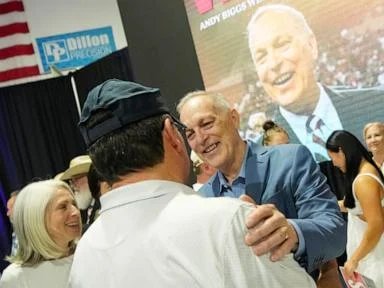
PHOENIX -- U.S. Rep. Andy Biggs, a fierce ally of President Donald Trump and former head of the House Freedom Caucus, won the Republican nomination for Arizona governor Tuesday.
Biggs overwhelmingly defeated fellow U.S. Rep. David Schweikert in the primary and will face Democratic Gov. Katie Hobbs in what could be one of the closest governor races in November.
By choosing Biggs, who supported Trump's failed attempt to block certification of his 2020 election loss, Republican voters risk nominating another conservative warrior who excites the party base but fails to win a general election by turning off independents. Although Republicans once dominated Arizona, Democrats now hold both U.S. Senate seats and the top three state offices.
Schweikert argued during the campaign that Biggs would continue a decade of Republican backsliding. However he struggled to raise money and did not even return to Arizona for Election Day, remaining in Washington as the House passed a government funding bill.
Biggs, who had Trump's endorsement and support from the grassroots organization Turning Point Action, said he can unite Republicans going into the general election.
“Everyone I have talked to is really conservative around here,” said Ray Roberts, a 33-year-old Republican who works as a processing engineer and knocked on doors for Biggs. “We all have mostly conservative values. I think Arizona is a red state. I think Andy will be the winner in November.”
Meanwhile both parties had hotly contested primaries to replace Schweikert in the highly competitive 1st Congressional District. Trump-backed Jay Feely won for the Republicans.
On the Democratic side, emergency physician Amish Shah faced off with Marlene Galán-Woods, a former television news anchor who used to be a Republican. She was backed by the Democratic Congressional Campaign Committee.
Linda Bandler, a 65-year-old independent who volunteered on the Galán-Woods campaign, said the party will be in good shape regardless of who wins the primary.
“There still is some sanity,” said Bandler, who like Galán-Woods is a former Republican. “I do think that the Democrats will take over the House and the Senate.”
Alexander Kolodin, a state lawmaker and lawyer who wants vast changes to Arizona election law, won the Republican nomination for secretary of state. Republicans were also picking a nominee for attorney general.
Biggs built a national profile as chair of the House Freedom Caucus from 2019 to 2022 and as a staunch defender of Trump. He assisted the president’s attempt to block the certification of his loss in the 2020 election, voting against accepting Electoral College votes from Arizona and other battleground states after the Jan. 6, 2021, riot.
He has always represented safe Republican seats and is a veteran of factional brawls within the GOP. Before going to Congress, he nearly lost his post as state Senate president during a confrontation with then-Gov. Jan Brewer, also a Republican, over her push to expand Medicaid.
“I want the border secured. I want the police and more money spent in the right places like education,” said Kate Rouleau, a 67-year-old Republican who voted for Biggs. “Biggs has the same quality as President Trump.”
Schweikert walked a tightrope with Trump, carefully keeping his distance without antagonizing him. That helped him win a string of tough races in a competitive House district but left him isolated from Trump's “ Make America Great Again ” base.
Democrats focused their attacks on Biggs, whom they plan to portray as an extremist focused on helping Trump and not Arizonans.
In a statement Tuesday night, Hobbs said: “The more Arizonans learn about Biggs, the more they’ll realize he’s one big problem they can’t afford.”
Schweikert’s 1st District is a top battleground in the fight for a congressional majority. Anchored in Scottsdale, it is home to many of the white, highly educated and affluent voters who have soured on the GOP under Trump.
Feely, a former Arizona Cardinals kicker, won Tuesday's GOP primary over Joseph Chaplik, a former state legislator popular with many of the GOP’s grassroots activists, and businessperson John Trobough.
Feely had Trump’s endorsement but has been dogged by criticism for living outside the district.
The Democratic Congressional Campaign Committee controversially threw its support behind Galán-Woods. Her late husband, Grant Woods, was the Republican attorney general in the 1990s and later became a vocal Trump critic.
Galán-Woods’ chief opponent, Shah, is also a former state legislator who was the nominee in 2024 but lost narrowly to Schweikert.
Republicans hold a voter registration advantage in the affluent district, which includes northeast Phoenix, Scottsdale, Fountain Hills and Paradise Valley.
But it started to trend toward the center after Trump’s 2016 victory. Redistricting accelerated the trend, fueling Democratic hopes that the seat could be flipped.
In Tucson, retired Marine drill instructor JoAnna Mendoza ran unopposed for the Democratic nomination to challenge second-term Republican Rep. Juan Ciscomani, who also had no primary opponent. The seat is perennially competitive in general elections and is a top pickup target for Democrats in November.
Meanwhile, Pinal County Sheriff Mark Lamb won the GOP primary for the safe Republican seat Biggs is vacating. The race turned salacious as Lamb, who was endorsed by Trump, came under scrutiny for alleged sexual misconduct and abuse of power.
The county attorney cleared him of criminal wrongdoing, and Trump reiterated his endorsement this month. Lamb dismissed the allegations as “slander and lies.”
___
Associated Press writer Josh Kelety contributed.
___
This story has been updated to correct the spelling of Feely.