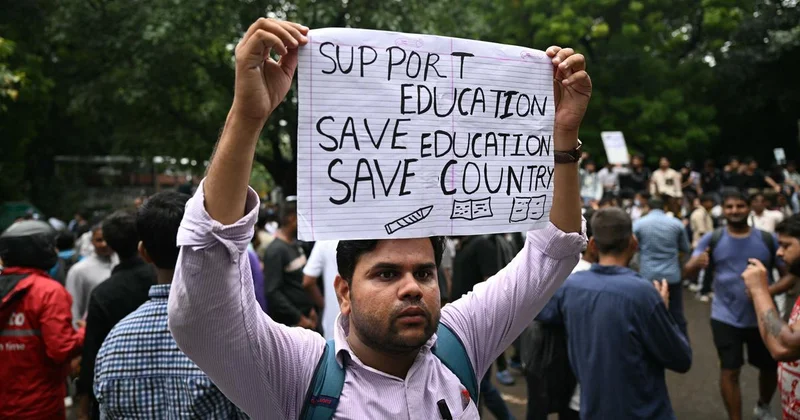
A stark and urgent crisis has been unfolding in Indian society over the years. The dream of education as a guaranteed path to upward mobility has been crumbling. The “GenZ” protests we are witnessing in India today has brought the crisis into sharp relief but millions of families have long been suffering its consequences. Some of the aspects of the problem are still not fully acknowledged in public discourse.
For generations, Indian families have treated education as the surest ticket to upward mobility. Even the poor scraped together whatever they could, sometimes at devastating personal cost, in the belief that a degree would lift their children, and therefore the family, into the economic stability and respectability of the middle class.
Education was an investment strategy, a form of social insurance and a retirement plan for parents who sacrificed everything for their children’s success.
However, recent trends indicate that the privatisation of education, rising costs of coaching and a shrinking job market have disrupted this conventional wisdom.
The gamble
Acquiring education has always been a powerplay. In post-colonial India, it also became a psychological anchor for families in an economy with no safety nets. Education promised not just employment but also dignity to the poor and a shield against social humiliation for the sections forced at the bottom of the society due to caste prejudice and discrimination.
Even parents who could barely afford three nutritious meals a day poured everything into tuition fees, coaching classes and other expenses related to preparing for entrance exams.
In the Indian public sphere, to question this logic remains unthinkable even today. Those who top various exams are celebrated and to reject the underlying injustice could amount to abandoning hope itself.
But a cruel realisation has been setting in for some time. In the last decade, the betting on education is yielding losses for families. Degrees no longer guarantee jobs. Not just blue-collar wages but even middle-class wages are stagnant. Most highly educated youth are stuck in underpaid and insecure employment, if not unemployed. Families who went into debt to finance higher education are now staring at financial ruin.
How did this happen? The destruction of public education has been underway for quite some time in India. Over the decades, the state has systematically withdrawn funding from public schools and universities, forcing students into an expensive and exploitative private education market.
Schemes such as the Right to Education have funnelled students from government schools to private institutions, fattening the private sector while public schools collapse from neglect, defunding and now rampant closures.
Simultaneously, the job market has been crushed under the weight of privatisation, labour informality and a ruthless proliferation – even valourisation – of the gig economy. Beyond financialisation, the Indian economy is now largely structured around precarious, low-wage work, where degrees are often meaningless.
Desperation economy
Defying all formal (but discredited) logic of rational markets, a massive parasitic industry has flourished in this new landscape, namely, the coaching-private knowledge industry. Coaching centres, some of which are openly exploitative, others predatory in their false promises, feed off parental desperation.
The costs are astronomical, but families, trapped in the psychology of “one last attempt” to keep spending. They go into debt for exams their children may never clear and degrees that lead nowhere.
Families once believed that even if they had nothing else – no land, no wealth, no connections – their children’s education would be their safety net. Instead of stability, many educated youth are unemployed or earn so little that they cannot support themselves, let alone their families.
The burden of intergenerational support, once expected to flow from educated children to parents, no longer holds.
The full weight of disappointment for the Gen X and late millennials is sinking in. They are taking care of their aged parents but despair at seeing their children flounder economically, socially, and emotionally.
Policy gaslighting
From the gaslighting about affirmative action in education using identity-based notions of merit, the coaching industry has shifted the goalpost further. We find ourselves now in an education model where success is contingent on financial investment rather than merit, bringing back the additional barrier of class with a vengeance.
Competitive exams themselves have proliferated with the policy shift in which newly established organisations such as National Testing Agency have dragged into the coaching industry even those students and families who aspire for medical and engineering seats.
This nexus of testing policy and coaching industry is reshaping student aspirations, leading to psychological distress and financial burdens on families. The industry’s growth has been undercutting formal schooling even for middle class children. This will further undermine even educational institutions run by non-government entities, such as minorities, charitable organisations and educational societies.
Top industrialists and CEOs have gone viral for suggesting untenable work hours, at the same time gaslighting jobseekers by repeatedly suggesting that their education and job preparedness is deficient. If such claims were true, where are the private-sector jobs languishing unfilled due to a lack of qualified personnel?
Earlier this year, young factory workers in the National Capital Region protested inhuman work conditions and below subsistence wages. There is little debate in the public sphere about consistent and rampant wage theft in India, which has made life unsustainable for the majority of Indians – leave alone education.
What is the future?
India must have the difficult conversation about whether higher education leads to better employment outcomes, given that wage stagnation and job insecurity persist even among highly educated professionals.
The issue is not only about delays and leaks in competitive examinations. India needs to prioritise heavy public investment in school education, followed by correcting the lopsided diversion of public funds in engineering and management schools considered elite within the public higher educational institutions.
We must sound alarm also at the unfettered growth of the private higher education bubble being facilitated through policy acrobatics.
Following this trajectory, we have reached a point where families buried in debt are having to question themselves about whether they can keep their children in school and if they should send them to a university. They are haunted by an ever-widening chasm between the rich, who can afford elite education, and everyone else, who are left with nothing but unfulfilled promises.
But even the elite are now haunted by a system degraded to an extent that they can no longer rely upon it to protect their social and economic standing. It was about time that someone sounded the alarm.
The cruel truth is that in today’s India, spending on education has become an unreliable investment. Most young people are set up to fail by the Indian examination system. But today, even if they succeed, investing in costly degrees by taking on crippling debt without job prospects is financial self-sabotage.
Until public education is revived and secure employment is restored as a viable reality, parents need to realise that investing heavily in coaching for BTech, MBBS, or even degrees like LLB and MBA is a high-risk gamble.
As a society, we need to understand that the stranglehold of gig work will only increase if labour protections and social security cover is not expanded, and if parents are forced to depend solely on their children for post-retirement survival.
They must demand affordable public education at school and higher levels, instead of joining the coaching bandwagon.
Pushing for systemic change is not utopian thinking. Rather than adapting to this broken system, we must demand accessible public education and secure employment. If we do not sound the alarm now, we are heading towards creating an entire lost generation.
We already have a large permanent underclass of underemployed and underpaid citizens.
Ghazala Jamil is an Assistant Professor at the Centre for the Study of Law and Governance, Jawaharlal Nehru University. She is the author most recently of What to Do with Political Sadness: And other Essays on Death, Destruction and Hauntology (Simon and Schuster India).
We welcome your comments at letters@scroll.in.