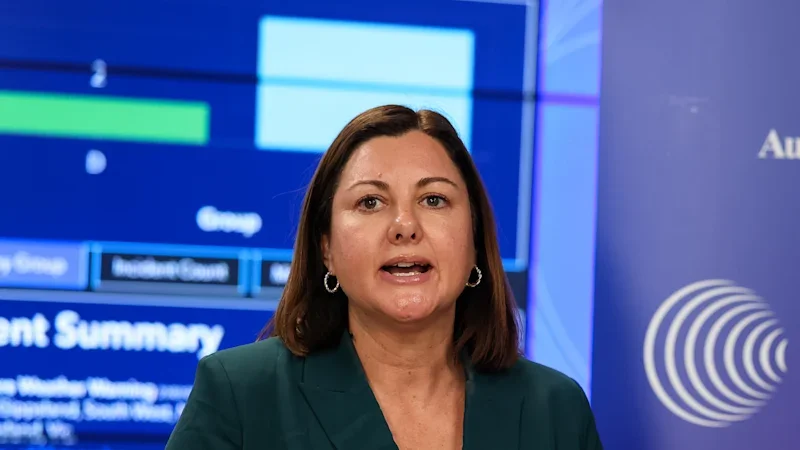
The national emergency alert test on Monday afternoon has been declared a success by the Albanese government even as it says it will take time to figure out how many phones received the message as it investigates reports many missed out.
Emergency Management Minister Kristy McBain said the test message was broadcast from 94 per cent of mobile phone towers across the country, exceeding its target to broadcast from at least 90 per cent of towers.
But the minister said it would take time to collate the results of how many phones were reached by the test of the new national warning system AusAlert after people reported on social media that their phone did not sound with the alert or received no message.
A test message was sent to millions of phones on Monday afternoon at 2pm, which read: “This is a TEST alert of AusAlert, Australia’s new emergency warning system. NO ACTION IS REQUIRED.”
The government is working with telcos to create an estimate of how many phones were reached by the test.
“We’ve been tracking public responses from the national situation room, and reports are that text messages reached high numbers of mobile devices around the country,” McBain said on Monday afternoon, shortly after the test.
“Obviously, we’re only an hour after this test, so [the National Emergency Management Agency] will continue to analyse the technical and performance data.”
No data is collected by the government or telecommunications companies when the emergency alert is sent. However, the number of phones reached by the test will be calculated with records from phone companies of how many compatible phones were in range of the 94 per cent of the nation’s mobile towers.
Opposition emergency management spokesperson David Littleproud backed the rollout of AusAlert and said it was important the government acted on testing results.
“I wouldn’t label [the test] a complete success and I wouldn’t expect that,” he said.
Littleproud criticised the government taking four years to start testing AusAlert since the royal commission into the 2019-20 bushfires issued its recommendations.
“The fact that it’s taken the Albanese government four years to get it together probably is the more concerning aspect to it,” he said.
AusAlert is compatible with most Android devices running version 12 or newer and many models manufactured after 2019. It also works with iPhone 11 or newer. Older devices that have installed software updates may be able to receive messages.
The new national warning system uses the same broadcast technology that operates in more than 30 countries.
AusAlert uses cell broadcast technology, not the SMS relied on by states to issue warnings. Cell broadcast sends messages from selected mobile phone towers to every compatible device within the towers’ range.
By selecting which towers transmit, the message can be targeted to people who need to see it, often down to a street-by-street level of accuracy.
The 6 per cent of mobile towers that did not broadcast were offline due to maintenance or upgrades.
McBain said people should not be concerned if they did not receive an alert.
“This could be because you are not in a coverage area [or] your software was not up to date or your device was incompatible,” the minister said.
The new national alert system will be used to issue a wide range of warnings, including for natural disasters, threats to public safety such as shooting incidents, as well as health and biosecurity threats like a disease outbreak.
There are two levels of alert. The “critical” warning for imminent threat to life, such as when a cyclone is about to hit, sounds an alarm and triggers a message on a phone’s home screen. These warnings are compulsory and cannot be turned off.
“Priority” alerts are issued when there is not an immediate threat to life but when people are advised to follow instructions before an approaching emergency, like a bushfire designated at the “watch and act” level. Phones can be set to opt out of priority alerts.
McBain said the government would “never want to dilute the effectiveness” of AusAlert and it would only be used for emergencies, not for other notifications like health reminders or tax returns.
There is no plan to immediately replace state-run warning systems, which use SMS technology, including for natural disasters, which will continue to operate in tandem with AusAlert over the high-risk summer period.
“This is another tool in the tool bag of emergency service organisations, and we are really excited that we now have this in Australia so that people will be able to receive this alert, along with their emergency broadcasts from radio, from television, along with the advice from local emergency service agencies,” McBain said.