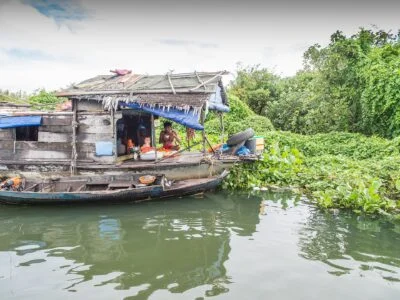
This post is part of Global Voices’ July 2026 Spotlight series, “Statelessness.” This series offers insight into the issue of statelessness and how it hinders people’s freedom of movement, educational opportunities, political access, and more. You can support this coverage by donating here.
Thousands of ethnic Vietnamese living in Cambodia continue to face discrimination, and many are considered stateless for lacking documents to prove their citizenship. Stateless individuals can face barriers accessing state services, medical care, education, marriage, and are unable to travel, among other issues.
A 2019 government census recorded 78,090 people whose mother tongue was Vietnamese. The Ministry of Interior said there were 180,690 “Vietnamese nationals” residing in Cambodia. But civil society groups estimate that around 400,000 to 700,000 compose the ethnic Vietnamese population in the country. The United Nations High Commissioner for Refugees cited a government report that listed 75,000 stateless individuals, the majority of whom have ethnic Vietnamese roots.
Vietnam and Cambodia are two neighboring states in Southeast Asia with a long and complicated history. Colonial occupations, the Cold War, and internal conflicts have caused mass evacuations and border porosity between the two countries. During the rule of the Khmer Rouge from 1975 to 1979, the Vietnamese population was attacked and forced to escape Cambodia. This was followed by Vietnam’s occupation of Cambodia for a decade, which stirred strong anti-Vietnamese sentiment in Cambodian society. Many politicians consider the ethnic Vietnamese “illegal immigrants.”
In a report by Women Peace Makers and Nationality For All released in June 2024, it identified the hurdles faced by ethnic Vietnamese in securing citizenship in Cambodia.
The group most struggling to prove their belonging are Cambodia’s long-term residents of Vietnamese descent — especially those residing in Cambodia for generations and prior to the creation of the modern Vietnamese state — many of whom are stateless or at risk of statelessness, having neither proof of Cambodian nor Vietnamese nationality.
It added that ethnic Vietnamese lack effective access to birth and other civil registration, they encounter legal barriers because of changing government policies on naturalization, and they face continuing prejudice in society.
In an article published in 2020, LiCAS.news featured several individuals highlighting the precarious situation of stateless ethnic Vietnamese in Cambodia. Anh Nguyen, who was born in Cambodia, shared the discrimination directed towards him and those with ethnic Vietnamese roots.
I would really like to have Cambodian citizenship. It would make life easier, I could go anywhere without problems, but they won’t give it to me. Now I need to pay to make sure me and my family can stay here.
When we speak Khmer they offend us and call us ‘yuon’ [a derogatory term referring to Vietnamese]. It makes me angry, but I can’t do anything about it. And you know what? Sometimes they say that we came to take their land. But how can we do that? We don’t have anything here.
LiCAS.news also interviewed Giang Duong, who narrated the difficulties she encountered in getting a Cambodian passport.
I was born in Cambodia and I have Cambodian citizenship, but because my parents were Vietnamese it’s really difficult for me to get a Cambodian passport. They tell me I should first speak proper Khmer because I have a Vietnamese accent. I’m not happy about this. I should get the passport, because I have all the required documents.
In 2024, Mai Nguyen did her internship for the Regent University Center for Global Justice by immersing herself in ethnic Vietnamese communities in Cambodia. She quoted an elderly lady who expressed her dream of a better future for her family.
We want education for our children. We are old now. We can die stateless and uneducated, but the kids have their whole lives ahead. Next is a safe and stable place to live. Even birds have nests, yet I cannot provide my children a place to call home!
Fr Tran Dinh Thuc, a former refugee, spent time in Cambodia this year and urged authorities to recognize those of Vietnamese descent as their citizens as well.
The vast majority of stateless people in Cambodia are of Vietnamese descent, numbering approximately 77,000. They are neither Vietnamese nor Cambodian. They cannot read Vietnamese and do not know Khmer. They are denied all civil rights and live in extreme poverty. Many reside on Tonle Sap Lake, south of Siem Reap.
My sole hope is that the Cambodian government will change its policy and grant citizenship to these 77,000 stateless individuals. By so doing, these people can participate freely in society and fulfil their duties and responsibility for the country.
Sovinda Po, a visiting Fellow in the Vietnam Studies Program at Singapore’s ISEAS – Yusof Ishak Institute, wrote that a step forward is to promote inclusion and understanding in order to address the anti-Vietnamese bias in Cambodia.
Moving forward, effectively addressing anti-Vietnamese sentiments in Cambodia demands a nuanced, multifaceted approach that goes beyond short-term political actions. It requires fostering a narrative of genuine inclusion and shared future aspirations, one that promotes mutual respect, empathy, and understanding.