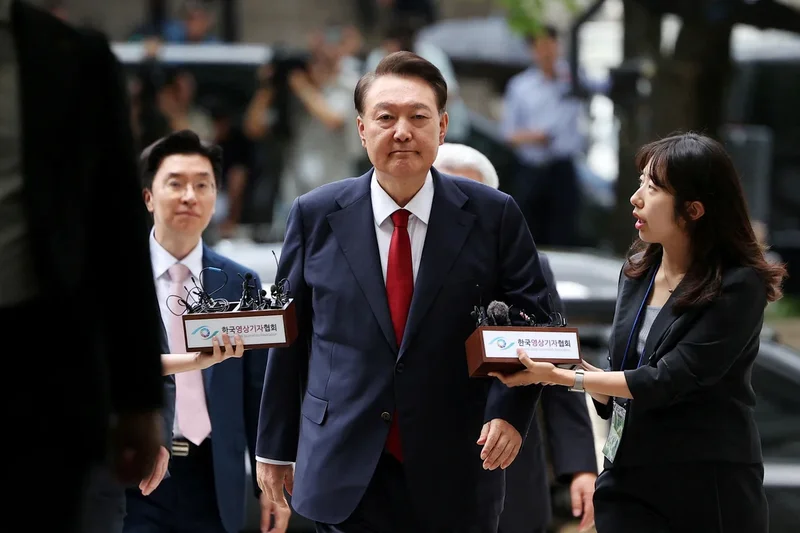
Former South Korean President Yoon Suk Yeol has been convicted of making false statements during his presidential campaign, a verdict that could financially cripple his conservative People Power Party.
This ruling marks the latest development since his removal from office last year over a brief imposition of martial law.
Mr. Yoon denies the charges, and his lawyers intend to appeal, arguing the judgment misinterprets facts and election law.
If upheld by higher courts, the judgment would force the People Power Party to return approximately 40 billion won ($27 million) in election expenses.
These funds were reimbursed by the government after Mr. Yoon’s narrow 2022 victory against current liberal President Lee Jae Myung.
South Korean law dictates that the government reimburses election expenses for candidates securing over 15 per cent of votes.
However, these funds must be repaid if the candidate is convicted of an election law violation punishable by a fine of 1 million won ($680) or heavier penalties.
The Seoul Central District Court sentenced Yoon to 18 months in prison, suspended for three years, saying his false statements during the campaign may have affected voters’ “fair judgment” of the candidates.
Yoon quietly listened as the chief judge read the verdict and did not comment after the verdict. The People Power Party did not immediately comment on the ruling.
The court ruled that Yoon lied during a January 2022 interview in which he downplayed his relationship with a fortune teller. That man was later convicted of acting as an intermediary between Yoon’s wife, Kim Keon Hee, and the Unification Church, which allegedly bribed her in exchange for political favors.
The court also ruled that Yoon falsely denied at a December 2021 news conference that, while serving as a state prosecutor in 2012, he had introduced a defense attorney to a former Seoul tax official under investigation on bribery allegations.
The case was one of seven ongoing criminal trials facing Yoon, who remains in custody.
He was removed from office in April 2025, months after he issued his brief martial law decree in December 2024, which triggered the country’s biggest political crisis in decades.
Yoon has appealed some convictions, including for rebellion, the most serious charge stemming from his botched power grab. He was sentenced to life in prison in that case in February.
The Supreme Court earlier this month upheld a seven-year prison sentence against Yoon for sidestepping a legitimate Cabinet deliberation before declaring martial law and resisting law enforcement attempts to arrest him, in his first case to be finalized by the country’s highest court.
Yoon’s surprise late-night martial law declaration on Dec. 3, 2024, lasted only a few hours, after lawmakers broke through a blockade of heavily armed soldiers and police at Seoul’s National Assembly and voted to repeal the measure, forcing Yoon’s Cabinet to lift it.