'Can’t turn every school into a garrison': SM Shanmugam on balancing security, free movement after school attack plots
The coordinating minister for national security also said that the government is studying the best way to protect youths on social media amid the recent detentions under the Internal Security Act.
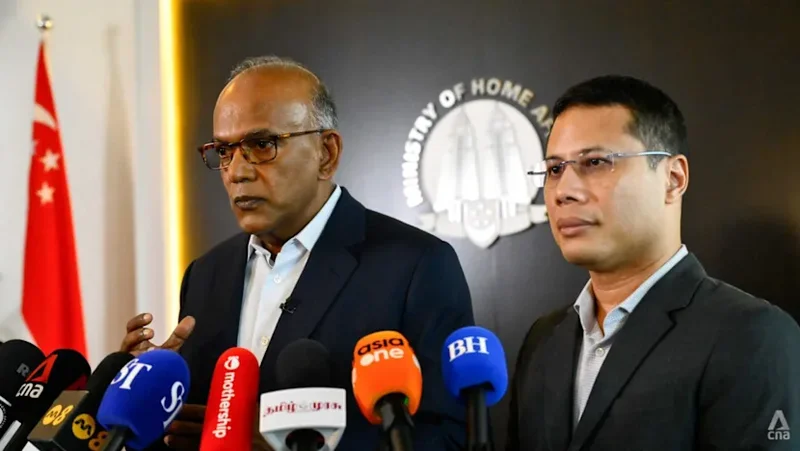
SINGAPORE: Schools cannot be turned into “garrisons” as there is a need to balance security and free movement on campuses, said Senior Minister K Shanmugam on Monday (Jul 27) after three teenagers were detained under the Internal Security Act (ISA).
Of the three students, two had planned attacks at schools. One of them, a 14-year-old, had drafted a 21-page manifesto detailing the attack.
When asked if security measures at schools will be stepped up, Mr Shanmugam said: “Schools are open spaces.
“You can't turn every school into a garrison or a cantonment, then it won't feel like a school. I've made the point about public buildings too in the past.
“In Singapore, if you want the majority of people to feel comfortable, confident, you have to have a balance between security and also free movement. People want to live without having to go through a whole series of restrictions.”
Mr Shanmugam, who is also coordinating minister for national security and home affairs minister, said that along with the efforts from the authorities, there has to be a vigilant society that looks out for each other and for things that are not quite right.
“At the same time, we have to accept that there is only so much you can do in terms of physical security. On top of that, of course, within schools and within other places, you train people to be alert and understand security,” he added.
The 14-year-old boy was detained just weeks before he had planned to carry out the attack on his school. The Ministry of Home Affairs described it as a “close shave” after someone from his school noticed the signs of radicalisation and alerted the authorities.
Education Minister Desmond Lee said on Monday that it is an instinct for people to tighten up when such events happen.
“Let’s put perimeter fences, let's do 100 per cent checks, let's go around and check every bag, have metal detectors and so on – that cannot be the main kind of approach that we take when it comes to this,” he said.
Mr Lee said there are already multiple layers of vigilance, training and contingency planning in place in schools, along with security measures such as closed-circuit cameras, security staff in schools and institutes of higher learning (IHLs) and selective bag checks when necessary.
“But schools are places where people learn. They spark the joy of learning. They are places where people must feel comfortable learning,” said the education minister.
He added that not every IHL is a gated and closed community, with campuses that are open and free for people to come and go.
“So we want to make sure that we strike the right balance and put in place the right measures through getting people more aware of what they need to look out for, and strengthening this overall community of vigilance,” said Mr Lee.
SOCIAL MEDIA BAN?
Several radicalised youths in recent cases had viewed harmful content on social media.
In the latest case involving the 14-year-old boy, he had “avidly consumed” violent gore and mass shooting content that he encountered on social media, based on algorithmic recommendations as well as on online channels that were linked to the True Crime Community.
In response to a CNA question on whether a social media ban will solve the issue of youths encountering extremist content online through their algorithms, Mr Shanmugam noted the experience of other countries.
“A number of approaches have been tried in other countries. Social media bans have been imposed in Australia, the UK has discussed it, France’s parliament has looked at it, with varying degrees of effectiveness,” he said.
He added that the Ministry of Digital Development and Information (MDDI) has been speaking publicly about what can be done to protect young people, not just from extremist online content, but also the harmful effects of social media on their development.
How to best deal with the issue, including whether a ban is the best approach, is a matter that MDDI is looking at, he said.
“But harmful extremist content, when we come across it, we block it. But as I said, in today's world, it's not possible to block everything,” said Mr Shanmugam, adding that one of the youths had been radicalised through online gaming platform Roblox.
MALAY-MUSLIM COMMUNITY
Mr Shanmugam also addressed the impact of the latest detentions on the Malay-Muslim community in Singapore, calling for people not to form divisions based on the actions of a few radicalised individuals.
“Since the 9/11 attacks in 2001 – 25 years, quarter of a century – that sort of thing has happened in some countries abroad, where the Muslim population is looked at with suspicion and fear. Has it made them safer? Has it made them a better place?” he asked.
He said that for the past 25 years, Singapore’s mantra has been that those who want to cause harm are “a very small extremist minority”.
“The majority are law-abiding Singaporeans. They are the same as us, and you don't draw artificial lines. The moment you draw these lines, that's when it becomes self-fulfilling,” said Mr Shanmugam.
“We have been working very hard to build the bonds between the communities, make sure our Malay-Muslim Singaporeans feel the same as everybody else in every aspect of society and life, and for Singaporeans of all races and religions – Chinese, Indians, others – to recognise that we are all one, and we are one together in this.”
Mr Shanmugam warned that if Singaporeans take the path of “looking at somebody else with suspicion based on skin colour or religion or race, we are asking for trouble”.
He said that Singaporeans should make sure not to “let a few radicalised individuals poison the whole atmosphere”, adding that all other Singaporeans should continue adopting a broader perspective and make sure that Malay-Muslim Singaporeans feel a part of the community.