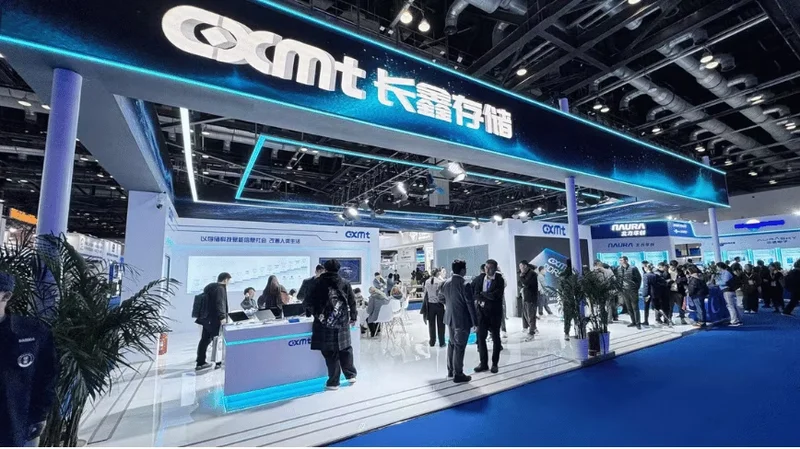
China has a new most valuable listed company, and it makes the chips inside your phone. CXMT, formerly ChangXin Memory Technologies, closed its Shanghai debut up 466% on Monday, the South China Morning Post reported. That values the Hefei firm at 3.28 trillion yuan, or about $485bn.
The numbers are hard to overstate. CXMT priced its IPO at 8.66 yuan a share, opened at 49.50 and touched 55.03 during the session. It raised 57.92 billion yuan, about $8.6bn, rising to $9.8bn if the overallotment is exercised. That is Asia’s biggest listing this year, and the second largest in Chinese history behind Agricultural Bank of China in 2010.
Turnover topped 140 billion yuan. No mainland-listed stock had ever crossed 100 billion in a single day. CXMT alone accounted for nearly 7% of all trading on China’s onshore market, Bloomberg reported.
It now outranks Industrial and Commercial Bank of China, worth 2.6 trillion yuan. A ten-year-old memory maker is worth more than the country’s biggest bank. Only Hong Kong-traded Tencent is larger.
Why memory, why now
CXMT makes DRAM, the working memory in phones, PCs and AI servers. That market has been squeezed brutally by the AI buildout, and the shortage has reached consumers. Roku just raised prices by up to 60%. Google confirmed the Pixel 11 will cost more as RAM costs surged sixfold.
CXMT is the domestic answer Beijing has been waiting for. It held 7.67% of the global DRAM market in 2025. That trails Samsung, SK Hynix and Micron, which together make about 90% of world supply.
But the trajectory is steep. First-quarter operating profit hit 35.43 billion yuan, against a 2.83 billion yuan loss a year earlier. Apple has begun testing its chips for devices sold in China.
“I have no doubt the company is going to grow to be a global leader,” Theodore Shou of Yiyi Capital told CNBC. “It can be a global champion in this particular sector.”
Ten times SpaceX
The pop is not purely a verdict on the business. Only about 7% of CXMT’s shares could be traded on day one, Hargreaves Lansdown’s Anna Macdonald told the BBC. Scarce supply met extraordinary appetite. The retail tranche was 212 times oversubscribed, Business Insider reported.
Individuals submitted 9.4 million orders worth 7.07 trillion yuan, roughly ten times the order book of SpaceX’s record listing.
Huge first-day pops are also normal in China. Semight Instruments soared 876% in April. MetaX rose 693% in December, Moore Threads 425%. “Given how scarce pure-play memory names are in the A-share market, I wouldn’t rule out a period of speculative frenzy in the first few trading days,” said Ao Fei of Beijing Xinhan Capital.
Regulators were nervous enough to act. Beijing’s securities watchdog met listed companies, brokers and fund managers this month, fearing the listing would drain money from other Chinese tech stocks. That fear did not bite on day one. The Shanghai Composite rose 1.2%, the Associated Press reported, on a day when oil fell sharply and world shares gained.
116 yuan, or 15?
Analysts are split, and not by a little. Nomura began coverage with a buy rating and a 116 yuan target. CXMT can rally 1,239% from its IPO price as it wins market share, the broker argued. It expects the firm’s slice of global DRAM output to climb from about 10% now to 18% by the end of 2028.
Morningstar puts fair value at 14.90 yuan, less than a third of Monday’s close. Analyst Jing Jie Yu set out why in a note reported by Bloomberg. CXMT has no access to extreme ultraviolet lithography. Conventional DRAM advancement will therefore get harder, he wrote, and the valuation gap will not close until the firm clears that constraint.
Shou was blunt about the cycle too. Investors are already selling into the IPO, he said, and today’s margins “are not sustainable and have to normalize over a cycle”. The market, he added, sits right at the peak of a supply-and-demand imbalance.
Two things can be true. CXMT’s technology still trails the leaders, and its valuation reflects a thin float and a national mood as much as its order book. It is also far smaller than SK Hynix, worth $881bn, or Micron, worth about $1tn.
Yet the direction is unmistakable. Earlier this month SK Hynix raised $26.5bn in New York. China has now answered with a memory champion of its own, and rivals Yangtze Memory and Baidu’s chip unit are queued up behind it.
The chips that make AI possible are now the most valuable thing either country can build.
Get the TNW newsletter
Get the most important tech news in your inbox each week.