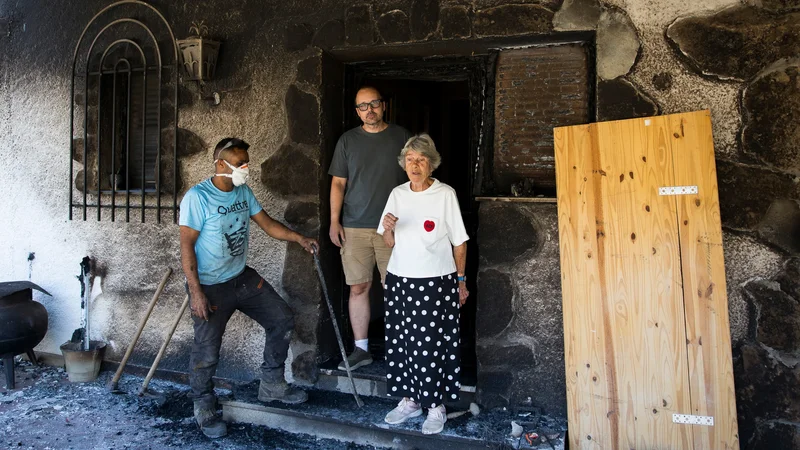
It was a beautiful stone house by a lake that the whole family loved. They spent the best summers of their lives there. The plants and trees were tended by each and every one of them as if they were tending a botanical garden. Their evacuated neighbors who returned to the area first them sent them photos of the damage, but it wasn’t until they saw it with their own eyes that they realized the extent of the tragedy.
The largest fire in Spain’s history since records began has affected 77,000 hectares of land and has forced around 100,000 people to either confine or evacuate. The smoke is visible from the Meteosat satellite. The flames have destroyed mountains, campsites, restaurants and bars, cars and houses. Those who have been able to return, even if only for a few minutes, have seen for themselves what the fire has stolen from them.
Beatriz Seijas arrived with her son-in-law and Karim, the maintenance worker at the Calas de Burguillo housing estate, located in the province of Ávila (west of Madrid) where 50,000 hectares of land have been devastated by the flames. What confronted them brought Seijas close to tears. The garden no longer exists. The porch has been reduced to ashes. Not even the metal remains of the garden tools as the high temperatures melted everything, even the floor tiles. Soot coats the stone walls of the house. The main door held, but the flames slipped in through a side window and burned a beam, which collapsed.
The hedges have burned down and only the trunk of the cypress tree remain. “The gardening work of a lifetime destroyed,” says Miguel Serrano, the husband of one of Seijas’ daughters. It was also the family’s home during winter weekends, a piece of “paradise”, something of “incalculable” value. “It’s been very hard for all of us,” he adds. The house overlooks the impressive Iruelas valley, right now in flames. Serrano remembers enjoying the view. No one knows what it will look like once the flames have finished with it.
The devastation has swept through Ávila, passed through Toledo and leapt to the Madrid region. In that triangle of three provinces, the fire has been on a steady advance. Diego Grande Zamarano, 53, has the appearance of a simple man; leathery skin and stubble. He works on a construction site, but he also takes care of just over half a hectare in Navaluenga that he inherited from his father, a retired goat herder. The fire has taken almost everything from him. “The land had a lot of sentimental value. I can’t put a price on this,” explains Grande, who is currently sleeping in a sports center that the Madrid regional government has made available to the displaced.
Grande did not have the land insured, so he can’t say what will happen next. He worked in the countryside for the love of it. He did not want to be a goat herder himself because it is a job that takes up 365 days a year. “Anyone can take care of a cow. It is easy to feed it and milk it, but a goat is something else,” he explains. So he ended up laying bricks instead, a job that allows him to sleep at night. But that does not mean that his true vocation is not in the mountains. He says he is actually a man of the streams and forests. For someone like that, what is happening is “terrible and devastating.” His voice breaks when he starts to think about how long it will take for things to look the way they used to.
If anyone understands this, it is Antonio Luis Rodríguez Zarzalejo, also a farm worker. His specialty is cleaning fincas, rural estates with a cottage attached. His own house in San Martín de Valdeiglesias has been spared. On July 23 he tried to return to it after work, but law enforcement officers stopped him. He asked to be allowed through to evacuate his dog Kiara, but was told it was too dangerous. A brother-in-law who has been confined in San Martín goes to Antonio’s house every day and gives water and food to the dog, and checks that nothing has happened to the house. Rodríguez fears he could be robbed, but he leaves it in the hands of God.
In winter, Rodríguez put some sheep in the land around his house so that they would eat the grass and prevent it from feeding wildfires. That worked for him. But another rural property he owns in the area of Pelayos de la Presa, one of the places hardest hit by fire, is another story. There, on two thousand-odd square meters of land, he has an orchard, some olive trees and a small vineyard. It’s not much, he says, but it might as well be the 500 hectares that Brad Pitt and Angelina Jolie had in California, given the way he feels about it. As a divorced father, this is the month he has to spend with his 13-year-old son. Since they have not been able to return home, they wear clothes that have been lent to them. Rodríguez wants the road to San Martín to reopen now so that he can go home, put the dog in the car and take a look at the orchard. It will be hard to see it, but at least, he says, he will have his son by his side.
To date, more than 40 houses are known to have been destroyed in the Madrid region; around 300 have been damaged. The first place the fire went out control was in El Encinar del Alberche, a housing estate in Villa del Prado. People there were evacuated on July 23 but were allowed to return two days later. On July 25 they had to leave again. In between, they were able to walk through their streets and see the devastated homes, charred cars, gardens lost forever. “I will never forget how it hit me when I returned,” says Emilia López. Her home had no significant damage because the swimming pool, at the front of the property, acted as a firebreak. The courtyard, however, has been destroyed. The feeling that something has been taken from her is hard to shake. The fire has stolen something from them all.