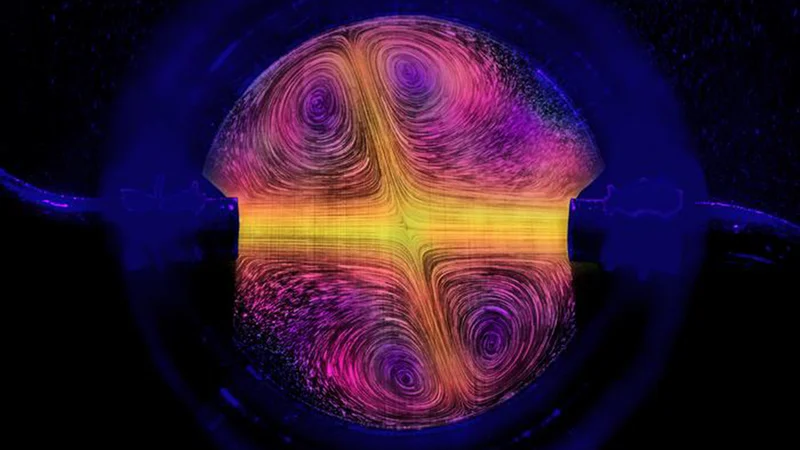
Richard Feynman was a serious physicist who loved to answer unserious questions. Can math tell you how to order the optimal lunch? Can a human track scents like a bloodhound can by smelling his own footprints? Now, researchers have picked up one of Feynman's most curious unanswered questions by looking at the physics of "silly" sprinklers.
A typical lawn sprinkler with an S-shaped nozzle spins in a given direction as it spews water from its two openings. But if you throw that sprinkler into a swimming pool and hook it up to a vacuum so it sucks water in instead of spraying it out, which way will it spin — the same direction as before, or the opposite?
Feynman __posed that question __as a Princeton graduate student in the 1940s. According to Feynman's telling, he rigged a glass sprinkler in his university's lab. It gave a brief "tremor," then barely moved even as he raised the pressure. He repeated the process until the glass shattered, leaving the answer ambiguous. Since then, decades of follow-up experiments have turned up every possible answer — the sprinkler spinning one way, spinning the other way, jittering back and forth, or not moving at all — depending on how carefully the tests were built.
In 2024, a team at New York University led by applied mathematician and experimental physicist Leif Ristroph took a first crack at the question, finding that the __reverse sprinkler rotates __opposite to a forward sprinkler. But that explanation was tested only on ordinary S-shaped sprinklers, and it hadn't yet been pitted directly against two other leading theories.
One, which traces back to Austrian physicist Ernst Mach, holds that the total angular momentum of the swirling water inside the sprinkler's arms must be balanced by an opposite spin of the sprinkler itself. The other, associated with Feynman himself, focuses on pressure and suction effects right at the outer nozzles.
So Ristroph's team asked, what if the sprinkler weren't shaped like a sprinkler at all? What if its arms spiraled, bent the wrong way or curled back on themselves?
In a new study published July 13 in the journal PNASs, the researchers built seven deliberately "silly" sprinklers with unusual arm geometries to pit the leading theories against each other. That includes one sprinkler with arms that spiraled several times to maximize the water's angular momentum, and another with a counter-bend at the nozzle.
Get the world’s most fascinating discoveries delivered straight to your inbox.
In the process, they tore down both ideas. If Mach were right, the spiral design should have spun dramatically differently. If Feynman were right, reversing the nozzle bend should have flipped the sprinkler's direction. Neither happened.
"We were forced to say, 'Feynman and followers, you guys are off,'" Ristroph told Live Science.
The spiral-armed sprinkler, meant to test Mach's theory, was just as unyielding. Even though the fluid inside carried substantially more angular momentum, "the solid barely cared," Ristroph said.
All three measurements across the seven designs pointed instead to the sprinkler's central hub, where the arms meet. There, incoming water collides and swirls, generating a flux of angular momentum inside the device that the solid structure pushes back against. The finding suggests that the reverse sprinkler is not much more than an inside-out version of a forward sprinkler governed by the same physics playing out at the opposite ends of the arms.
Related stories
- Physicist Richard Feynman's forgotten notes on 'the restaurant problem' finally deciphered after 50 years
- Science history: Richard Feynman gives a fun little lecture — and dreams up an entirely new field of physics — Dec. 29, 1959
- Physicists push quantum boundaries by turning a superfluid into a supersolid — and back — for the first time
Ristroph emphasized that this result was made possible because of Jesse Smith, who just completed his physics doctorate at NYU while working on the project, along with a small team of Ristroph’s own students, and Ristroph's longtime collaborator Brennan Sprinkle, a computational fluid dynamics expert at the Colorado School of Mines whose surname is a coincidence.
Now, the team is building computer simulations to test whether the momentum-flux model holds up beyond the flow conditions already studied, and they hope to eventually derive it from fundamental fluid dynamics equations.
Ristroph said this "silly" problem does have real-world applications: Understanding how curved channels convert fluid flow into rotational force could inform the design of turbines and other devices that harvest energy from wind and water currents.
"If we can do something that would help with engineers designing devices to better make use of all the huge amounts of wind and water energy we have all around us," he said, "that would be, of course, a fantastic thing."
Smith, J.E., Zuo, M., Kuhlke, W., Sprinkle, B., & Ristroph, L. (2026). Geometry controls momentum flux in the sprinkler problem. Proceedings of the National Academy of Sciences, 123. https://doi.org/10.1073/pnas.2537479123
Larissa G. Capella is a science writer based in Washington state. She obtained a B.S. in physics and a B.A. in English creative writing in 2024, which enabled her to pursue a career that integrates both disciplines. She reports mainly on environmental, Earth and physical sciences, but is always willing to write about any science that sparks her curiosity. Her work has appeared in Eos, Science News, Space.com, among others.