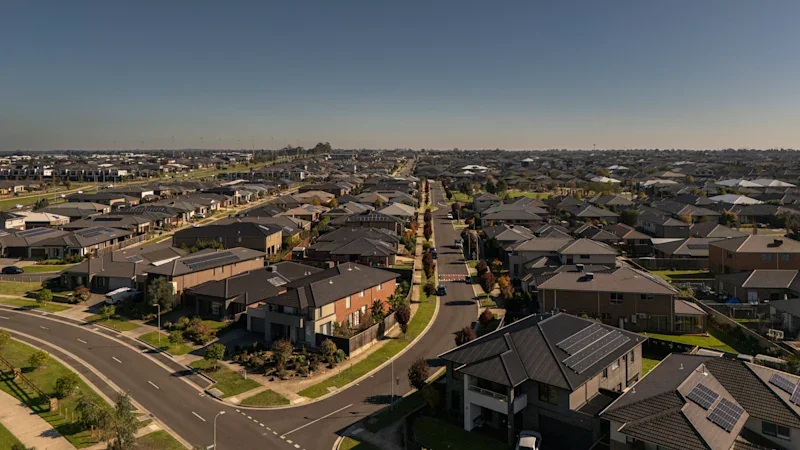
The nation’s sprawling suburbs of single-storey homes would be transformed under a plan from the Productivity Commission to make the property market affordable, with three-storey developments allowed everywhere and high-rise apartment blocks built near train, tram and bus stations.
Declaring state and local government planning regulations a key reason for Australia having some of the most expensive homes in the world, the commission also wants the minimum size of home lots to be reduced while allowing more European-style mixed commercial and residential developments.
Commission chair Danielle Wood said regulation was the handbrake on new homes, with the time needed to save for a deposit climbing by almost 30 per cent over the past 20 years.
“When people can’t live near work or family the economy and the community suffers. We cannot solve our housing affordability problem unless we build more homes where people want to live,” she said.
The commission has been charged by Treasurer Jim Chalmers to examine the nation’s building approval process, land use, access to infrastructure and construction methods.
The government, which in the budget committed $2 billion towards states and councils for housing-related infrastructure, is more than 100,000 properties behind its own target of building 1.25 million homes between mid-2024 and mid-2029.
Despite a slowdown in the nation’s property market since February, house prices are still at record levels of unaffordability. Median house prices in some cities are still climbing, with Perth up 87 per cent since 2020 and in Brisbane up by 92 per cent.
In its interim report, the commission said state and territory governments should allow three-storey developments on all residential land, with exceptions only for environmental factors, particular hazards or heritage listings where benefits of protection outweighed the costs.
State and council planning schemes would allow four- to nine-storey and high-rise apartments in high-demand areas with existing transport infrastructure, or where it could be quickly upgraded.
Minimum lot sizes on new developments should be cut, especially in designated high-demand areas. Commercial zones that effectively prohibit residential development should also be overhauled to enable mixed-use areas.
Commissioner Alison Roberts said there were far too many regulations that had driven up the cost of building or reduced supply.
“Regulation is essential – particularly where it ensures buildings are safe and built to a high standard. But too often, other rules are making it illegal or unviable to build the kinds of homes people need in the places they want to live,” she said.
“The kind of rules that stop you adding a granny flat in your garden or replacing a single home with townhouses are at the core of our housing challenge.”
The commission said the surge in the cost of housing had led to an almost 18-percentage-point drop in the number of people between 25 and 34 with their own home between 1981 and 2021. Australian mortgage debt is among the highest per person in the developed world.
In a bid to reduce construction costs, the commission recommends car parking requirements be reduced or axed completely, especially in areas where there is evidence that off-street parking is not being used or there are high levels of public transport.
Broad heritage listings would be replaced by more specific protections that had gone through a cost-benefit analysis. Instead of blanket heritage protections, specific buildings or small areas would attract heritage listings, with more options to delist buildings.
A constant complaint from the housing sector is the imposition of developer contributions for new projects. The Urban Development Institute of Australia estimates developer fees can make up to 20 per cent of the cost of bringing a new lot to market.
The commission found developer contributions should be used where there is a “close nexus” to the proposed development and local infrastructure needs.
Estimates of developer fees should be made before the release or rezoning of land, with proponents given the option to make the payments over a period of time or later in the development process.
Under the commission’s proposals, current restrictions in areas such as minimum dwelling and balcony sizes and storage requirements for apartments would be axed. Current dwelling and bedroom size requirements differ between states and territories.
The commission said “state, territory and local governments should avoid regulating observable characteristics that do not negatively affect the wider community”.
Restrictions on housing types would also be ditched.
Another area targeted by the commission is the time many authorities take to approve new housing.
Wood said in one case, a developer spent an extra three years on reports and waiting for approvals for a 1600-lot development on Melbourne’s urban fringe.
The commission’s final report is due by March next year.