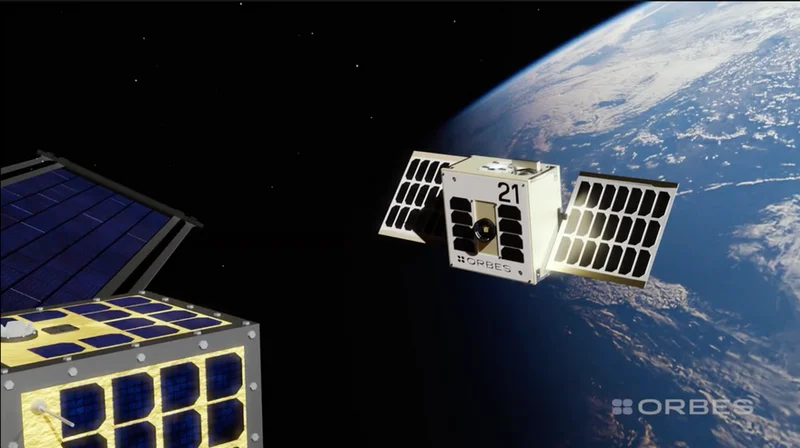
SAN FRANCISCO – Southern California startup Orbes announced an agreement July 27 to send Exo-ORB, a free-flying satellite, to gather imagery of an uncrewed Symphony Space station.
Exo-ORB, which is roughly the size of a 12-unit cubesat, will launch alongside Prelude, Symphony Space’s demonstration mission, in late 2027 or early 2028. Once in orbit, Exo-ORB will move 10 to 20 meters from Symphony Space’s station to capture and downlink imagery, Orbes CEO Anna Shaposhnik told SpaceNews.
To prevent collisions, Exo-ORB will be equipped with cold gas thrusters, iodine thrusters and reaction wheels. “We have the [guidance, navigation and control] GNC in place to keep it safe,” Shaposhnik said.
Orbes also is preparing to send ORB, a free-flying robot, to the International Space Station in early 2027.
“ORB is a robot built with astronaut input,” Shaposhnik said in early July on LinkedIn. “One that is approachable, modular, and first and foremost safe. With quick acceleration at low speeds to swiftly complete tasks.”
Orbital drones
Orbes was founded in 2024 in Arcadia by Shaposhnik, former Orbit Fab marketing manager and University of Southern California Rocket Propulsion Laboratory machinist, multimedia design lead and mechanical engineer, to develop robots to inspect and maintain space stations, orbital data centers, space solar power installations and other large structures.
Adarsh Rajguru, Orbes senior GNC engineer, previously worked at NASA’s Jet Propulsion Laboratory. Chief technology officer Paul (who declined to provide his last name) is an electrical engineer and machinist with cybersecurity expertise.
Initially, Exo-ORB will gather “stunning visual imagery and provide inspection,” Shaposhnik said. Future ORBs and Exo-ORBs will be equipped with robotic arms to perform maintenance tasks and passive sensors for environmental monitoring.
Adagio
Arlington, Virginia-based Symphony Space, established in 2025, signed a letter of intent to launch Exo_ORB aboard Prelude and Adagio, a full-scale uncrewed station scheduled to launch in 2029.
“We built Adagio to make space missions simpler, more cost-effective and faster to deploy,” Symphony Space CEO Merry Walker, said in a statement. “Capturing images and video of the work performed will not only support maintenance but beautifully translates what’s happening in orbit back to people on Earth.”