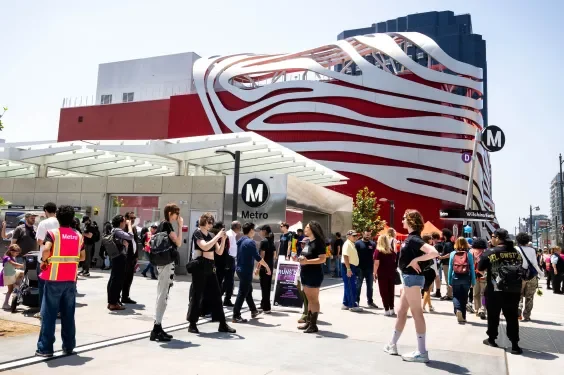
This is not, really, a blog about trains. A blog about trains in Los Angeles, and my experience with them across 10 days, would ultimately be very short: Despite its notorious gaps in coverage, L.A. Metro was perfectly functional. If there were any calendar window during which it would be easy, relatively speaking, to visit Los Angeles without a car, it would be during the World Cup, with swarms of European tourists purportedly accustomed to better things.
Some of the World Cup's influence was directly in L.A. Metro's hands: Subways still bore advertisements for the D Line Extension which opened on May 8, connecting the Miracle Mile and a large stretch of museums to the rest of the network. Getting to Inglewood had never been easier. A noticeable population of Metro workers wearing high-visibility vests answered questions at stations, particularly on World Cup match days. An equally noticeable population of Metro police gathered in packs ranging from two to six. Other impacts were more abstract, but no less important: There were simply more people riding the subway.
There are very few ways that combining 10-minute frequencies with a $1.75 fare can go wrong. Ten minutes is just fine enough to never have to check schedules or run for a train or even fret overly much about delays or cancellations. Pair that with two lines running along the same stretch, particularly through the more trafficked areas of Downtown Los Angeles (DTLA)—most importantly, for me, to and from Union Station—and that wait time effectively halves. $1.75 a ride is, as a friend of mine declared, "basically free," though she is from Munich, which is comfortably the most expensive transit city I've ever visited. Factor in free transfers within two hours, a $5.00 daily cap and an $18.00 weekly cap, and taking the Metro is really, truly, basically free.
As for the special quirks of the Metro system, I liked that the A Line is so absurdly long, though I never took the opportunity to ride it beyond downtown because it is so absurdly long. (One of the great casualties of Metro coverage and speed was visiting The Huntington in San Marino, northeast of L.A. proper, as the 40-minute A ride from a downtown station only gets you within two miles of your destination. In retrospect, a 1.5-hour trip could have been workable; it was just insulting that it would only take 25 minutes total by car.) I also enjoyed being funneled around to only one or two exits, so it was impossible to really get lost, even if you tried. Because Metro trains cap out at four cars, you never have to walk very far, even if you are at the wrong end.
In some cities, or even countries, it would be enough to talk, only, about the trains. If a city is a living entity, then in those particular ones, the trains form a network so vast and interconnected that you can treat it as a system in isolation: circulatory (how one flows through the city), skeletal (what holds up the city's form), whichever. If a city is a living entity, then Los Angeles is a sprawling and unwieldy one; even a decently comprehensive Metro resembles scattered bones than anything more complete. To take the train, you must get to the train first. In that instance, you have to worry about everything else: the viscera and gummy tendons that you ordinarily chew and spit out.
Perhaps this could be a blog about buses. My first transit ride in Los Angeles was to get from LAX—which is not directly connected to any Metro line, though there is a shuttle and a future(ish) people mover—to my friend's hotel in DTLA. The FlyAway bus from LAX to Union Station previewed my overall experience: better than I'd expected, easy, spiritually frightening, and fundamentally influenced by cars.
The FlyAway is a service run by LAX, not by the L.A. Metro authority. The buses resemble intercity buses, with a large storage compartment for luggage underneath and much more comfortable seats than a city bus. The FlyAway has served nine different destinations in its lifespan, though it currently only serves two, Van Nuys and Union Station. Two of the other locations, Hollywood and Long Beach, were, like many other transit routes, hit hard by COVID-19, and shuttered in March 2020.
Taking transit in Los Angeles will make you wonder how much, in U.S. dollars and portions of your soul, you value your time. The FlyAway to and from Union Station, which theoretically takes 40 minutes and runs every 30 minutes, costs $12.75. A Metro ride from Union Station to 7th Street/Metro Center, an 11-minute, two-mile ride, costs $1.75. Combined, the journey can take anywhere from an hour to an hour and a half, and the transfer involves a little bit of geographic backtracking, but overall, it is extremely simple. Meanwhile, a rideshare from the airport directly to the hotel would cost comfortably more than $50 and take anywhere from 30 minutes to an hour. Is 30 minutes of my time and a small chunk of my soul worth $35? As I was on vacation and in no particular rush, the answer was, always, a resounding no.
My timing was fortunate. I came into the stop, which was decently signposted, only a few minutes before the bus arrived. My single, small suitcase was placed in the compartment. The bus stopped at each terminal, before wandering onto the Los Angeles highways. Because of its luggage compartment and the stairs leading up to the seating, the FlyAway is a tall bus. On the ramp, the view from the window—of guard rails built for cars, which would be entirely inadequate to keep a large bus from tipping over the side and then down into the traffic below—freaked me out so suddenly and comprehensively that I could not look outside again until we were safely at grade. I am told I think about the horror of what the future could portend more often than most people.
The fundamental issue with any bus, unless it is fully grade-separated, is that a bus is still subject to the same traffic woes as a car. In my case, traffic was a kind devil. We arrived at Union Station, one of the most beautiful train stations in the country, 15 minutes before the bus's scheduled arrival time, and from there it was an easy transfer onto either the B or D line. I can't remember which one I took, but it didn't take long to arrive at my stop. I was helpfully funneled by Metro signage to one of two exits, and had a nicely confusing moment of not realizing I did not need to tap to be let out. (On my last full day in Los Angeles, we ran into a British man who was experiencing the exact same confusion. "In London," he said, which was all the explanation we needed. No doubt adding to this confusion, you do have to tap out at Union Station.) I rode a jittery escalator, and then a less-jittery escalator. And then, speaking of cosmic horrors, I walked.
What makes a walkable city? I've seen the video that L.A. Metro posted about taking public transit to Dodger Stadium, too. You know, the one featuring narrow sidewalks next to a multi-lane road, and a pedestrian footbridge that stretches over a multi-lane highway, again inciting visions of falling to one's demise. But tempting as it is to rely on that image, that is not, actually, what makes Los Angeles a particularly unpleasant city to walk in. Most of the sidewalks in Los Angeles, or at least the areas I most frequented in and around DTLA, as it turns out, are actually quite large, so long as they exist.
For a pedestrian, the best streets will be narrow, one-way, with short blocks and a lot of shade. For bonus points, there will be a lot of other people and things to do (coffee shops, bookstores) or see (pretty houses) along the streets. Narrow streets serve as natural traffic-calming mechanisms. One-way streets make it easier to watch for incoming cars, or jaywalking. Short blocks are psychologically beneficial and also make it easier to have favorable traffic and/or jaywalking patterns. Trees cut heat and sun and look pretty, even if they're ginkgos or Bradford Pear trees. This is what makes certain areas of Philly the most walkable in the country, despite the bloodlust of the average urban driver.
If Los Angeles sidewalks are unpleasant, that is mostly to do with the streets they run alongside and the design of the city. Almost every road is multi-lane and two-way. Due to the sprawl of the city, blocks run long; due to the car-favoring infrastructure, traffic lights for pedestrians feel even longer. There are few trees and no grass. As a perk, some intersections use delayed green lights that let pedestrians get into the crosswalk before cars can start turning, but this is more mitigation than a real solution. It is not that sidewalks in Los Angeles are particularly dangerous because a car will be driving right next to your elbow; it is mostly that they are unpleasant because 20 cars will be zipping by as a backdrop to your walk.
Even the delivery robots in Los Angeles are more hostile toward pedestrians than the norm, zipping with a speed that implied an expectation that there would be no one else on the sidewalk. Unfortunately for them, this proved drastically untrue when Anime Expo began; swaths of con attendees meant a disproportionate number of pedestrians and also swords on the sidewalks. It almost felt like a living and breathing city, though one with a very particular vibe.
The more dramatic horrors, however, do still exist. A tweet became my mantra: "every city is a walkable city if you've got big strong beefy legs and an indomitable human spirit like me. also broke and car-less." I have big strong beefy legs and an indomitable human spirit, I thought in my second day in Los Angeles, when I decided I would "walk to Chinatown," despite seeing on Google Maps that it was probably a very bad idea. Here is the situation I found myself in:
I was uncertain about complaining to locals about the state of getting around in their city without a car. As someone who is frequently wronged by my own transit system but will still defend it loudly to outsiders, I figured it would be smartest to tread with caution. Then, in an Inglewood bar, as I made a tepid complaint about walking around the city, a local said, "Oh yeah, it's ugly as shit."
This is an oddly well-framed complaint about the walking because the things that make a walk better tend to make it prettier too: narrower streets, closer buildings, things to see and do while walking, more people, more trees, grass, and so on. The realest neighborhood I encountered in that respect was East Hollywood, on my last full day in the city. Even then, I had to cross an intersection that looked like this:
Walking in Los Angeles can be summarized by the walk I regularly took between the 7th Street/Metro Center stop and my friend's hotel. Depending on the route, I would pass by anywhere from 10 to 13 parking garages, both public and private (I counted), on the mere 15-minute (according to Google Maps) or 11-minute (if you have big strong beefy legs and also some fortunate stoplight timing) walk to and from the station; there is nothing worse for pedestrian morale or sightseeing than walking past a parking garage. On one route, there were patches of artificial turf on the side of the road that had dog shit in varying stages of desiccation lying atop them.
No matter what, I would have to cross at the intersection of Figueroa and West Olympic Boulevard, the only consolation of which was that one side of Figueroa was closed for various events for a large part of my stay. If I were to cross both streets at that intersection, I could total 14 lanes crossed. In that way, some of the sidewalk-less streets I encountered were more pleasant because it meant there weren't so many cars about. It was almost like being in Paris.
There were two highlights of my regular commute. One, there was a gas station I would see semi-regularly and price-watch with morbid fascination. On my first day in Los Angeles, it listed $6.69 for a gallon of regular gasoline, if paid for in cash. And two, my favorite entrance to the train station was in a shopping space called The Bloc. The Bloc itself had a patch of green in the middle, with a sign that read, We love dogs, but please keep them off the lawn. I cut across the green. It was artificial turf, upsettingly spongy under my boots.
A bit I enjoyed doing was noting a detail, good or bad, and then declaring, "This is why Californians/Angelenos are like that." For example, the weather: Nearly every day I spent in Los Angeles was between 65 and 80 degrees Fahrenheit; most days would start out cloudy, then become beautiful around 2 p.m., and later become windy and pleasantly cool. Like an idiot, I had brought an umbrella. If the weather were that nice all the time, I would be evil, too. For another example, the beach: If I could have ready access to the beach via an hour-long Metro ride with no transfers, I would be evil, too.
The transit experience as a tourist is fundamentally different from that of someone living in the city. You try to go more places in less time; you are eating out every single day; you are not, frequently, going to the grocery store. You may try to go to the climbing gym in both instances (despite being a hobby generally associated with activities like bike-riding, no gym was particularly efficient to access via transit from where I was staying). You are going to ride the E one hour with your friend (German) to get to Santa Monica on a Monday afternoon for her birthday in order to watch Germany play Paraguay in the World Cup at Big Dean's Ocean Front Cafe.
A list of sensations: We sat facing backward, which usually does not bother me on trains, but something about the start-stop and acceleration of the light rail made me intensely nauseous. An hour-long Metro ride was still not that bad, as long as I spent most of the trip staring out of the window and listening to the announcements. They kept mentioning a "Big Blue Bus," of varying numbers. I did not, at the time, know what this "Big Blue Bus" was but, as I felt faintly unwell, the concept of one frightened me. Looking out of the window, I learned that gas outside of DTLA cost $5.19, a significant savings.
Speaking of tourists, there was a large crowd of other Germans at the bar. What happened to Germany in that game happened, a fact that would have been less emotionally meaningful for all present if not for the small gaggle of teenagers wearing Brazil jerseys—presumably Brazilian—who descended upon a table during the penalty shootout and alternated between shouting incoherently and screaming, "BRAZIL NUMBER ONE!" after each Germany miss or Paraguay goal. It was all right, in the end; a beach, as it turns out, is a more than sufficient consolation prize. Perhaps if I had regular access to a beach, I thought, despite the fact that I don't like beaches that much, I would be more normal about sports. Maybe this is why Angelenos are like that.
As the wind turned on, just in time, we abandoned the beach to take the hour-long trip back. The fare gates on one side of the stop were broken, with turnstiles rendered unusable. Some Austrian tourists attempted to tap on to the wider, accessible gate that lay open. "Just go," my friend translated into German, and we committed incidental fare evasion by walking through, single file. On the other side of the stop a gaggle of four L.A. Metro policemen were watching, and did not say a single word. Our delay was just enough that the train on the platform closed its doors before anyone could enter, and pulled away.
To get to the Petersen Automotive Museum via transit, one must make use of the new D Line Extension. On the train, L.A. Metro policemen scanned TAP cards for fares. As I did not pay $10 for a souvenir TAP card, I used my credit card; they waved me off. The museum itself has not yet fully adapted to the concept of regular pedestrian access. When I arrived at the museum—an architecturally impressive red steel construction resembling, at different angles, a brain or a race car—I smiled at the security guard and went for what I thought was the front door. The guard then informed me that I had to go around the corner and enter through the museum café instead. The parking garage, as far as I could tell, led directly into the museum.
The Petersen is primarily a museum about cars. It is an automobile museum, rather than a museum about the culture and infrastructure surrounding driving: more about the thing itself than what it means. Many of the general admission exhibits were sponsored. As art collectors donate art to museums, car collectors donate, or at least loan, cars; less comparable to an art museum, car manufacturers will provide their automobiles for display as well.
Mercedes-Benz had an exhibit titled "World-Class: 100 Years of Mercedes-Benz." I immediately went on the hunt for any information about the Silver Arrows. Waymo had its own wing to advertise the cars' developmental history and the safety benefits of autonomous vehicles. Aston Martin's exhibit was titled "Performance & Prestige"; from one direction, the very first car one encounters is Aston Martin's 2023 Formula 1 car, the AMR23, which bore a placard reading, "Coupled with a deal to use 2026 Honda power units, these moves have positioned Aston Martin among Formula One's most ambitious teams." Alas!
But there was one exhibit dedicated to more far-reaching concerns than chassis or designs. The Petersen Automotive Museum, at least, does not lack in self-awareness. In the very first exhibit, after extolling that the car helped "democratize mobility," a placard acknowledges that "the automobile has also brought complex consequences: air pollution, roads that forever altered natural environments and displaced or split communities, and time lost to sitting in traffic."
The opposite wall read LOVE IS A MANY SPLENDORED THING and noted Southern California's notorious "passion for—and ultimate reliance upon—the automobile ... Despite an availability of an expansive public transportation network in the early twentieth century, area residents came to prefer the independence offered by automobiles and urban planners responded by shaping the growing infrastructure to accommodate them."
The clumsy assertions of cars providing "independence" and "freedom" did not do much to move me. I didn't particularly care for the clumsy justification of positive emotion about a selfish affection. Some honesty, please. Of course it feels good to own a car; sometimes it is even necessary to own a car, because enough people have decided that it feels good to own and drive a car.
It is OK, on occasion, to have to reckon with the embarrassment of your affections. I waltzed into the car museum wearing a Sebastian Vettel T-shirt and negotiated with the sensation by taking a selfie with Lightning McQueen. Sometimes you are materialist; sometimes you like something new and shiny and specific; sometimes you want something that is your own, that lets you move as one person in your own self-contained world.
In that way, the museum's heart and core and most compelling draw is in the Vault, which runs an additional $29 on top of the $22 general admission ticket. If the general admission allows you to see cars of which there are only a thousand or several thousand ever manufactured, the Vault lets you see cars that are one-of-10 or one-of-five or one-of-one. Most of the cars in the Vault are owned by the museum. There were three workers actively caring for the cars in the time I was in the Vault. Each car was cleaned every single day, with particular care taken because the Vault was not necessarily the most ideal, climate-controlled locale in which to store cars. The license plates displayed on each car depended on the owner of the car; some had display plates, others had their originals, with the official antique registration and all.
Doesn't the collated experience of so much one-of-a-kind product inspire some sort of awe? There is Fred Astaire's 1927 Rolls-Royce Phantom I; there is Steve McQueen's 1957 Jaguar XKSS, of which there were only 16 ever built; there is a Ferrari SF90 Spider; there is a 1964 Porsche 901, the name originally intended for the Porsche 911. There is a Lincoln custom armored limousine used by Presidents Franklin Delano Roosevelt and Harry S. Truman; there is a Cadillac blessed but not used by Pope John Paul II, because it failed to meet the security requirements of serving as a Popemobile. There is Herbie of The Love Bug and Herbie: Fully Loaded fame. There is Mika Häkkinen and David Coulthard's 1999 McLaren; there is Max Verstappen's 2023 Championship–winning RB19. There is a 1978 Mercedes-Benz 600 that was driven by Saddam Hussein.
A tour guide leading a group of elderly museumgoers pointed out Hussein's car. "A lot of people think we go to war for the oil. We go to war for the cars," he said, to chuckles. I thought of $6.69—or $5.19—for a gallon of oil. I don't know, man. Sounds like the same thing said twice.
If you want to see a lot of cars, not just the special ones, go to a Dodgers game. It's easy enough to get there without a car, so long as you can get to Union Station or the J Line and hop on the Dodger Express bus service, where crowds are slightly diffused by passengers arriving to the game at different times. The Dodger Express from Union Station leads directly to Dodger Stadium's center field gates, bypassing the swath of parking lots. Getting back is a different story.
My friend had done a pseudo-reconnaissance mission by attending a separate Tuesday home game a couple of weeks prior. Then, when she arrived (slowly, as there is no in-arena wayfinding to the bus stops) at the departure for the Dodger Express to Union Station, she wound up in a long line that would, allegedly, be an hour-and-a-half wait. Instead, she took the A back. When we went to the game, we beelined for the Dodger Express immediately after the final play (the Dodgers lost, but it did not go to extra innings, a victory) and still saw a long line waiting for us. Instead, we took the A back.
Putting aside the qualifiers—no wayfinding inside the stadium complex, leaving you to blindly cross a sea of parking lots and massive cars eager to leave as soon as possible; walking on an unprotected painted crosswalk roughly four feet across that runs along a multi-lane road; not seeing a sign pointing toward the A until after exiting the stadium entirely; reaching the safe haven of an elevated sidewalk roughly four feet across running along a multi-lane road and flanked on one end by shrubbery that will smack you in the shins; crossing a multi-lane road that appeared to have stop signs in one direction only; walking across a pedestrian footbridge over the highway; descending the footbridge via a vertigo-inducing spiral; finally hitting a real road; just missing the A and having to wait 13 minutes for another—it was OK. If you want a first-person POV of this experience, you can find one here, though it can't quite capture the feeling of making the walk at night, having forgotten your high visibility vest at home.
Being hungry and tired exacerbated every irritating inconvenience of the experience, but overall, if you are able-bodied, have big beefy legs and an indomitable spirit, it is entirely workable. I failed to note exactly how long it took to return to the hotel, but we made it back to our shared hotel just before the Colorado Rockies did—probably an hour or so after resolving to take the A.
The fundamental problem was that there were so few other people taking the Metro. There's safety in crowds, and reassurance that you have not taken the wrong turn. In that sense, the best part of the journey was actually the first stretch, when a large group was departing the game at the same time. Sure, we were unprotected, and a hastily swerving SUV could easily have wiped us all out. But the big group's sheer size and visibility made it less likely that an SUV would hastily swerve into us. That protection slowly thinned out: Varying walking paces, or perhaps people abandoning the trek for relatively cheaper rideshares, meant the group fractured as we progressed.
As we got on the A, there were more commuters returning from relatively late-night jobs. We disembarked at Pico station, rather than 7th St/Metro Center, which is one stop past the hotel but allegedly five minutes shorter a walk; while I am normally morally opposed to riding past your location in order to shorten walking distances or overall transit time, I was so irritated that I was willing to optimize.
At the station was a man holding what resembled a large wooden plank. He faced a semi-circle of approximately six police. The police had elected one representative to speak. It was unclear what the other five were contributing to the situation; perhaps they, too, primarily found safety in crowds. I didn't capture the entirety of the discourse, but heard the word "man" a lot. We walked back to the hotel.
The single worst ride I took in Los Angeles was the hour-long bus journey back from Westfield Century City, where we had gotten hot pot. This was not due to the bus itself (my loyal friend the 28), or even due to the starting station, which was a small stretch of narrow sidewalk leading from the corner of the intersection purely to serve as a bus stop, but rather due to the fact that I needed to piss for most of the ride. With about 20 minutes to go in the voyage, I began to consider the ominous image of peeing one's pants in public. Suffice to say that it was a miserable, though fortunately not disastrous, trip back to the hotel room.
I bring this up because I can make observations and readily blog them on the internet, which means I am in a position where I rarely lack in access to basic human dignity, and even then I have ready solutions. The time my heat and hot water were broken for almost a month during the coldest stretch of winter, for example: Even then, I just had to walk to a shower, and used a space heater for my bedroom. In this case, if I couldn't get back to the hotel room, perhaps I could've dropped by those public, or mostly public, Throne bathrooms I'd seen by Metro stations: I would only need my smartphone to scan the QR code to be able to enter.
The Throne website informs me that, "With multiple ways to enter, we want everyone to have access. It's not about keeping people out, but ensuring the next person walks into a clean and safe restroom." Of course it mostly just works to ensure that there's a little bit more friction for everyone. The bathroom itself, I'm sure, is very nice, though I never bothered to try one. It just will not necessarily stop someone from pissing on the sidewalk if they do not have a phone or one of the allegedly extant NFC cards.
What a car is, for the vast majority of people, is a vessel to travel through the world in a compact and fundamentally isolated manner. It is nicer, the environment more controllable; it is clean, if you want it to be, and somewhat safe, at least for yourself, if you want it to be. To a certain extent, I can see how that provides some amount of "freedom" and "independence." You do not have to worry overly much about the things you would see or feel or, maybe most viscerally, smell if traversing a city on foot or by subway or by bus. You do not have to feel the sort of regular discomfort or friction that I consider an important part of being a human being. You do not have to encounter, face-to-face, the fact that you live with other people, including irritating people or kind people or vulnerable people.
I abhor the fatalistic pessimism that regards American public transit as unfixable, and I extend that to Los Angeles. But while increasing ridership through coverage and frequency is in the hands of L.A. Metro and funding, the broader experience of getting around is a bit more complicated. A lot of my complaints fundamentally boil down to a desire for there to be fewer cars. That feels, somehow, like an even more complex issue than the multi-lane roads and sprawl, which are fundamentally design flaws that perhaps just need to be lived with.
To the question of why people from California are the way they are, people's behavior influences their cities, and the city influences the behavior of its people in turn. Or, as the Petersen Automotive Museum had helpfully put it, "area residents came to prefer the independence offered by automobiles and urban planners responded by shaping the growing infrastructure to accommodate them." People like cars; people design city around cars, to the detriment of other forms of getting around; people in the city consequently prefer and/or need cars. It is difficult to let go of a routine you've cultivated, even if it's at least a little bit embarrassing. Aren't we, after all, allowed one or two little embarrassing, world-ruining habits?
At the Dodgers game, we sat on the first-base side, which looked out west. About an hour into the game, the sky high above the stadium colored an absurd purple that faded into orange and yellow behind the stadium lights and the trees. Beneath that, the sea of cars visible past the edge of the grandstand shimmered.
Earlier that day, we had gone to Griffith Park, where, standing by the Observatory, you could see the Hollywood sign from a distance. And then, looking south, even across miles, you could see specks of light reflecting off mirrors and windshields, traveling across town; cars, running through the veins of the city.