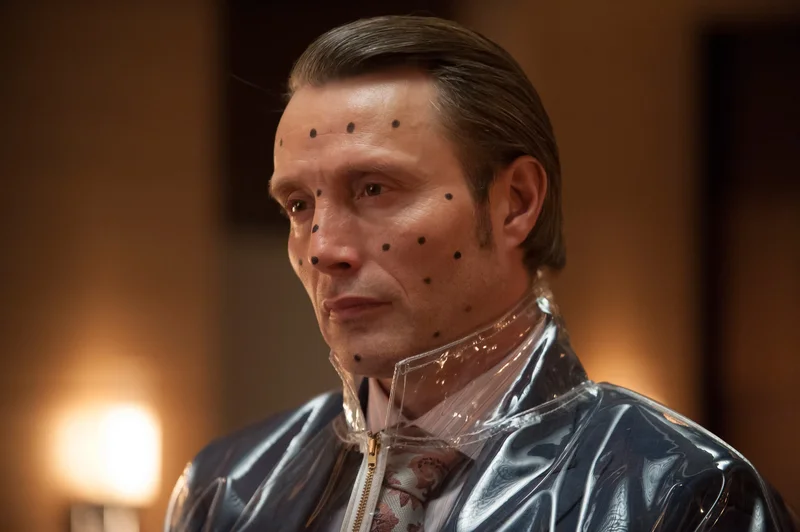
As Obsession and Interview with the Vampire have proven, people are hungry for horror in which the line between psychological terror and possessive romance is as blurry as my eyesight when I’ve misplaced my glasses. The love for dark romance largely stems from Gothic literature, where there is something inherently thrilling about exploring the taboo. It makes the idea of all-consuming infatuation and the moral ambiguity in the media we consume feel equally exciting and disturbing.
Dust Bunny and Pushing Daisies creator Bryan Fuller is well known for diving headfirst into the macabre. The writer-director delights in exploring the paper-thin line of the best and worst humanity has to offer, highlighting the grotesque absurdity of human nature. And as any devoted Fullerverse fan would tell you, he did so best with his 2013 series Hannibal, an adaptation of Thomas Harris’s thrilling book series about the cannibalistic serial killer Hannibal Lecter, now streaming in full on Netflix.
For first-time viewers — and fans of Harris's novels — Hannibal can be an enigma. For one thing, Clarice Starling, the tough-as-nails FBI trainee turned badass who plays such a pivotal role throughout most of the novels, is nowhere to be seen. Instead, the series follows the traumatized — and often unsettling — FBI profiler Will Graham (Hugh Dancy), whose ability to empathize with serial killers has made him both a valuable asset to the bureau's Head of Behavioral Sciences, Jack Crawford (Laurence Fishburne). With an ability that delights and terrifies him in equal measure, Will is able to solve a case that proves pivotal to the FBI — but ultimately drags him into the orbit of forensic psychiatrist Hannibal Lecter (Mads Mikkelsen).
The reason why we follow Will and not Clarice comes down to a simple fact that would go on to plague Fuller right up until the series cancellation: rights issues. The series only had so much access to some parts of Harris’s novels, and the character of Clarice Starling was not one of them.
However, while some would balk at the idea of telling a story that is inauthentic to the source material, Fuller took it in stride. The result is an adaptation of Hannibal that, dare I say it, is far superior to the original. Characters like Freddie Lounds (Lara Jean Chorostecki) and Alana Bloom (Caroline Dhavernas) are transformed from barely memorable old men into strong, decisive women who give as much as they get. Gillian Anderson’s performance as the original character Bedelia Du Maurier, Hannibal’s psychiatrist, is mesmerizing from the moment she steps on the screen. The women of Hannibal are easily one of the most compelling things about Fuller’s adaptation in a way that Harris’s novels can’t match.
Yet the biggest — and best — change is Will and Hannibal’s relationship. Red Dragon, the first of the Hannibal novels, protrayed Will and Hannibal strictly as enemies. In Fuller’s adaptation, however, the two’s yearning desire to both harm and help each other brings a push-and-pull dynamic that's strange, but undeniably fascinating. If you’re a fan of Interview with the Vampire, a show where the bond between Louis and Lestat becomes everyone else’s problem, you’ll find the same dynamic in Fuller’s Hannibal — though not quite as explicitly romantic, a quality Fuller has admitted to regretting.
It helps that, even though we don’t see the two men share a kiss, there are constant reminders that Will and Hannibal are the living, beating heart of this show. Dancy adds a vulnerable quality to Will that was never present in the books, making his eventual descent into murder and madness even more astounding to witness. Mikkelsen’s stunning portrayal of the cannibalistic serial killer defined the character for me in ways that not even the stellar Anthony Hopkins can match in his own Hannibal trilogy. While Hopkins leans into the mania of a Hannibal who’s been cooped up in prison for decades, Mikkelsen’s portrayal highlights who Hannibal was before his capture — an intelligent, well-liked, and upper-class man. It's a disguise so cunning in its novelty that, when the mask slips and we see the predator lurking beneath, the beautiful kaleidoscope of violence and gore that follows becomes even more captivating to witness.
If you expect a direct adaptation of Harris’s Hannibal novels, you'll likely be disappointed. But if you want a gothic thriller that reimagines the source material while honoring its core themes, Fuller’s adaptation is worth your time. Chances are, like us, you'll be hungry for more by the time the season three finale credits roll.
Hannibal seasons 1- 3 are available to stream on Netflix.