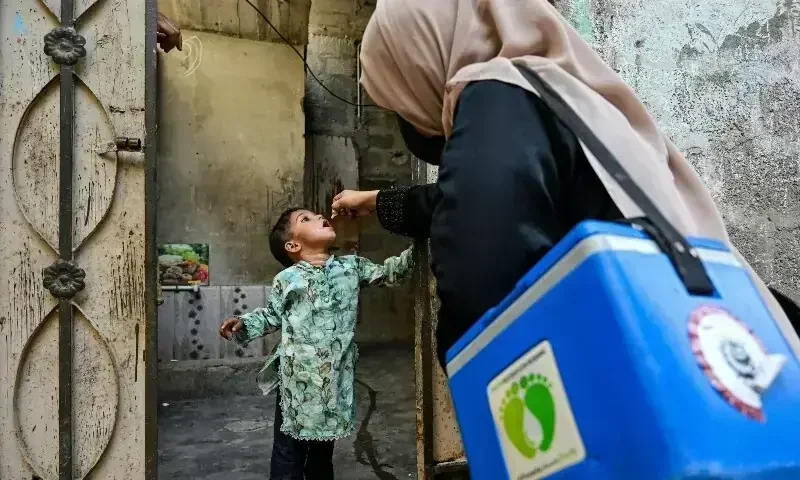
ISLAMABAD: Pakistan on Monday told the global Independent Monitoring Board (IMB) that the country has entered a decisive phase in its decades-long fight against polio, claiming the virus has been pushed into a shrinking number of high-risk areas but cautioned that persistent insecurity in southern Khyber Pakhtunkhwa remains the biggest obstacle to reaching every child. The IMB — an independent oversight body of the Global Polio Eradication Initiative — met from July 20 to 23 to assess global eradication efforts, with a particular focus on Pakistan and Afghanistan, the world’s only two countries where wild poliovirus remains endemic. During a high-level review meeting of the IMB in Geneva, Pakistani officials claimed that the country’s strategy was delivering results, while acknowledging that failure to eliminate transmission from the remaining hotspots could jeopardise years of progress. Pakistan informed the board that it had reduced polio cases by 99.8 per cent since the early 1990s, when an estimated 20,000 children were paralysed annually. Official figures show cases fell from 74 in 2024 to 31 in 2025, while only three cases have been reported so far in 2026. The Pakistani delegation was led by Minister of State for Health Dr Malik Mukhtar Ahmad Bharath and included Prime Minister’s Focal Person for Polio Eradication Ayesha Raza Farooq, the chief secretaries of Punjab, Sindh, KP and Balochistan, National Emergency Operations Centre Coordinator Muhammad Anwarul Haq and senior officials from the national polio programme. According to an official statement, Dr Bharath told the board that the recent decline in virus transmission reflected stronger political leadership, improved accountability, data-driven decision-making and better quality vaccination campaigns. “Over the past year, virus transmission has declined significantly,” he said, adding that the progress was encouraging but that Pakistan remained fully aware of the challenges ahead. He stressed that polio eradication was now “a whole-of-government mission” led by Prime Minister Shehbaz Sharif, with oversight extending from the federal government to provincial administrations. Farooq said the virus was no longer widespread but had become concentrated in the country’s most difficult and insecure areas, particularly southern KP, where thousands of children remain beyond the reach of vaccination teams because of security threats. She added that Pakistan had adopted a more targeted strategy involving smaller local vaccination teams, repeated visits to missed children and closer integration of polio campaigns with routine immunisation, nutrition, maternal and child health, water, sanitation and hygiene services. “The poliovirus footprint is narrowing, but it is now concentrated in the most difficult geographies,” she said, adding that the programme would respond with “urgency and precision” to reach every missed child. Farooq also credited sustained, evidence-based planning, stronger disease surveillance and closer coordination with the Expanded Programme on Immunisation for the recent decline in cases. Expressing confidence that eradication was within reach, she said scientific evidence indicated Pakistan had a realistic opportunity to interrupt transmission if the current momentum was maintained. It is worth mentioning that IMB works on behalf of the international donor agencies and issues reports on the performance of countries every six months. In November 2012, IMB recommended that travel restrictions be imposed on Pakistan, which were implemented on May 5, 2014, making it mandatory for everyone travelling abroad from Pakistan to get vaccinated and carry a polio vaccination card.
Pakistan tells global watchdog polio eradication is within reach as insecurity in KP remains biggest hurdle