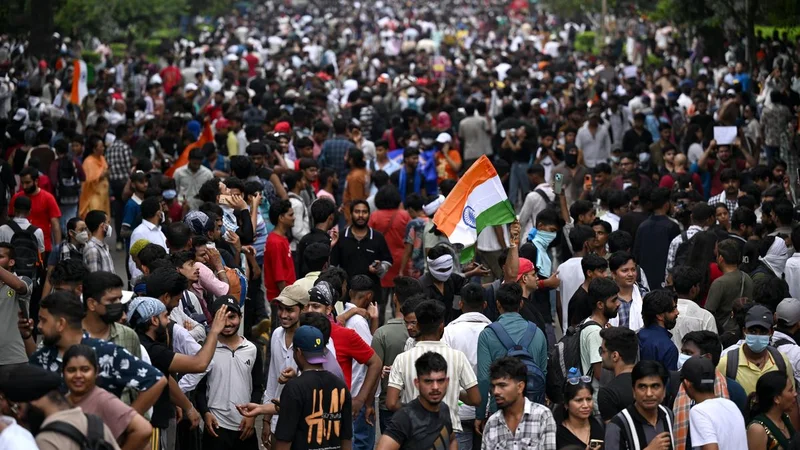
There is both a doubling down and a softening in the approach being taken by the government and the larger ‘Sangh Parivar’ in its messaging after young protesters against the National Eligibility-cum-Entrance Test (NEET) exam paper leak concluded their stir.
Going by the statements made publicly, a few things spring immediately to mind on how the BJP and the Sangh Parivar are framing the protest and its aftermath.
Former Union Minister Dharmendra Pradhan’s letter announcing his resignation on social media platform X, addressed to “young friends” rather than the President of India, states that he takes responsibility for what happened under his watch, that he initiated action when informed of the leak, handed the case to the Central Bureau of Investigation, and conducted a re-examination successfully. The reason he specifically provided for his resignation was: “However, even during this time, individuals in responsible positions attempted to create obstacles and mislead students, which caused me deep distress.”
“Considering the situation at Jantar Mantar and across the country—with the aim of preventing anti-national forces from exploiting it, preserving national unity, ensuring that not a single Indian student’s future gets entangled in legal complexities, and allowing our children to devote their time to studies and focus on building their careers—I have submitted my resignation to the Honourable Prime Minister,” Mr. Pradhan said in his resignation letter.
This frames the protest as something that could have hurt the security of India, and the government, by asking for the Minister’s resignation, had sought to end the protest in the larger interests. Moreover, the Centre maintains it has administratively carried off all the required measures for the NEET exam paper leak. The letter and the government’s statements thus try to make it seem the NEET exam paper leak was more an act of omission than commission, a matter on which the intent of the government should not be interrogated.
The support offered to Mr. Pradhan, both online and offline, by his party and government colleagues demonstrates that he is likely to make a political comeback soon, possibly in the BJP’s party organisation.
For the long run, one may look to the reels posted by Mr. Modi on Instagram, and the speech on the role of mothers, at the height of the protests in Delhi, by Rashtriya Swayamsewak Sangh chief Mohan Bhagwat.
Mr. Bhagwat appeared to suggest that he viewed the protests as a social issue pertaining to young Indians and education. “There is a need to give the new generation a sense of belonging. We need to communicate. Not dictation, but discussion. Not orders but consensus,” he said in his speech.
The PM’s posts on Instagram can also be seen as a way of reaching young people, via the platform they seem to prefer, and he insists that his government has taken on board their concerns on the exam system and frequent leaks of papers.
Whether these two simultaneous offered approaches, one aimed internally at the political class and the other a societal position, will hit the mark in the conundrum now facing the government and the Sangh Parivar with young protesters, remains to be seen.
Published - July 27, 2026 08:07 pm IST