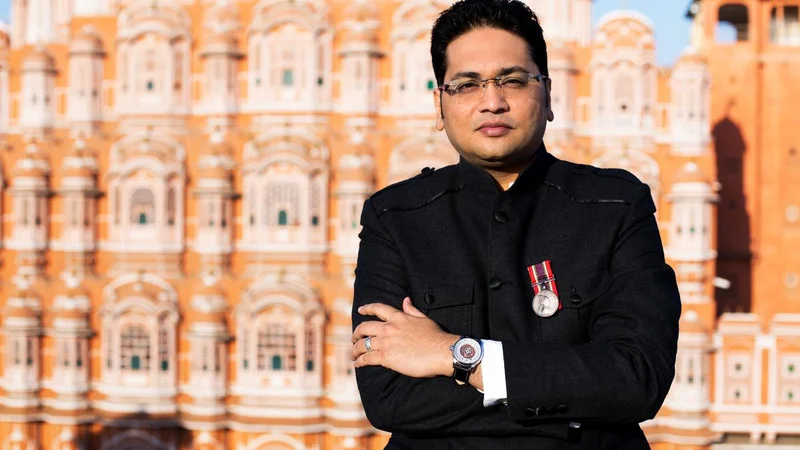
At the Chamber of Princes in Jaipur’s Rambagh Palace, the morning light slips through carved jaalis and settles across marble floors. Delicate filigree curls around doorways, chhatris punctuate the palace skyline beyond the windows. Outside, peacocks wander the lawns with the soft entitlement of permanent residents.
By the time watchmaker and founder of Jaipur Watch Company, Gaurav Mehta, lifts the lid off his newest watches, it becomes difficult to tell where the palace ends and the timepieces begin.
Jaipur as the blueprint
This was perhaps why the Jaipur Watch Company chose Rambagh Palace to unveil its newest collections, Premium Baagh and Gates of India. The jaalis, chhatris, and filigree have found expression on the dials of the watches resting inside velvet-lined boxes, revealing the architectural vocabulary from which Gaurav Mehta’s designs emerged. Both collections were designed in consultation with Gaurav’s design team in Jaipur, with the watch straps crafted in Indian leather.
Prior to the launch , the company drove us through the Pink City’s walled precincts to the City Palace, stopping before the ornate gateways of Pritam Niwas Chowk , the Lotus Gate, and Leheriya Gate to reveal how the architecture of the gates had spilled onto the dials of the watches.
For Gaurav, this was less a design exercise than a return to the city that has shaped and inspired almost every watch he has made.
“Jaipur is known beyond jewellery. It is known for its history, its palaces and its architecture. We are a watch company. We have never wanted to become a jewellery brand. We wanted to tell Jaipur’s stories through watches,” says Gaurav.
That philosophy has guided the company since its founding in 2013. Long before Indian microbrands became fashionable, the company built its identity around Indian narratives rather than Swiss imitation. Ancient coins like the Indian 4 anas, 50 paisa and 1 rupee became dials, and painted miniatures found their way onto watch faces. Sandstone, Rajput jewellery, Mughal motifs, and now architecture, have all been translated into mechanical objects worn on the wrist.
Today, the company describes itself as India’s first micro luxury watch brand. Last year it sold around 10,000 watches. This financial year it hopes to cross 20,000.
The growth has been gradual, and, Gaurav insists, painfully slow. “It took us almost nine years just to survive. Consumers weren’t there. Manufacturers weren’t supportive. Retailers weren’t interested. The only thing that kept me going was making these watches,” recalls the founder.
That persistence received an unexpected endorsement late last year. In November 2025, photographs surfaced of Prime Minister Narendra Modi wearing what appeared to be one of the company’s Baagh watches. Gaurav had no idea until someone called to say the timepiece looked familiar.
“We went through the Prime Minister’s official photo gallery. He wears his watch on the inside of his wrist, so it wasn’t easy to identify. But I recognised our logo and the distinctive lugs. Then I knew,” says Gaurav, smiling.
At its heart is an original 1947 one rupee coin bearing India's iconic walking tiger which is a nod to the year of Independence and the country's emergence into a new identity. Housed in a 43 mm 316L stainless steel case, the Roman Baagh is powered by a Japanese Miyota automatic movement, with sapphire crystals on both sides, a transparent case back, and 5 ATM water resistance (which means it is safe for shallow swimming up to 50 meters). Priced between ₹55,000 and ₹60,000, it positions itself as an accessible luxury timepiece rooted in Indian history and craftsmanship.
The photographs quickly circulated online, sending enquiries and searches for the small Jaipur brand soaring. For Gaurav, the moment represented something larger. “I think it sent a message that if you are honestly building something in India, there is support,” he notes.
Yet the watches themselves resist becoming symbols of nationalism alone, they remain intensely local.
The Premium Baagh Collection
The Premium Baagh
Its offset dial is wrapped in genuine muslin khadi, bordered by intricate court-inspired filigree, and crowned with a miniature Rajput chhatri set with a ruby jewel. Beneath sits a natural stone dial, turquoise, tiger eye, aventurine or abalone depending on the variant while a Swiss Sellita or Japanese Miyota automatic movement powers the watch.
Each case is individually CNC-milled (computer controlled cutting) from 316L stainless steel with engraved flanks and custom turquoise stone inlays integrated into the lugs, the movement of the watch visible through an exhibition caseback that reveals its inner working alongside an etched tiger motif.
Priced at approximately ₹ 1,65,000, each piece requires roughly seven weeks to complete. Gaurav explains that the tiger represents strength, and more than an animal, it celebrates India’s rich cultural heritage and its symbolism also collides, and most proudly so with India’s Make in India logo.
The Gates of India collection
If Baagh borrows from Nature, Gates of India borrows from Jaipur. The watch carries two movements and can be flipped, allowing wearers to display separate time zones on either face. One side is playful and colourful, the other restrained and monochromatic. Flip the watch over and its personality changes, much like walking through Jaipur’s gates into different neighbourhoods.
The collection also completes a full circle within the company. Since 2013, Jaipur Watch Company’s logo has consisted of four arches positioned at twelve, three, six and nine o’clock.
Most customers recognise them simply as a logo. Few realise they are lifted directly from the arched crowns that sit atop Jaipur’s historic city gates. “Our logo always carried the identity of those gates. People just never noticed,” smiles Gaurav.
His fascination with Jaipur’s urban planning began in school, when he was assigned a history project requiring him to hand-draw a map of Jaipur’s walled city. “That’s when I realised how brilliantly planned the city was. Everything connected. There was so much architectural thinking behind it,” recalls Gaurav with a glint in his eye. Those lessons have lived on long after school.
Planning for the future
When discussing future ambitions, developing Indian made movements, opening 100 stores over the next three years and expanding internationally, Gaurav repeatedly returns to the same idea: watches as conversation starters, “You’re not just wearing a watch. You’re carrying a story about India.”
The writer was in Jaipur on invitation from the Jaipur Watch Company
Published - July 27, 2026 08:03 pm IST