- See more Daily Mail on Google - save us as a Preferred Source
When Jessica Engel's baby boy, James, stopped growing at four months old, she had a harrowing feeling that something was seriously wrong.
Doctors, however, insisted she just had to feed the infant more.
Despite being brushed off by medical professionals, Engel continued to 'ask questions' and 'demanded more testing.'
Her intuition was ultimately right, and her son was later diagnosed with cystinosis, a rare genetic condition that can cause 'crystals to build up' which leads to serious 'problems in the organs.'
Engel, 38, from Cincinnati, Ohio, laid bare her son's harrowing health journey during an exclusive chat with the Daily Mail.
She explained that after she gave birth to her son, James, in December 2025, he had to immediately be rushed to the NICU because he was 'showing signs of low glucose.'
Initially, she was told that James had something known as hyperinsulinemia, which is when your body produces more insulin than your body needs.
Luckily, doctors said it was something he would 'outgrow' and he was given medication to keep his glucose levels regular until then. He spent 23 days in the NICU and was sent home.
When Jessica Engel's baby boy, James, was born in December 2025, he had to immediately be rushed to the NICU because he was 'showing signs of low glucose.' He's seen right after he was born
Initially, she was told that James had something known as hyperinsulinemia, which is when your body produces more insulin than your body needs
Luckily, she doctors said it was something he would 'outgrow' and was sent home after 23 days in the NICU
'We had to check his glucose multiple times a day and the medication was hard on his belly, [but other than that] he was perfectly fine. He had no other issues,' she explained. 'He was meeting all [of his] milestones.'
However, all of that changed when Engel took James in for his routine four-month doctors appointment in April.
His pediatrician noticed he wasn't gaining enough weight, and suggested Engel bring the infant to the hospital.
Initially, the ER doctors weren't concerned and told her that his low weight was likely because of his hyperinsulinemia medication.
They decided to try taking him off the medicine and noticed his glucose was normal, so Engel thought that her son's health problems were over. Sadly, they were just beginning.
'He seemed to have outgrown the condition and did well off the medication, so we were super excited thinking, "Our boy is finally cured and can be off all the meds!"' she recalled.
But when James' weight didn't improve in the weeks that followed, Engel began to worry something more sinister was at play.
She brought him back to the hospital but was told she simply had to feed him more formula. As someone who exclusively breastfed, it didn't sit right with her.
But when Engel took James in for his routine four-month doctors appointment in April, his pediatrician noticed he wasn't gaining enough weight. He's seen at four months old
'The doctors at [the hospital] were very confident that I just needed to feed him more and that being off the medication would help his appetite,' she continued.
'But when we saw he still wasn't gaining ... I really started asking questions and for tests and more answers.
'The hospital telling me "feed him more" and "give him formula and he will grow" was not a good enough answer for me ... I knew there was something more wrong.'
Thanks to Engel's insistence, doctors began running tests and discovered his kidneys weren't working properly. He was then diagnosed with cystinosis.
'Cystinosis is a genetic condition in which an amino acid called cystine builds up within your cells,' per My Cleveland Clinic.
'Too much cystine causes crystals to form that accumulate and then cause issues in your organs and tissues.
'Cystinosis most often affects your kidneys and eyes. It can also damage your brain, muscles, liver, thyroid, pancreas and testes.
'The condition is a rare but serious disease that has a lifelong impact. Prompt diagnosis and treatment can slow the development and progression of the disease.
'Even with treatment, most people will develop end-stage kidney disease (kidney failure) and require kidney transplants.'
Engel described the news as 'absolutely devastating.'
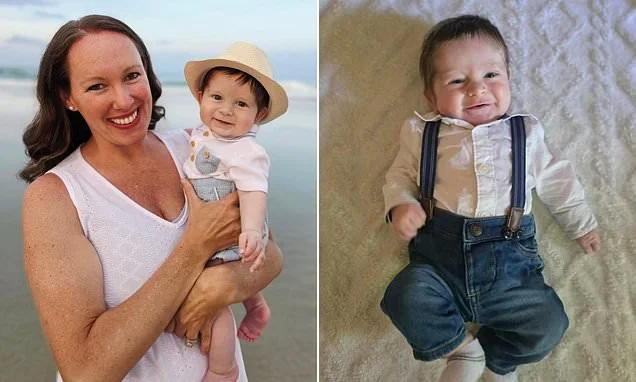
James, seen recently, was diagnosed with cystinosis, a rare genetic condition that can cause 'crystals to build up' which leads to serious 'problems in the organs'
'Going from "he's healed from his hyperinsulinemia" to now "he has a lifelong disease and will forever be on medications" was hard to hear and accept,' she said.
'I am grieving the life we had hoped for and trading the life of "always being on the go" to now "always watching the clock for next medication and fighting to get him to eat."
'Our future now looks very different with lots of medications, appointments, hospitals, blood test... it's just heartbreaking.'
Engel said she's been suffering from severe anxiety since the diagnosis and 'can't sleep at night' because she is 'constantly in fear' over her son's future.
'Not only did this diagnosis change James's world, it changed the whole family's,' she added. 'It's very mentally, physically and emotionally exhausting.'
For now, she said James is 'doing okay' but has to take supplements and medication daily to 'manage his condition.'
Three months on from the diagnosis, he recently started to finally gain weight.
'This will affect him progressively over time, his organs will start being damaged and he will most likely need a kidney transplant in the near future,' said Engel.
'His future is unknown, but we are learning to take each day at a time and our main goal right now is staying consistent and on top of the intensive medication routine (which includes waking him up through the night), and making sure we stay on top of his feedings so he's gaining weight.'
My Cleveland Clinic noted that medication can 'slow the development and progression of kidney damage,' however, there is currently no cure for cystinosis.
Despite everything, Engel said she feels 'very hopeful' for her son
The organization adds: 'At one point in time, nephropathic cystinosis was fatal in young children.
'Today, with the development of [medication] and advancements in kidney transplantation, the life expectancy for people with cystinosis reaches far into adulthood. Some people live beyond 50 years of age.'
Despite everything, Engel said she feels 'very hopeful' for her son.
'I believe in the healing power of God but also believe in the miracle of medical interventions and a cure to be on the horizon,' she said.
'They say they are close to a cure (10-20 years away potentially) but I am hoping James will become known around the world and be accepted in future clinical trials to hopefully cure him before more damage is done to his organs.
'I am hoping his story will spread awareness to others possibly in the same boat looking for answers for their children, but also share that even in our grief and heartbreak, we can find happiness and hope.'
She stressed the importance of 'advocating for your family and children.'
'Ask the hard questions, and never settle,' she concluded. '[And remember] it's okay to feel grief but also find joy in different circumstances.
'We are all human and all have different stories that we should all be ok sharing openly without judgment, our stories will hopefully help others.'