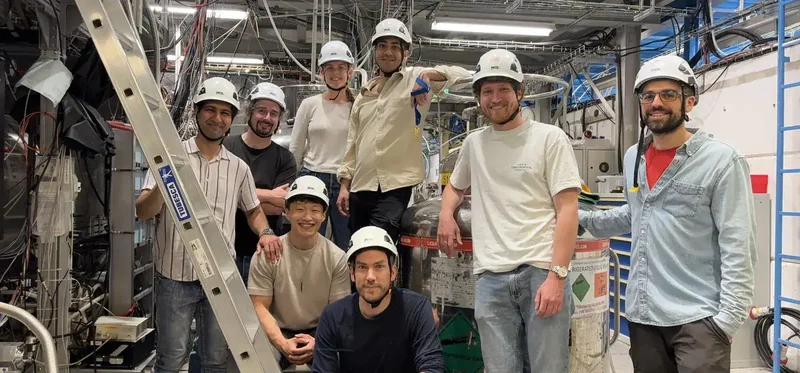
A new measurement of the ground-state hyperfine splitting in antihydrogen shows that it is identical to that of normal hydrogen to within four parts per million – two orders of magnitude more precise than previous experiments. Although the measurement by CERN’s ALPHA collaboration did not reveal any asymmetries between matter and antimatter, the result is nevertheless a milestone in the search for reasons why the universe appears to be made up almost entirely of matter, with only minute amounts of antimatter.
According to the Standard Model of particle physics, all matter particles have a corresponding antimatter particle that is identical to them in every way apart from their charge and magnetic properties, which are reversed. If this model is correct, then the Big Bang that formed our universe nearly 14 billion years ago should have generated equal amounts of antimatter and matter. But in that case, neither we nor almost everything else we observe should exist, because pairs of antimatter and matter particles annihilate each other whenever they collide.
“This apparent lack of antimatter in the universe remains one of the biggest mysteries in modern physics and suggests there is something about antimatter and matter that we do not understand,” says Timothy Friesen of the University of Calgary, Canada, one of the lead authors of a Nature paper on the new measurement.
Measuring antihydrogen
To look for subtle asymmetries that might explain why matter triumphed and antimatter all but disappeared, ALPHA is performing precise measurements on the simplest antimatter atom: antihydrogen, which consists of an antiproton bound to an antielectron, or positron.
These measurements take place at the CERN Antiproton Decelerator Facility using the ALPHA-2 antihydrogen apparatus, which is designed to prevent antihydrogen from coming into contact with normal matter. It does this by confining the antimatter within a cylindrical Penning–Malmberg trap under an extremely high vacuum and surrounded by strong superconducting magnets. These magnets suspend the antimatter in the trap so that it does not touch the walls of the container it is held in, preventing it from annihilating before measurements can take place.
In the latest work, the ALPHA collaboration focused on a parameter known as hyperfine splitting. This splitting occurs because magnetic interactions between the spins of the antiproton and positron cause the positronic ground state in antihydrogen to split into four sublevels, which the researchers label |a⟩, |b⟩, |c⟩ and |d⟩.
In hydrogen, the magnitude of this hyperfine splitting has been measured extremely precisely – we know its value to within a few parts per trillion – and it is particularly sensitive to the structure of the proton. Measuring this splitting in antihydrogen with the same precision would therefore be an excellent way of searching for differences between matter and antimatter. Previously, however, the most sensitive measurements only managed a precision of 400 parts per million (ppm).
In pursuit of precision
To push beyond this level, the ALPHA researchers applied pulses of microwaves at frequencies between 28 GHz and 31 GHz to induce the positron spin flip transitions |c⟩ → |b⟩ and |d⟩ → |a⟩ between the hyperfine levels of ground-state (2S and 1S) antihydrogen atoms. By measuring the frequencies at which these transitions occurred, they could then calculate the hyperfine splitting energy.
“At a magnetic field of 1 Tesla, we measured the hyperfine splitting for antihydrogen to a precision of 4 ppm – a result that has allowed for one of the best comparisons of matter-antimatter symmetry in antihydrogen ever,” Friesen says.
Internal structure of antihydrogen probed for the first time
While the new measurement is precise enough to push experiments into a regime that is sensitive to the structure of the antiproton, Friesen notes that it is still five orders of magnitude less precise than comparable measurements in ordinary hydrogen. “The comparisons at this level of precision with matter hydrogen are identical, and our current models of physics therefore still hold,” he says.
The team does have some ideas for further improvements. “To push the measurement to improved precisions we are aiming to induce antiproton spin flip transitions, since these can be less sensitive to magnetic field inhomogeneities, which are our biggest systematic uncertainty,” Friesen explains. “This, combined with laser cooling the antihydrogen samples to reduce the width of our spectroscopic line-shapes, could help improve the precision by at least another factor of 100.”