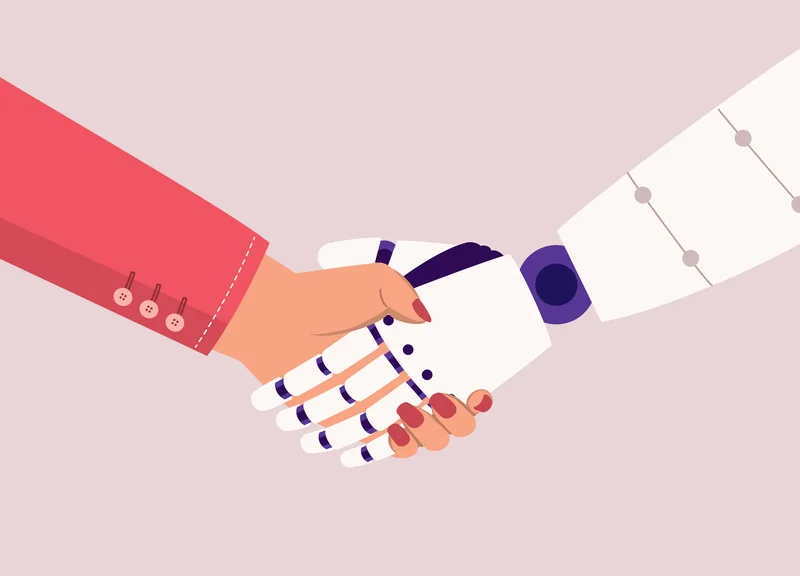
While large AI companies are being besieged by a more conscious and critical perception of the risks and impact of their technologies, more and more corporations such as Meta, Google, Anthropic and Open AI are investing in what is being termed “Girlbossification of AI.” If the recent booing of tech CEOs during their speeches at graduations wasn’t evidence enough that not everyone wants or needs AI in their lives – a recent New York Times poll found that 47% of 18-to-29-year-olds consider AI to be a very bad thing – coupled with the rise of anti-data center legislative proposals and the growth of anti-AI movements around the world, the female user is now being schmoozed.
In a clear example of pinkwashing that has been going on for months, companies have invested in communication campaigns involving businesswomen, fashion and beauty influencers, well-known actresses, and even viral challenges aimed at capturing the attention of their most precious target: educated, professional and socially mobile women.
Although men are the demographic to adopt new technology the fastest, the female audience is usually responsible for making much of the technology that we use today successful, culturally relevant and lucrative, from social networks to iPhones, as specialists such as technology journalist Taylor Lorenz explain. Despite being underrepresented in STEM positions, women have enormous power within households regarding what is to be consumed; this 50% of the US population controls or influences 85% of consumer spending, according to Forbes.
“To understand the scope of this, we have to see it within the geopolitical context of AI development, the fear of bursting that economic bubble and a desperate whitewashing in the face of growing anti-AI sentiment,” says Micaela Mantegna, a specialist in Neurotech and AI Ethics. “Geopolitically, it is part of a race for global domination with China as its main rival,” she adds.
On the networks, there has been a wave of posts by paid lifestyle influencers to highlight the ‘benefits of American AI’ using videos shot in a domestic context. But behind these astroturfing campaigns – a manipulative practice that simulates spontaneous popular support and poses as a legitimate social movement – there are ‘pro-AI’ think tanks such as ‘Build American AI’ or ‘Leading the Future’. funded by Palantir, OpenAI and others.
The rhetoric of fear
What are these narratives like and who is driving them? Some of the more visible faces include Mel Robbins, the lawyer-turned-empowerment-influencer, Emma Grede, the CEO of the company Good American that has links to the Kardashians, and even well-known actresses-turned-influencers-and-entrepreneurs such as Reese Witherspoon and Gwyneth Paltrow who hosted an ex-Palantir owner of an AI company for military networks on her podcast.
With messages that capitalize on fear — a strategy on which the big tech companies base a large part of their communication with messages such as that AI is inevitable, adapt or you will lose your place in the labor market — you don’t have to be a genius to realize that billion-dollar interests lie behind the apparently objective and beneficent advice.
Robbins collaborates with Microsoft’s Copilot and was widely criticized for encouraging women to enter their private financial information, including their bank statements, into Copilot. Meanwhile, both executive Sheryl Sandberg (ex-Meta) and Bumble CEO Whitney Wolfe Herd (ex-Tinder), have very controversial records of working for the interests of technology companies. Now Bumble is going to add AI to its dating app.
Coincidence or causality?
Making AI seem inevitable is not only a fallacious position — we can always choose not to use it — it prevents a critical analysis of how it is developed and marketed. It also allows ideologues to wash their hands of its impact. It’s no coincidence that the rhetoric on the inevitability of AI come mostly from CEOs, technocrats, Silicon Valley, and all those who benefit from the mass exploitation of our knowledge and sensitive data.
But the most startling thing about all this is that feminist arguments are being used to suggest that AI could become the great equalizer between men and women, “providing women with the support, efficient means and confidence that previous systems have not achieved,” despite the fact that, with or without AI, the gender gap is still structural and the result of a patriarchal system. The reasoning is doubly absurd given it is these same technologies that put women at a disadvantage regarding the displacement of skilled labor that harms all workers, regardless of gender. Among other things, this is due to the fact that they are the ones who work the most in routine and easily automatable jobs, they are the worst paid, are a minority in technology sectors, and are also the ones who carry the burden of domestic and child-rearing tasks.
And this is before all the other ways in which this technology is harmful to women has been taken into consideration. “The contradictions are obvious when it comes to seducing an audience that is disproportionately affected by AI. From deepfakes to visual bombardment, AI contributes to the objectification and alienation of women. ‘Virtual influencers’ elevate beauty standards to inhuman levels. Worse still, men lurk behind many of these accounts, manipulating the female image as an object of consumption. The circle is completed with predatory accounts, such as ‘political influencers,’ that contribute to validating the misogynistic visions of the manosphere,” Mantegna adds.
“The latest ambition is not to achieve new goals, but to hold on to what we have already gained,” explains journalist Angelina Chapin in a review. The old and familiar status quo. In short, the message is not only focused on the fact that AI can help women “to have it all” – which is why they target housewives and overwhelmed mothers – but also that it could help them not to go backwards. This is something that we are clearly doing if we believe that the tech bros are on our side in this post-DEI era of anti-feminist and ultra-conservative political projects.