The Galaxy Z Fold 8 is all set to be a hit for Samsung, if my first weekend with the phone is anything to go by, as the positive attention it received shows it’s already well on its way to winning a lot of fans.
After a lot of time dedicated to Samsung over the last week or so, I should have hit a degree of fatigue, but not so with the Z Fold 8. It’s astonishing just how much difference a size change can make.
It's the perfect size
And it's made to be used open
I’m straight into using the Galaxy Z Fold 8 from the Motorola Razr Fold, Vertu Alphafold, Honor Magic V6, and the Motorola Razr (2026). I’ve been living the foldable life for several months, so you may expect the Galaxy Z Fold 8 to feel like more of the same, or at least have lost some of its sheen.
This is not the case at all. The Galaxy Z Fold 8 is a very different phone to all the other big-screen models I’ve used recently, and is closer to being the exciting, capable, and fresh compact foldable I wished the Razr (2026) was.
It’s not about the cover screen though. It’s all about how much more I’ve used the open screen than usual. The large, open screen is just about the perfect size, and there’s a genuine difference between using it in landscape and portrait orientation.
Sitting down and having coffee with a friend, while we spent an imaginary budget in the AutoTrader app, highlighted how much of a step forward the display is.
It was easily bright enough to be visible in the afternoon sun, the crease was barely noticeable, and I could hold the open phone to show my friend a photo without juggling an ungainly shape or battling with excessive device weight.
I could have done the same with the Razr Fold, but it wouldn’t have been as comfortable or easy. This is the Galaxy Z Fold 8’s talent. It takes away the awkwardness that’s part of a big-screen foldable, replaces it with convenience, yet loses none of the versatility.
Unprompted, my friend said, 'This is a beautiful display,' when looking through a gallery of photos in the AutoTrader app. Elsewhere, when I was showing a complex map of a water outage in my area, several people said how easy the Z Fold 8 made it to see detail. Yet, it’s a phone I can fold up and put in my pocket, where I barely know it’s there.
The hinge is a strength of the Galaxy Z Fold 8
As long as you don't ask too much of it
The Galaxy Z Fold 8 encourages you to use the open screen, and I’ve found myself opening the phone more than I did the Razr Fold, for example, where I’d just make do with the cover screen.
A lot of this is down to the wonderful hinge, or more precisely, its resistance, weighting, and tactility.
Samsung specifically engineered the Z Fold 8’s hinge to feel different to the hinge of the Z Fold 8 Ultra, and it’s by far the better of the two. It requires little effort, and almost no specific grip, to pull the two sections apart.
It’s then a linear motion right up until it snaps open with a very pleasing thunk, and you really get the impression the display has been stretched out to its limit. The Galaxy Z Fold 8 has an almost completely flat, uniform glass panel.
It’s the hinge’s fluidity and minimal resistance that subliminally tells you the phone was designed to be used opened up.
There’s no half-fold orientation, but this is where Samsung’s marketing-based split between the Fold 8 and Fold 8 Ultra comes in. The Fold 8 Ultra is for productivity, making the half-fold’s ‘desktop’ style fit better on it.
The Galaxy Z Fold 8’s natural state is open, while a lot of other foldables feel like their natural state is to be closed. It’s an important distinction.
It's so photogenic
And there's a reason why
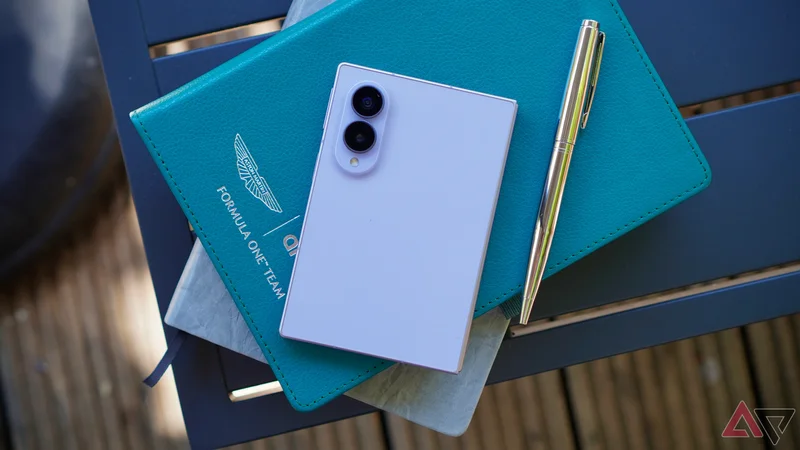
This will sound weird at first, but it’s a reaction to another spot-on aspect of the Galaxy Z Fold 8. The phone is very photogenic.
This has nothing to do with the way it looks, as it’s a fairly standard-looking Samsung phone, and everything to do with its shape and dimensions.
It’s not another slab like the Galaxy S26 Ultra, and it’s not a tall, thin foldable like the Galaxy Z Fold 8 Ultra. It’s not as cute as the Z Flip 8 either. Instead, it’s a shape most of us will be familiar with, as it’s about the same size as a passport.
It increases its familiarity. I feel at home holding the Z Fold 8 when it’s closed. It doesn’t take up much room in my pocket or bag, and it’s not thicker than my Apple iPhone 17 Pro Max in its Casetify case, but it is lighter.
I call it photogenic because it fits in with everyday life in a way some other large mobile devices don’t. It’s more Amazon Kindle Paperwhite than Apple iPad Mini, if that makes sense. I like looking at the Galaxy Z Fold 8, and therefore quite liked taking photos of it too.
A different way to enjoy foldables
It's all set to be a hit
It was good to see people react positively to the Galaxy Z Fold 8 over my first weekend with it, plus there’s excitement about it on social networks too, certainly more so than the Galaxy S26 Ultra attracted. It's an excellent sign.
It’s hard to describe why the Galaxy Z Fold 8 has worked so well for me, and seemingly others too, especially as on the surface the smaller dimensions are the primary change, and we’ve seen similarly-sized products before.
But it does work, and to the point where I believe it will change people’s minds about whether a larger foldable will work for them or not. It has definitely ruined the Z Flip line for me, as it gets the balance of compact dimensions and big, useful screens just right.
It’s a significant investment, and I haven’t spent enough time with the phone to assess its camera, battery life, or performance yet, but at this point it’s already turning into one of Samsung’s most interesting devices in a while.
When more people get the chance to try it for themselves, I think they’ll agree. If so, Samsung has a serious hit on its hands.