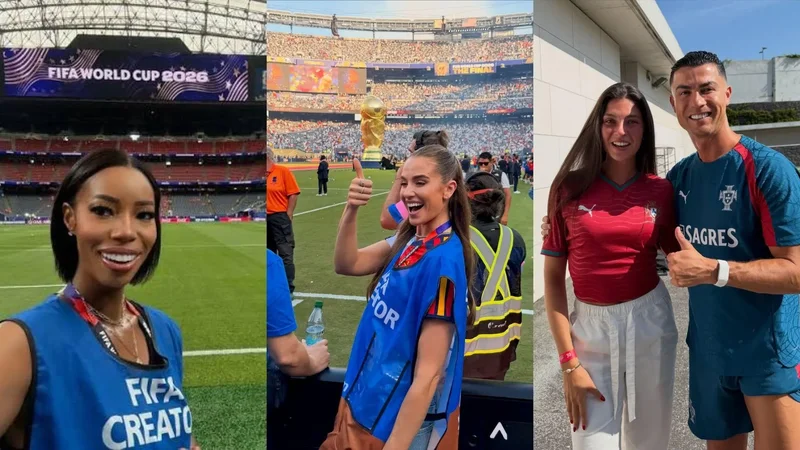
The 2026 FIFA World Cup will be remembered for its record 48-team format and its three-country footprint across the United States, Canada and Mexico. But inside the media industry, the tournament is being remembered for something else: the moment creators, not broadcasters, became the primary lens through which most fans experienced the games. Tubular Labs data cited by The Measure found that World Cup content generated more than 259 billion social video views across YouTube, Instagram and TikTok, with creators responsible for over 70 percent of that engagement. Digiday went further, reporting that creator-led posts outperformed celebrity endorsements on a per-view basis, with median views of 929,000 for top creator content compared to 573,000 for celebrity posts.
Within that larger creator story, women set the pace. From official FIFA-aligned correspondent programs to independent breakout stars, women content creators didn't just participate in the 2026 World Cup conversation. In several of the tournament's most cited data points, they led it.
The clearest marker of that shift was FIFA's decision to formalize creator access at all. TikTok became FIFA's first-ever Preferred Platform partner, a deal that granted a select group of creators press-level credentials: training sessions, press conferences, warmups and matchday positioning once reserved for accredited media. TikTok has been explicit that the model was not built from scratch. The agreement builds directly on FIFA and TikTok's partnership for the 2023 Women's World Cup, which generated tens of billions of views and effectively proved the format before it was scaled up for the men's tournament.
That Preferred Platform deal produced the TikTok World Cup 2026 Creator Correspondents, a cohort of 30 creators spanning 11 countries. Women were well represented throughout the group, including Rosa Jacob, one of the leading soccer content creators across Germany, Austria and Switzerland, and Samantha Miller, a London-based creator known for blending behind-the-scenes access with her own soccer journey. YouTube ran a parallel program, naming 24 creators with official tournament access and a combined subscriber base of more than 350 million; its U.S. roster included Ashley Alexander, Haley Kalil, Jenny Hoyos and Kelly Wakasa.
Three names in particular capture how far that access translated into measurable impact.
Celine Dept, a Belgian creator, emerged as one of the tournament's single biggest stories on any platform, regardless of gender. Digiday's analysis of Instagram data found that Dept and IShowSpeed were two of the platform's top three creators for World Cup content, with their combined videos drawing more than 700 million views. Tubefilter reported, via OneFootball, that by late June, Dept had become the most-watched female YouTuber in the world, with 1.1 billion channel views, a surge driven in part by an emotional video of her pre-tournament meeting with Cristiano Ronaldo that spread widely across platforms. Dept's access extended beyond content: she captained a team at the first-ever YouTube FIFA Creator Cup exhibition match in Central Park in July, alongside IShowSpeed's competing squad.
Rachel DeMita, a former college basketball player turned sports podcast host, placed among the tournament's top five creators by combined cross-platform Estimated Media Value, according to a CreatorIQ analysis, generating roughly $1 million in EMV across TikTok, Instagram, YouTube and X. She was also the most prolific poster among that top tier, publishing 49 TikTok videos over a 21-day window that drew 7.5 million impressions, underscoring how consistency, not just single viral moments, drove her numbers.
Simone Scott offers a different but equally telling case. A former Fox Sports reporter who moved into full-time content creation, Scott was named one of TikTok’s 30 official Creator Correspondents and became known for her "For the Girls" series breaking down major sports storylines. Her correspondent status came with the same tunnel access, pre- and post-game interviews and press conference credentials typically reserved for accredited journalists. SponsorshipX later cited Scott by name as one of the creators whose FIFA access marked a turning point in how the organization treats creators relative to traditional press.
Taken together, these examples point to a broader structural shift rather than a handful of isolated viral moments. Forbes contributor Ian Shepherd reported that industry executives now describe formal creator accreditation as the natural next step for major sporting events, treating creator access as infrastructure rather than a supplemental marketing layer. Unilever's tournament-wide activation, which mobilized 50,000 creators across more than 120 markets for brands including Dove, Axe and Rexona, reflects the same logic applied at scale.
For marketers and platforms still calibrating how much weight to put behind women creators in sports verticals, the 2026 World Cup supplied a real answer: several of the single highest-performing pieces of tournament content, by both raw views and EMV, came from women working inside official FIFA-aligned programs. The tournament didn't just include women creators. In multiple cases, it depended on them to reach the audiences that mattered most.