- See more Daily Mail on Google - save us as a Preferred Source
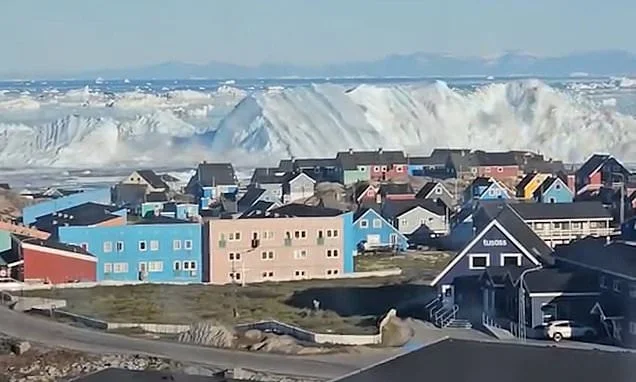
This is the moment a colossal iceberg capsized off the coast of Greenland, sending cascading waves erupting from beneath it and clouds of mist up hundreds of feet.
The iceberg, which was as long as at least a dozen houses, capsized near to the UNESCO-listed Ilulissat Icefjord, on the west coast of Greenland.
Sped-up footage showed the huge ice mass tipping over and towering over the nearby settlement.
Despite sending tsunami-like waves when it flipped, no injuries were reported.
Shocked viewers expressed their horror at the unnerving scene, with one questioning if this would cause a tsunami, while another wrote: 'What's astonishing is when you realize just how deep the water has to be to do that, THAT CLOSE TO THE SHORELINE.... Greenland isn't for wimps.'
Another said: 'A massive iceberg flips in mere seconds. What looks most solid can collapse without warning. Nature needs no words; it quietly reminds us never to take the fragility of everything for granted.'
Some have argued that El Nino, a climate pattern that has resulted in unusually warm surface water temperatures in the Pacific, could have impacted the iceberg.
The elevated temperatures of El Nino change the weather around the world for a minimum of several months and are expected to continue well into next year.
The iceberg, which was as long as at least a dozen houses, capsized near to the UNESCO-listed Ilulissat Icefjord
Despite sending tsunami-like waves every time it turned over, no injuries were reported
Climate scientists fear this frequent weather event will become a 'Godzilla' or 'Super' El Nino by December, meaning sea surface temperatures rise to 3.6°F above normal or even higher - which National Oceanic and Atmospheric Administration (NOAA) classifies as 'strong.'
Climate officials added that this El Nino will likely be one of the strongest since 1950, and there is a fear it could match an event from 1877, which triggered severe droughts and crop failures around the world, contributing to more than 50 million deaths globally.
Ilulissat Icefjord is one of the few areas where the Greenlandic ice cap reaches the sea and is home to Sermeq Kujalleq, one of the fastest and most active glaciers in the world.
It sheds over 46 cubic kilometres of ice every year - some believed to be as old as 250,000 years - as icebergs and is the most of any glacier outside of Antarctica.
Earlier this year, the world watched as the world's largest iceberg finally disintegrated into chunks after nearly four decades.
A–23A was a 'megaberg' that weighed nearly a trillion tonnes and measured 1,540 square miles (3,988 square kilometres) at its peak – twice the size of Greater London.
It originally calved from Antarctica's Filchner Ice Shelf back in 1986, remaining grounded on the seabed before finally setting off on its slow journey in 2020.
Since then, the giant has drifted more than 2,000 miles (2,300 kilometres) north, going on an epic jaunt that has captured the attention of scientists across the globe.
Its final months brought extensive melt and breakage, shrinking the colossal berg to just over 66 square miles (170 square kilometres) before it disintegrated.