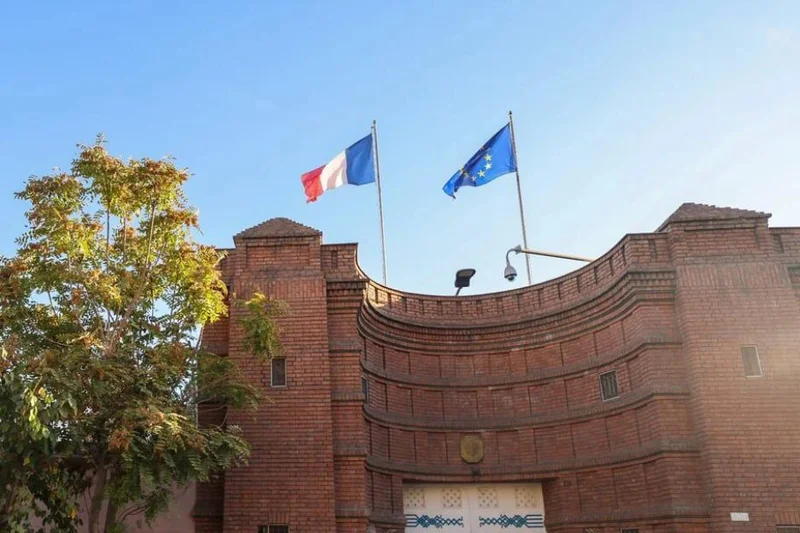
Are France and Britain about to dive into the quagmire Trump created?
Iran warns against 'hostile and politically motivated' actions of certain European countries
TEHRAN – Iran pushed back hard against European powers on Monday, charging Britain and France with orchestrating a “blame game” and coordinating with the US in an aggressive campaign of “psychological warfare” targeting the Islamic Republic.
Iranian Foreign Ministry spokesman Esmaeil Baqaei made the remarks during his weekly press briefing on Monday in response to recent allegations and “politically motivated” moves by Britain and France.
On July 22, the UK stated that it had temporarily withdrawn its diplomatic staff from Iran due to rising regional tensions.
“Due to the ongoing security situation, we have taken the precautionary measure to temporarily withdraw UK staff from Iran. Our embassy continues to operate remotely,” the Foreign Office said, while continuing to advise British citizens against traveling to Iran.
Earlier, on July 13, Britain decided to designate Iran’s Islamic Revolution Guard Corps (IRGC) as a threat to national security and ban support for it—a move officials said came close to proscribing a branch of Iran’s military as a terrorist organization. Beyond the IRGC’s role in defending Iran against foreign attacks, the military force has been praised in the region for its efforts to eradicate the ISIL terror group. Keir Starmer and Home Secretary Shabana Mahmood accused Iran and the IRGC of doing “dirty work” under the pretext of threatening British national security.
Britain stands accused of allowing the US to use its military bases for attacks against Iran during the joint war launched by America and Israel five months ago. The IRGC had previously warned that “any base used for aggression against Iranian territory constitutes a legitimate target for our forces.”
The Iranian Foreign Ministry spokesman condemned the UK’s move to designate the IRGC as a national security threat. He stated that applying such designations violates "international law and constitutes a hostile, politically motivated act intended solely to pressure Iran." Warning that London bears full responsibility for the consequences of its decision, Baqaei affirmed that the Islamic Republic will take decisive steps to counter the “illegal” move.
Baqaei further emphasized that the United States relied on British military bases to facilitate its aggressive operations targeting Iran during 39 days of war. The aggression, which began on February 28, was paused by a Pakistani-brokered ceasefire on April 8. A memorandum of understanding signed by Tehran and Washington on June 17 aimed to underpin the truce. However, in violation of the agreement, the US resumed attacks against Iran, prompting military retaliation by Iran against American regional bases.
Further in his remarks, Baqaei criticized Bulgaria for its role in assisting the US military action against Iran. "We are aware that Bulgaria has previously allowed Sofia Airport to be used for the deployment and operation of US aircraft supporting American military action against Iran," Baqaei said. He described Bulgaria's move as an “unwarranted and dangerous decision” that violates international law.
Baqaei then denounced the French government’s accusations against Iran. On July 20, French Foreign Minister Jean-Noël Barrot said two French diplomats in Iran were targeted by Iranian officials the day before in "an extremely serious act of intimidation." The top French diplomat claimed that both were "detained for several hours without reason, interrogated, and one of them was physically abused" before they were able to return to the embassy.
Dismissing these claims, Baqaei said, “Attribute the vast majority of these reports to psychological warfare, a tactic the US excels at and has employed repeatedly. Do not give them too much weight.” He described the French narrative surrounding the two diplomats as part of a “blame game.”
He confirmed that the Foreign Ministry had summoned the French ambassador to Tehran on Sunday to protest the conduct of the two diplomats who were briefly detained earlier this month. Baqaei stated that the diplomats had "interfered in Iran's internal affairs under the pretext of engaging with civil society," stressing that the French government “must cease such actions and such interference in Iran's internal affairs under misleading labels.”
Tehran Times revelations
Following recent accusations against Iran by European officials, the Tehran Times highlighted how Paris and London are effectively playing into Washington's hands.
According to revelations by the English-language newspaper, the departure of British diplomats from Tehran was part of a US psychological warfare campaign coordinated directly with Secretary of State Marco Rubio during a phone call with his British counterpart.
The publication learned that several foreign ambassadors, primarily from European countries, attended a meeting at the residence of the French ambassador in Tehran on July 20 at his invitation.
During the gathering, the French ambassador criticized Iran’s multi-hour detention of the two French diplomats and called on the diplomatic community to support the French Embassy. The British chargé d’affaires expressed support for the French ambassador and stated that he intended to leave Iran in the coming days, emphasizing that the United States expects its partners to cooperate in exerting political pressure on Iran. Nevertheless, several ambassadors openly opposed the idea.
“Apparently, our British friends suspect that the Iranians are preparing a strong reaction to the designation of the IRGC …, and therefore they want to stay out of the Iranians’ sight for a while in a dignified manner—especially since it is now August, when most embassy staff normally go on summer vacation anyway,” the French ambassador remarked sarcastically.
He added: “What I can do is turn the departure of the two diplomats detained by the Iranians into a news story—and in any case, they were already scheduled to leave Iran. Two other diplomats were supposed to go on vacation on July 29, so we can simply say they are leaving a little earlier.”
The German ambassador, who was present at the meeting, pushed back against calls for a coordinated exit, pointing to upcoming diplomatic engagements: “I am scheduled to present my credentials to Iran’s president on Wednesday, so our departure at this time would not be in our interest.”
On the sidelines of the gathering, the German ambassador told an Eastern European ambassador that he was dissatisfied with the British ambassador’s “overbearing” proposal, calling the move “childish.” According to him, Britain was acting preemptively because it was aware of Iran’s plan to expel several British diplomats in response to London designating the IRGC as a national security threat.
The German Embassy in Tehran denied the comments attributed to its ambassador, calling them “completely invented,” though it stopped short of denying his participation in the meeting. Meanwhile, the French Embassy denied that such a meeting took place at the French Embassy on July 20, whereas the Tehran Times revelations specified that the gathering was held at the French ambassador’s private residence.
In response to the French Embassy’s denial, the Tehran Times reiterated the exact location of the meeting, noting that the German ambassador “has only denied his own remarks—not the meeting itself. Next time, make sure you're on the same page with your guests!”
“For future receptions, we recommend extra ice. It might help keep both the drinks—and the narratives—a little cooler!” the Tehran Times added sarcastically.
It appears that following the NATO summit in Turkey, some European countries face pressure from the US president for not fully supporting attacks on Iran. Now, these nations are targeting Iran to win back Washington's favor. However, Iran is watching these hostile actions closely, and these policies will certainly come at a cost for the European countries involved.