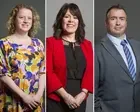
Andy Burnham has appointed three new ministerial aides from Labour’s most leftwing faction, the first time members of the Socialist Campaign Group have been part of the government.
The new chief whip, Anneliese Midgley, has also promised MPs that the government will beef up the role of ministerial aides – known as parliamentary private secretaries (PPSs) – who traditionally go under the radar, allowing them to do more media appearances, take on parliamentary roles and contribute more directly to policy direction.
Burnham has said he wanted to end the Labour factionalism that divided the party under both Jeremy Corbyn and Keir Starmer – and would seek to make appointments from the party’s left and centrist wings.
Though Burnham has returned several soft left ministers to key positions in the cabinet – such as Louise Haigh, Lucy Powell and Angela Rayner – there were no ministerial appointments from the party’s most leftwing caucus, the Socialist Campaign Group, which was the group affiliated with Corbyn.
But three of Burnham’s new parliamentary private secretaries will now hail from that socialist grouping – the Sheffield Hallam MP Olivia Blake will be the PPS for local government, City of Durham’s Mary Kelly Foy at housing and Montgomeryshire and Glyndŵr’s Steve Witherden at energy.
PPS is the most junior role that can be awarded and is often a training ground for promising new MPs who manage the liaison between the government and backbenchers.
Cabinet ministers are not always given a say over which MPs become their PPS – but Midgley said all the appointments this time had been done in consultation with cabinet ministers.
Speaking to the Guardian during the Makerfield byelection campaign, Burnham said he wanted to build a broad church frontbench.
“I do think the Labour movement has to draw on all parts of it when we’re in government. I remember Tony Blair’s most difficult days. Dennis Skinner would come out and rally the troops. I think we need to get back to that. I’m not a factional person.
“I’ve always been a Labour politician, that’s about unifying people, trying to be positive and working together. That’s my approach to politics. I think politics needs less division and less factionalism these days.”
In her letter to MPs announcing the new PPS appointments, Midgley said the prime minister intended to “build, relentlessly, a genuine culture of one Labour team”.
“Our aim has been to assemble a diverse and talented group of PPSs, bringing together a broad range of experience, expertise and perspectives to support ministers and help deliver the prime minister’s agenda.”
She said that PPSs would have “greater opportunities to undertake media and parliamentary activity, including on national policy, with the agreement of departmental media advisers, No 10 and in line with government policy”.
Burnham has given the prestigious role of his own PPS to the veteran MP Sir Nic Dakin – a job which often includes helping with preparation for prime minister’s questions.
He appointed two other local allies as his second and third PPS – Jo Platt, who succeeded him as MP for Leigh, and St Helens North MP David Baines, who helped run Burnham’s Makerfield campaign.
However, some MPs expressed frustration at the number of new MPs who had lost their roles – including Abena Oppong-Asare, who had been Starmer’s PPS.
The former minister Tulip Siddiq said: “It’s been extremely frustrating to see so many competent people unceremoniously sacked from government. This latest list showing sacked PPS’ makes me despair in particular because PPS-ing is not a glamorous job and so many of these MPs just got on with it, put in the hours and would have been an asset to any Labour government. Not to mention that the first black woman ever to be PPS to a prime minister was removed.”