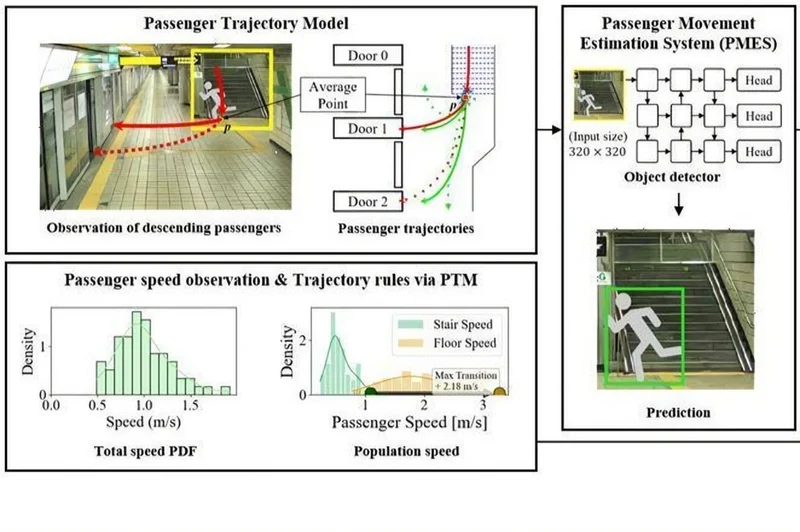
A Sungkyunkwan University research team has developed an artificial intelligence (AI)-based system to prevent subway door-related accidents in collaboration with the Korea Advanced Institute of Science and Technology (KAIST) and Texas Tech University.
The university said researchers from the three institutions worked together to develop an AI-based passenger movement estimation system to help prevent subway door entrapment accidents.
The system is designed to predict passenger movements using CCTV footage by detecting passengers and classifying their movement types.
Unlike conventional reactive methods, the new system is capable of proactively identifying risks before passengers even reach the platform, according to the university.
The research team was led by Chong Jo-woon, a professor at Sungkyunkwan University’s School of Electronics and Electrical Engineering. Jo Hee, a doctoral student, contributed to analyzing data and designing an AI model for the accident prevention system.
The team was joined by Lisa Lim, a professor of civil and environmental engineering at KAIST, and Yifan Li, a researcher in the Department of Electrical and Computer Engineering at Texas Tech University.
The findings were published online on July 3 in IEEE Transactions on Intelligent Transportation Systems under the title, “Passenger Trajectory Model and Passenger Movement Estimation System for Preventing Passenger Subway Door Accidents.”
The research team conducted experiments by classifying passenger movements on station stairs into three categories: ascending, descending and passing.
The team empirically validated a passenger trajectory model, which showed that when a train is present at or approaching the platform, 97.85 percent of passengers descending the stairs move directly toward the train doors.
“Based on these behavioral patterns, we built a system that captures passenger movements using just a single video frame, allowing us to detect risks in advance before passengers reach the train doors,” the team said.
The team also proposed decision support system guidelines that help train operators determine safe door-closing times while recommending passenger-facing safety signage and alarm systems.
The university said the proposed framework can help reduce door-related accidents and minimize unexpected delays on subway platforms.
According to the university, the study highlights the value of global interdisciplinary collaboration among experts from diverse fields.