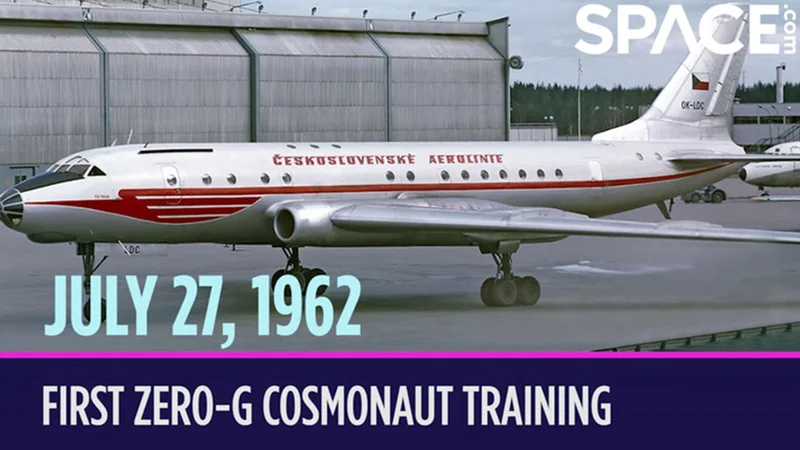
On July 27, 1962, two Russian cosmonauts boarded a Soviet airliner and experienced weightlessness without going to space. This was the first time cosmonauts completed zero-G training on an airplane.
The Tupolev Tu-104 was a type of jetliner originally designed to transport 50 passengers. It was modified to accommodate cosmonauts who needed to train in an environment that simulated weightlessness. By flying in a parabolic arc, passengers could experience 6 to 25 seconds of weightlessness on each maneuver.
Cosmonauts Andriyan Nikolayev and Pavel Popovich were on this flight to prepare for their upcoming orbital missions Vostok 3 and Vostok 4.
Why it mattered
Human spaceflight was barely a year old in July 1962, so methods of training cosmonauts (and astronauts) were still in development. In the early days of the Space Age, the effects of weightlessness on the human body — including basic functions like eating and using the bathroom — were still being understood, so the more realistic training could be the better.
For Nikilayev and Popovich, this training was vital. Their Vostok 3 and Vostok 4 missions flew at the same time, marking the first-ever dual spacefligth of two crewed craft (they were single-person capsules). Vostok 2 lasted nearly four days — something NASA would not beat until the Gemini program in 1965 — while Vostok 4 was a nearly three-day flight. The two spacecraft flew within 4 miles of each other during their missions.
Today, NASA and Russia's Federal Space Agency (Roscosmos) still train astronauts and cosmonauts on modified jets that simulate weightlessness by flying parbolic flights. You can even buy a ticket to try it yourself through commercial companies like Zero Gravity Corporation, which also flies science flights for NASA.
Want more space history? Check out our __ full On This Day In Space video archive on YouTube__.
Hanneke Weitering is a multimedia journalist in the Pacific Northwest reporting on the future of aviation at FutureFlight.aero and Aviation International News and was previously the Editor for Spaceflight and Astronomy news here at Space.com. As an editor with over 10 years of experience in science journalism she has previously written for Scholastic Classroom Magazines, MedPage Today and The Joint Institute for Computational Sciences at Oak Ridge National Laboratory. After studying physics at the University of Tennessee in her hometown of Knoxville, she earned her graduate degree in Science, Health and Environmental Reporting (SHERP) from New York University. Hanneke joined the Space.com team in 2016 as a staff writer and producer, covering topics including spaceflight and astronomy. She currently lives in Seattle, home of the Space Needle, with her cat and two snakes. In her spare time, Hanneke enjoys exploring the Rocky Mountains, basking in nature and looking for dark skies to gaze at the cosmos.