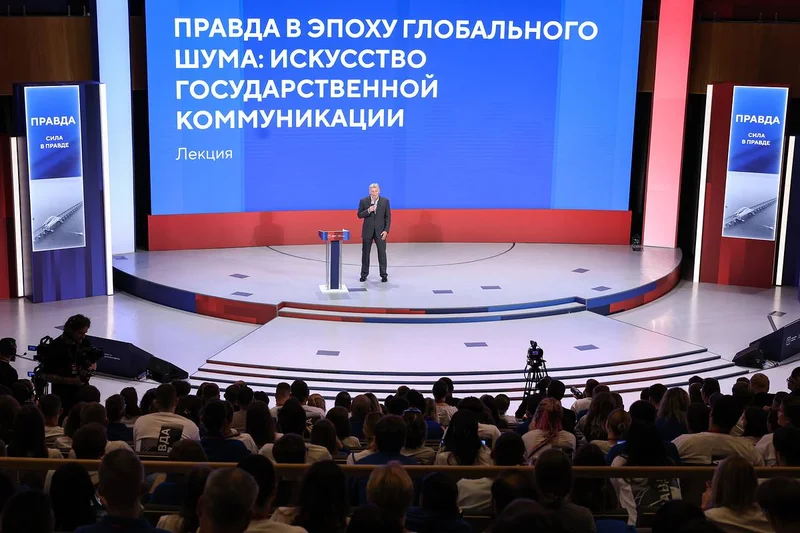
SOLNECHNOGORSK /Moscow Region/, July 27. /TASS/. Russia maintains its obligations in the social sphere and, therefore, it cannot afford spending hundreds of billions of dollars on social networks like the United States does, Russian Presidential Press Secretary Dmitry Peskov told the Territory of Meanings forum.
There is no law in the information sector, so the "might makes right" rule is widely used there, he added.
Russian President Vladimir Putin studies every subject that he is working on in detail, and is ready to discuss matters with related specialists on an equal footing, the Kremlin spokesman said.
Below are Peskov’s key remarks made at the forum.
Spending on social networks
Russia sticks to its social commitments, and, therefore, cannot afford spending hundreds of billions of dollars on social networks. "Americans spend hundreds of billions of dollars to develop their social networks. We cannot afford that: we do not have such funds, and, unlike them, we are a welfare state. Our state bears an enormous load of responsibilities to its citizens."
Being unable to direct vast funds to the sphere of information technologies, Russia should bet on making unique products instead: "The success of an information product is not always defined by the amount of money invested. We need to take a different approach, to aim at adding some unique elements."
Illusion of media freedom
The much-touted media freedom "remains in place as long as it corresponds to the views of owners of this or that media platform." "As soon as it starts to contradict with interests of [media] bosses or the government’s interests, the independence is over."
The only rule in the information sector is the ‘might makes right’ approach: "There are no laws and no rules, what matters is only who is the strongest and most technologically advanced."
"Information is being suppressed. They launch their own algorithms that push any information that you try to send to the very bottom [of the search list]."
Western countries destroyed independent and dissenting media as soon as the conflict with Russia began: "What happened when the conflict started? Despite claims of unquestionable media freedom, which they professed to us for decades, they simply closed and prohibited [undesirable media outlets]."
Informational and technological sovereignty
"There is no information sovereignty as such, information knows no borders or boundaries."
Russia should rely on sovereign media technologies and instruments: "We should have at our disposal the entire array of instruments allowing us to bring about our own meanings."
Sovereignty in the area of information and technologies develops best during crises: "This experience is useful, because any sovereignty, particularly in the sphere of information, can hardly develop within the zone of comfort, when everything is calm. It needs a crisis to thrive."
The current crisis only made the Russian society stronger: "We are now in the midst of an ideal crisis, which strengthens our sovereignty and which <…> filled our lives with unity and consolidated our ranks."
About Putin
Russian President Vladimir Putin closely studies every subject he has to deal with: "Every time, Putin studies the subject from a to z, to the point where he is capable of engaging in a meaningful discussion with specialists, who have been studying the subject for their whole life. And his ability to learn <…> always makes me admire him."
"This is a quality of exceptional importance, and I advise you all to learn."
Russia’s development
Russia will always have to resist flows of information from countries that are angered by its clout, power or independence. During the current difficult period, Russia will achieve its goals "and enter the period where it will start to develop at a rapid pace.".