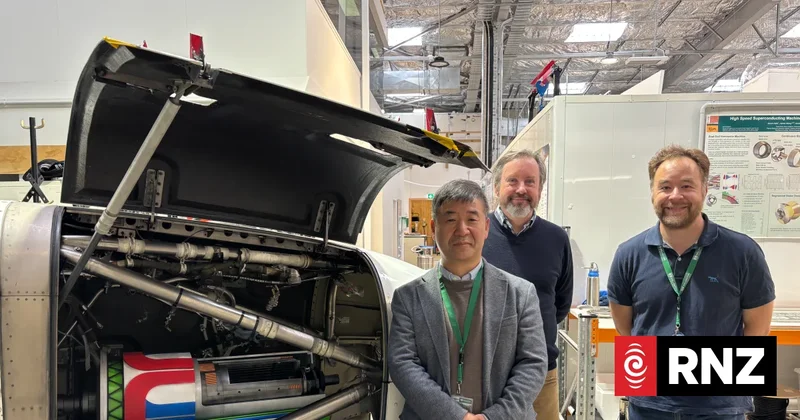
Electric motors for future flight
On 17 October 2025, an Air New Zealand-branded BETA ALIA CX300 took off from Tauranga airport in the first of a series of test flights.
The aircraft, made by US company BETA Technologies, is fully electric. Rechargeable batteries feed an electric motor which can power the two seater cargo plane a distance just shy of 400 kilometres.
While testing took place across four months before the plane was returned to the company, the plan is that in the future such a plane will shuttle mail across the Cook Strait.
It's an exciting advancement.
But while the numbers of electric cars and buses on our roads have increased, it may still be quite a while before we are flying on clean-fuel electric planes because of several engineering challenges.
One is weight.
When scaled up, traditional copper electric motors and the batteries to power them just get too heavy.
Some airplane manufacturers are looking to hydrogen as a potential fuel source to create electricity onboard instead of storing energy in batteries, but the issue of the heavy copper motor still remains.
Other solutions are required, and that's what a team at the Robinson Research Institute at Victoria University of Wellington are working on.
The potential of superconducting motors
The institute is known for its decades-long expertise in high temperature superconductors.
These remarkable materials are able to conduct large amounts of current with zero resistance when cooled to -196oC. As a result, high temperature superconductors can be used to make very powerful electromagnets - magnets that 'switch on' when a current is passed through them - exactly the kind of thing you need for an electric motor.
Crucially, by replacing the heavy copper wires traditionally used to make the magnets with significantly lighter superconducting tape, a superconducting electric motor could result in a much better power-to-weight ratio - a key metric that the aviation industry is looking for.
"[If] we can achieve a really high power-to-weight ratio - thirty kilowatts per kilograms - people, manufacturers, the aeroplane companies will come to us" says Professor Zhenan Jiang.
Zhenan leads the 'Machines' theme in the Future Magnetics and Materials Technologies Platform, supported by the New Zealand Institute for Advanced Technology.
So far, they have been working on the architecture of the motor, says principal scientist Dr James Storey, "We've published several concept designs and with the new funding, with this platform, we intend to explore the actual build of most of the components if not realise a machine by the end."
The race is on to find a good solution in part because airplane manufacturer Airbus has laid down the gauntlet.
The Airbus target
Airbus launched their ZeroE project in 2020 to investigate how hydrogen might be used to power electric aircraft of the future. Last year they decided on hydrogen fuel cells as the way forward. This technology chemically converts hydrogen gas to water and heat to create electricity, which can then power an electric motor.
At the same time they announced what this plane of the future would look like, says Dr Grant Lumsden.
"Airbus released their architecture for their first electric aircraft last year, and it was like four engines, four motors. Each of them was two megawatts, so sort of four megawatts on each wing. So that's where everyone is looking at the moment, an electric motor of about that size."
The competition is on, he says, with the commercial heft of Airbus firing up groups around the world to try to solve the fundamental physics and engineering problems.
Once such problem is understanding alternating current (AC) loss through the high temperature superconductors.
While superconductors have no resistance under direct current when cooled, they do have some when an alternating current is passed through them. For some electric motor designs an alternating current is needed through one of the electromagnets, to make the magnetic field continuously flip, which powers the rotor.
But because this is such a new application of high temperature superconductors, to date they've been relying just on modelling, says Zhenan, and he wants to change that.
"Worldwide, we don't have any experimental data. So we [will] try to be the first in the world to characterise those AC losses in superconductors potentially [to] be used in motor windings."
An electric passenger plane by 2035?
In their announcement, Airbus said they are targeting 2035 to have that all-electric aircraft in the sky.
However, scientist James cautions that solving the physics and engineering questions is just one side of the coin when considering how quickly electric planes will become available.
"I think the ultimate factor will be getting the technology through all the regulatory steps and in a very safety critical field like aviation that can take a long time," he says.
But on the flip side, Grant says, if they can design and build something that solves the problems and clears the regulatory hurdles, it will be in demand.
"The great thing about aviation is once you've got a part that's on an aircraft, the aircraft manufacturers never want to change. They always want to buy exactly the same part from you."
"We're hoping that companies in New Zealand can build the tech and feed into those supply chains."